 Analysis by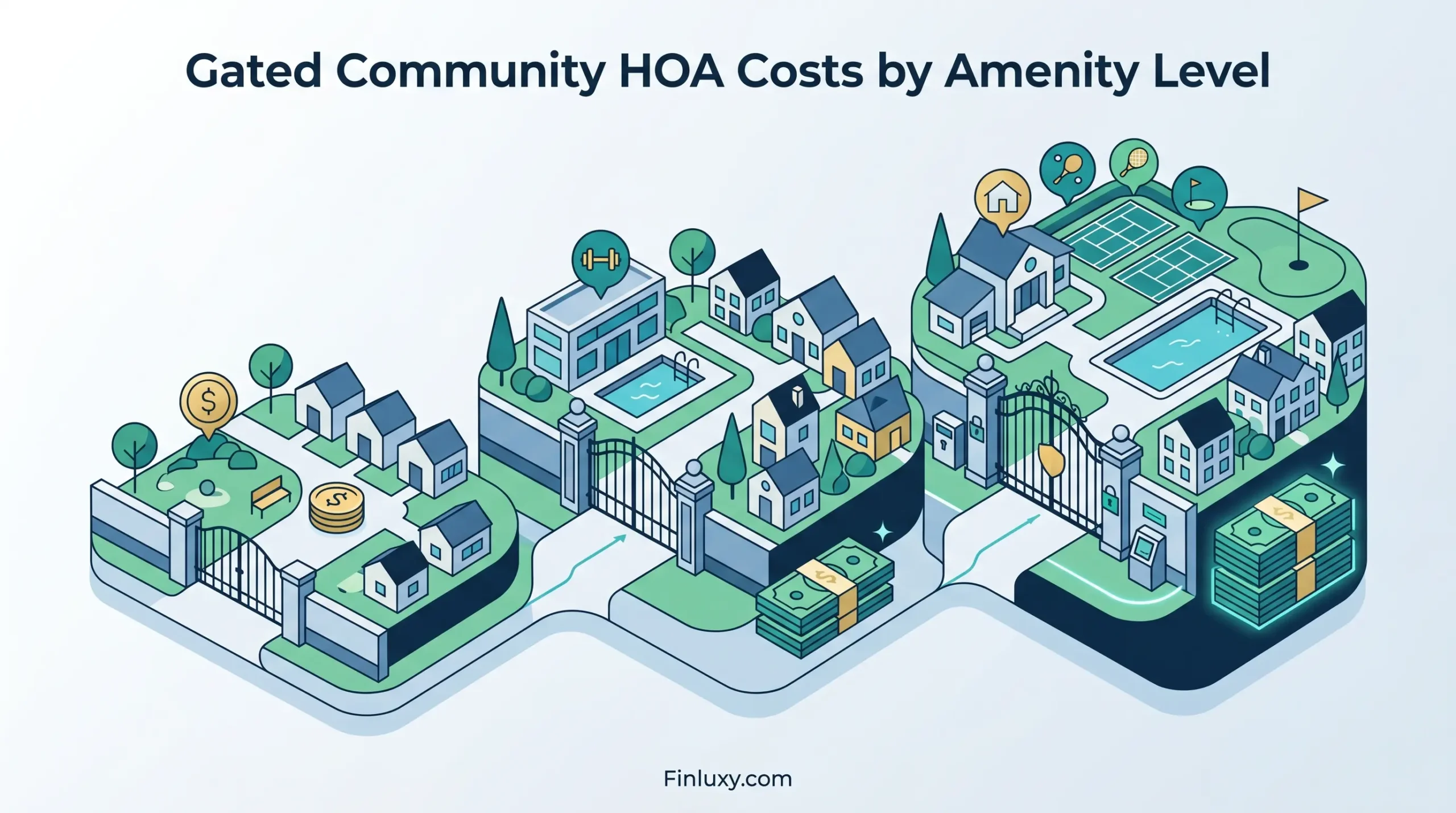
Roughly 3 million U.S. households paid more than $500 per month in HOA or condo fees in 2024, according to the Census Bureau’s 2024 American Community Survey — and a disproportionate share of those households live in gated communities. Yet the sticker-price monthly fee tells almost none of the real story. Special assessments, reserve fund shortfalls, and amenity-specific operating costs can push the Finluxy HOA True Annual Cost 15–30% above what the disclosure sheet shows.
Scope and data limitations: Fee ranges in this article are drawn from the 2024 Census Bureau American Community Survey, Realtor.com’s 2025 HOA Report, Association Reserves’ 2026 Industry Insights Report (covering 100,000+ reserve studies through 2025), and market-level data from multiple regional sources. Figures represent ranges across amenity tiers and geographies — individual communities vary significantly. This article is cost analysis, not financial or legal advice. Covenants, Conditions, and Restrictions (CC&Rs) and state HOA law govern your specific rights and obligations; consult association documents before purchase.
Key Figures at a Glance
| Metric | Figure | Source |
|---|---|---|
| National median HOA fee (2025) | $135/month | Realtor.com HOA Report, Jan. 2026 |
| Households paying $500+/month in HOA/condo fees (2024) | ~3 million | U.S. Census Bureau, 2024 ACS |
| Luxury gated community monthly fee range | $500–$1,500+ | Market data, multiple regional sources, 2024–2025 |
| HOAs estimated to be underfunded nationally | ~70–74% | Association Reserves, 2025 (100,000+ reserve studies) |
| HOA fee increase, median year-over-year (2024→2025) | 8% | Realtor.com HOA Report, Jan. 2026 |
Sources: U.S. Census Bureau 2024 ACS (September 2025); Realtor.com HOA Report (January 2026); Association Reserves Industry Insights Report (April 2026).
The Amenity-Level Framework: What You’re Actually Paying For
Gated community HOA fees don’t cluster around a single number — they follow a fairly predictable cost structure tied to amenity complexity. Gate infrastructure alone (staffed guardhouse vs. automated code entry vs. video-monitored barrier arm) creates a $50–$100/month differential in operating costs before any amenities enter the picture, according to market data from the 55+ community segment analyzed by Where55.com in 2026. Understanding where a community sits on this spectrum is the starting point for any true cost comparison.
The fee architecture by tier breaks down roughly as follows across the market:
| Tier | Monthly Fee Range | Typical Included Amenities | Gate Type |
|---|---|---|---|
| Entry-level gated | $150–$300/month | Automated gate, landscaping, basic common areas | Code or card access |
| Mid-tier amenity | $300–$550/month | Pool, fitness center, landscaping, clubhouse | Code/card or part-time guard |
| Premium amenity | $550–$900/month | Pool, tennis/pickleball, full fitness, staffed gate, patrol security | 24/7 staffed guardhouse |
| Ultra-luxury / resort-style | $900–$1,500+/month | Golf, spa, multiple pools, concierge, restaurant facilities, valet | 24/7 staffed + roving security |
Sources: Where55.com 2026 Data Report; JDJ Consulting Group (January 2026); market data from Orlando, Tampa, Scottsdale, and Los Angeles gated community analyses, 2024–2026. Ranges represent typical market clusters, not guarantees for any specific community.
Resort-style communities — those with golf courses, multiple pools, and food-and-beverage facilities — typically land in the $350–$700/month range for the HOA component alone, with some markets pushing past $1,000/month where labor costs are highest, according to the Where55.com 2026 dataset. The Los Angeles market is illustrative: JDJ Consulting Group’s 2026 analysis found luxury gated developments there regularly exceeding $1,500/month, driven by above-average labor rates and land costs inflating every vendor contract the HOA carries.
Breaking Down the Cost Components
Most HOA disclosures show a single monthly fee. What that fee covers — and what it doesn’t — determines how close it is to your actual cost of living in the community.
Security and Gate Operations
A 24/7 staffed guardhouse requires at minimum three full-time-equivalent positions to cover round-the-clock coverage, plus management, benefits, and overtime. In labor-intensive markets, this alone can represent $120,000–$200,000+ in annual HOA operating expense for a small-to-mid-sized community. Spread across 150 units, that’s $800–$1,300 per unit annually — before the gate infrastructure, camera systems, and visitor management software. Automated-only gate systems cut this to a fraction, which is why communities with code-only access can price entry-level gates at $150–$200/month while staffed communities start materially higher.
Pool and Tennis Court Premiums
Dedicated pools and tennis or pickleball courts carry specific operating cost burdens. Pool and tennis court HOA premiums are among the most analyzed amenity costs in association budgeting, and the data consistently shows these facilities add $30–$80/month per unit to operating budgets in moderate climates, more in markets requiring year-round staffing. A community with multiple pools and a full tennis complex can easily absorb $500,000–$800,000 annually in operating costs for those amenities alone across a 200-unit development.
Common Area Maintenance (CAM)
Common area maintenance covers landscaping contracts, exterior building insurance, road maintenance for private roads, and utility costs for all shared facilities. In gated communities with private roads — which are the norm rather than the exception — road maintenance and repaving cycles represent a recurring capital obligation that must be funded through the reserve fund. Landscaping on large planned community parcels can run $150,000–$400,000 annually depending on acreage and local labor markets.
Reserve Fund Contributions
This is where most buyers underestimate their true exposure. The industry guidance — cited in materials from CAI and reserve study professionals alike — is that reserves should represent between 15% and 40% of an association’s annual operating budget, though the actual required amount for any community depends on a reserve study rather than a fixed percentage. The funded ratio (reserves held ÷ fully funded reserves) is the meaningful metric. According to Association Reserves’ April 2026 Industry Insights Report, which analyzed more than 100,000 reserve studies conducted through 2025, approximately 70–74% of HOAs nationally are underfunded. That means the fee a buyer sees today may not reflect the reserves needed to avoid future special assessments. A reserve fund analysis should be the first document requested before any purchase.
Finluxy HOA True Annual Cost by Amenity Tier
The monthly fee is a floor, not a ceiling. The Finluxy HOA True Annual Cost incorporates the monthly fee annualized, an expected annual special assessment allocation (using the CAI industry average approach where 10-year community-specific data is unavailable), and applicable non-HOA upkeep costs for common elements.
For the special assessment figure: where community-specific 10-year assessment history is unavailable, the calculations below use a conservative industry-average approach. Special assessments in amenity-rich gated communities are not rare events — they are predictable budget items that boards routinely fail to adequately reserve for. The 70–74% underfunding rate (Association Reserves, 2026) implies most buyers will encounter at least one material special assessment during a typical 7–10 year ownership period.
| Amenity Tier | Monthly HOA Fee (Midpoint) | Annual HOA Fee | Est. Annual Special Assessment Allocation | Finluxy HOA True Annual Cost | Monthly Equivalent |
|---|---|---|---|---|---|
| Entry-level gated | $225 | $2,700 | $600 | $3,300 | $275 |
| Mid-tier amenity | $425 | $5,100 | $1,200 | $6,300 | $525 |
| Premium amenity | $725 | $8,700 | $2,400 | $11,100 | $925 |
| Ultra-luxury / resort-style | $1,200 | $14,400 | $4,500 | $18,900 | $1,575 |
Finluxy HOA True Annual Cost = (Monthly HOA Fee × 12) + Est. Annual Special Assessment Allocation. Monthly fee midpoints derived from tier ranges in the amenity-level table above. Special assessment allocations are conservative estimates based on the CAI industry-average framework applied to amenity complexity; community-specific 10-year assessment histories are the preferred input where available. This metric is for comparative analysis; actual costs depend on individual HOA financial documents.
The gap between the monthly fee and the Finluxy HOA True Annual Cost monthly equivalent runs from $50 at the entry-level tier to $375 at the ultra-luxury tier. For a household buying into a premium amenity community and budgeting $725/month for HOA, the realistic figure is closer to $925/month once special assessment exposure is properly amortized. Over a 10-year holding period, that differential compounds to over $24,000 in unbudgeted outflows.
For a deeper look at how these numbers interact with broader HOA fees at luxury properties, the cost architecture follows similar principles across property types, though high-rise condos carry additional structural maintenance obligations not present in single-family gated communities.
The Reserve Fund Problem Is Specific to Amenity-Heavy Communities
High-amenity communities face a reserve funding challenge that basic HOAs don’t: more components, more replacement cycles, and higher per-unit replacement costs. A pool resurfacing, a clubhouse HVAC replacement, a tennis court reseal, and a guardhouse renovation can land within the same five-year window — and if reserves are underfunded, the board’s options reduce to special assessment, association loan, or deferred maintenance. None of those outcomes are good for property values.
Association Reserves’ April 2026 report — drawn from over 100,000 reserve studies — found that approximately 66% of associations fall in the “Fair” or “Strong” funded ratio categories, meaning the majority are not in crisis. But the remaining 30%+ sitting in critically underfunded territory are disproportionately older communities with aging infrastructure. An amenity-rich 20-year-old gated community is exactly the profile that carries elevated risk: replacement cycles for pools, courts, roads, and clubhouses are all converging simultaneously while the funded ratio may have been eroded by years of boards minimizing assessments to remain competitive in the resale market.
The funded ratio — reserves held ÷ fully funded reserves — is the number that matters, not the nominal reserve balance. A community with $2 million in reserves sounds well-prepared. If the fully funded balance for that community’s component inventory is $6 million, the funded ratio is 33% — which Association Reserves categorizes as critically underfunded, with high special assessment risk. Buyers should evaluate special assessment risk by requesting the most recent reserve study and calculating this ratio before closing.
What Most Coverage Misses: The Amenity Inflation Asymmetry
Most HOA fee analyses focus on the national median or broad averages. The figure that matters for gated community buyers is amenity-specific cost inflation — and it runs materially faster than general HOA fee trends. The national median HOA fee rose 8% from 2024 to 2025, per Realtor.com’s January 2026 report. But communities in amenity-intensive Sun Belt markets — the precise markets where luxury gated developments concentrate — saw fee increases of 8–15% annually in 2022–2024, driven by insurance premium increases, labor cost inflation, and deferred maintenance backlogs, according to Where55.com’s 2026 dataset.
The asymmetry works like this: a basic HOA’s largest line item is landscaping, which tracks general labor inflation. A high-amenity gated community’s budget is dominated by insurance (spiking in coastal markets post-Surfside), staffed security (labor costs), and pool/fitness facility operations — all categories that have outpaced general inflation since 2021. When 71% of HOA boards reported planning fee increases of up to 10% in 2024, and 19% planned increases of 11–25%, the boards running amenity-heavy communities were disproportionately in that second bracket.
For a household evaluating a gated community purchase, HOA fee increase history over the prior 10 years is more predictive of future cash flow than the current fee. Ask for it.
Non-HOA Upkeep Costs in Gated Single-Family Communities
Gated single-family communities transfer most exterior maintenance to the HOA but leave interior and lot-specific maintenance to the homeowner. The applicable maintenance budget for the non-HOA portion depends on home value and age. NAHB data, analyzed alongside the 2019 American Housing Survey, found that single-family homes built before 2010 average around 5% of home value in annual operating costs — though regular maintenance (as distinct from major replacements) runs considerably lower, typically in the $1,400–$2,300 range for smaller homes rising significantly for high-value properties.
For a $1.2 million home in a premium gated community, applying the 1% maintenance rule produces a $12,000 annual figure — but that’s a starting estimate, not a ceiling. Homes with high-end finishes, larger square footage, and landscaped private lots carry proportionally higher maintenance burdens. A more defensible range for luxury gated single-family homes in the $800k–$1.5 million range is $8,000–$18,000 annually for non-HOA upkeep, depending on age, finishes, and climate zone. Annual upkeep cost by property value follows a relatively consistent relationship with home value once property age and condition are controlled for.
In communities where the HOA covers certain exterior elements — roofing maintenance, exterior painting under CC&Rs — the homeowner’s non-HOA burden decreases. Read the CC&Rs before assuming any item is or isn’t covered. Disputes over what falls within “common area maintenance” versus individual owner responsibility are among the most frequent HOA conflicts, and they carry real dollar implications.
The $150k+ Household Decision Framework
At $150k+ household income, gated community HOA costs are unlikely to be a budget constraint in isolation. The relevant question is allocation efficiency: does the Finluxy HOA True Annual Cost of $6,300–$18,900+ deliver commensurate value relative to alternatives, and is the financial structure of the specific community sound enough to avoid compounding costs through underfunded reserves or escalating special assessments?
Three thresholds are worth establishing before committing. First, the funded ratio: request the reserve study and calculate reserves held ÷ fully funded reserves. Below 50%, the community has a structural funding problem that will resolve through some combination of fee increases and special assessments during a typical holding period. Second, the 10-year fee increase rate: communities that have held increases to 3–5% annually demonstrate disciplined financial management; those with irregular large increases often signal deferred reserve funding catching up. Third, special assessment history: any community that has levied a special assessment exceeding $5,000/unit in the past five years without a corresponding improvement in funded ratio is managing reactively, not proactively.
The consequences of underfunded HOA reserves extend beyond special assessments — they affect resale liquidity because lenders increasingly scrutinize reserve health before approving financing for buyers, which directly compresses the pool of qualified purchasers for your unit at exit. A well-funded community with higher monthly fees is frequently a better long-term financial decision than a lower-fee community with a 35% funded ratio. Comparing HOA structures across property types reveals this pattern consistently: fee level alone is a poor proxy for financial health.
One final consideration: ultra-luxury resort-style communities sometimes separate mandatory HOA fees from optional or mandatory club memberships. A community showing a $900/month HOA fee may carry a required $15,000–$40,000 initiation fee and $500–$800/month club dues on top — costs that don’t appear in standard HOA disclosures and are governed by separate membership agreements outside the CC&Rs. Confirm whether any club membership component is mandatory before treating the HOA fee as the complete amenity cost picture. For buyers evaluating luxury HOA costs across major metro markets, those mandatory membership structures vary substantially by geography and community type.
Methodology
This analysis synthesized data from the U.S. Census Bureau’s 2024 American Community Survey (released September 2025), Realtor.com’s January 2026 HOA Report, Association Reserves’ April 2026 Industry Insights Report (covering 100,000+ reserve studies conducted through 2025), Where55.com’s 2026 HOA fee dataset, JDJ Consulting Group’s January 2026 Los Angeles market analysis, and regional market data from Florida, Texas, and California gated community sources. Fee tier ranges were constructed by synthesizing multiple regional data points rather than from a single national source, reflecting the geographic dispersion of gated community markets. The Finluxy HOA True Annual Cost was calculated using the formula defined in the Finluxy cluster methodology: (Monthly HOA Fee × 12) + estimated annual special assessment allocation. Special assessment estimates use a conservative industry-average framework where community-specific 10-year histories were unavailable. NAHB data on single-family home maintenance costs was drawn from their analysis of the 2019 American Housing Survey. Where figures from secondary sources conflicted, the range is reported. All figures represent market-level analysis; individual community financial documents remain the authoritative source for purchase decisions.
Frequently Asked Questions
What is a typical HOA fee for a luxury gated community?
Premium amenity gated communities — those with 24/7 staffed gates, pools, tennis courts, and full fitness facilities — typically charge $550–$900/month in HOA fees based on 2024–2025 market data across major U.S. markets. Ultra-luxury and resort-style communities with golf, spa, and concierge services regularly exceed $1,000/month and can reach $1,500+/month in high-cost markets such as Los Angeles, South Florida, and Scottsdale. The national median HOA fee was $135/month in 2025 (Realtor.com), but that figure is dominated by basic single-family communities and condos — it understates what gated communities with meaningful amenities charge by a factor of three to ten.
What is a special assessment and how often do gated communities levy them?
A special assessment is a one-time charge levied on all homeowners in an HOA to cover costs not adequately funded by the reserve fund — typically major repairs, replacements, or unexpected capital expenditures. High-amenity communities levy special assessments more frequently than basic communities because they have more components with significant replacement costs. With approximately 70–74% of HOAs nationally carrying underfunded reserves (Association Reserves, 2025), the statistical expectation for any buyer entering a gated community with a less-than-robust funded ratio is at least one material special assessment during a 7–10 year holding period.
How do I evaluate whether a gated community’s reserves are adequate?
Request the most recent reserve study — ideally one conducted within the past three years — and calculate the funded ratio: reserves currently held divided by the fully funded balance identified in the study. A funded ratio above 70% is generally considered strong by industry standards, per CAI’s National Reserve Study Standards. Below 50%, the community faces a structural funding gap that will likely result in fee increases, special assessments, or both during your ownership period. Also request the HOA’s 10-year financial history to see actual special assessment frequency and size alongside fee increase patterns.
Do gated communities with more amenities always cost more to own?
In direct HOA fees, yes — the operating cost of pools, staffed gates, tennis courts, and fitness facilities is real and material. But total cost of ownership also depends on reserve funding health. A well-funded premium amenity community with a 90% funded ratio and a track record of 4–5% annual fee increases may represent a more predictable cost than an entry-level gated community with a 30% funded ratio heading into a major infrastructure replacement cycle. Fee level and financial health are separate variables; evaluate both.
Are gated community HOA fees tax-deductible?
For a primary residence, HOA fees are not deductible for federal income tax purposes under current tax law. For an investment property or rental, HOA fees are generally deductible as an ordinary and necessary business expense. If the property is used partly for rental and partly personally, the deductible portion is prorated by rental use percentage. Tax treatment depends on individual circumstances and applicable law; confirm with a qualified tax professional for your specific situation rather than relying on general guidance.
Sources & References
- U.S. Census Bureau — Condo or HOA Fees Topped $500 Monthly for About 3 Million Households, 2024 ACS (September 2025)
- Realtor.com — HOA Report: Median Fee Rose to $135 in 2025 (January 2026)
- Association Reserves — HOA Reserves: Industry Insights Report, 100,000+ Reserve Studies (April 2026)
- Where55.com — Average HOA Fees by State in 55+ Communities: 2026 Data Report
- JDJ Consulting Group — Average HOA Fees in Los Angeles (January 2026)
- HOA Start — The State of HOA Reserves 2026
- ManageCasa — HOA Reserve Funds: Funding Levels, Studies and State Rules (2026)
- Community Associations Institute (CAI) — Official Resources and National Reserve Study Standards
- HomeKeep / NAHB — Annual Cost of Home Maintenance: NAHB Research Summary
- HOA Start — Average HOA Fee Increase: Annual Rate Trends (2025)