 Analysis by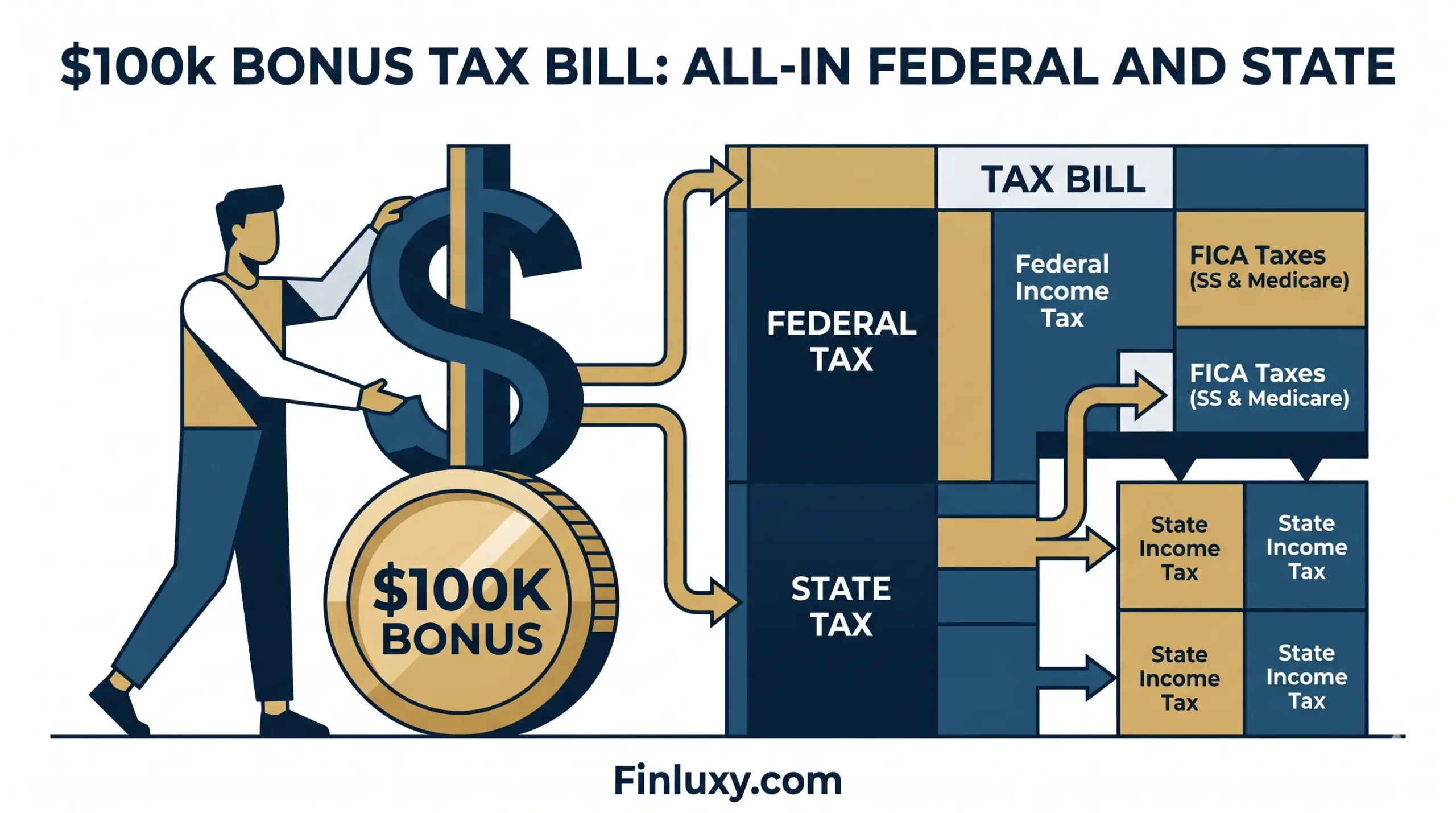
A $100,000 bonus is not a $100,000 windfall. Drop it on top of a $300,000 salary for a married-filing-jointly household, and the all-in federal and state tax claims between $26,350 and $35,650 depending on where you live — leaving net cash of $64,350 to $73,650 before the bonus check ever clears its withholding.
The 22% your employer withholds is not the number that matters. That figure comes from the IRS supplemental wage withholding rule, and it bears almost no relationship to what the bonus actually costs at settlement. The real bill is set by your marginal rate stacked on everything else you earned, plus state tax, plus a Medicare component most withholding tables ignore. I ran the full calculation across three state regimes using the 2026 federal brackets. The spread is wide enough to change relocation math.
Scope: This analysis models a cash bonus paid to a married-filing-jointly household using 2026 federal tax brackets (IRS Revenue Procedure 2025-32), the 2026 Social Security wage base, and 2025 California rate schedules (the latest finalized FTB figures as of publication). All figures assume the bonus stacks on top of existing W-2 salary with the standard deduction applied, no additional deductions, and year-to-date earnings already above the Social Security wage base. It does not model the qualified business income deduction, AMT exposure, capital gains, or itemized deductions, any of which shifts the result. State figures cover three regimes only; your state’s marginal rate determines your own number. This is data analysis, not tax advice.
The number that actually lands
Start with what comes out of the check. Under the IRS supplemental wage withholding rule in Publication 15, employers withhold federal income tax on bonuses under $1 million at a flat 22%, and at 37% on amounts above $1 million. The optional 22% flat rate and the mandatory 37% rate were both retained permanently by the One Big Beautiful Bill Act, so the withholding mechanics for 2026 match what filers saw the prior two years.
Withholding is not tax. It is a deposit against a liability that gets settled at filing. For a household already earning $300,000, that distinction is worth roughly $13,000 across the scenarios below. The supplemental wage withholding rule pulls 22% — $22,000 on a $100,000 bonus — but the bonus dollars land in the 24% federal bracket, and that is before state tax and Medicare enter the picture. The gap between the deposit and the bill is the entire reason a bonus feels like it shrinks at filing. The mechanics behind that gap are spelled out in detail in the breakdown of [bonus withholding versus actual tax](/tax-wealth/bonus-tax/bonus-withholding-vs-actual-tax/).
| Figure | Amount |
|---|---|
| Federal supplemental wage withholding (22%) | $22,000 |
| Actual federal marginal tax on the bonus | $24,000 |
| All-in tax — no-income-tax state | $26,350 |
| All-in tax — California | $35,650 |
| Finluxy Windfall Net Rate range (TX to CA) | 73.7% to 64.3% |
Source: Author calculation using IRS Revenue Procedure 2025-32 (2026 brackets), IRS Publication 15, and 2025 California FTB rate schedules. Medicare component includes 1.45% base plus 0.9% additional Medicare surtax (income above $250,000 MFJ).
Building the all-in rate, component by component
Four separate levies hit a bonus, and they do not share a rate. Federal income tax is the largest. Social Security tax is usually zero for this income tier. Medicare runs higher than most people expect once the surtax applies. State tax is the swing factor that separates a Texas household from a California one by nearly ten cents on every bonus dollar.
Federal income tax: the 24% reality
The 2026 federal brackets for married couples filing jointly place the 24% rate on taxable income from $201,775 to $403,550, per IRS Revenue Procedure 2025-32, which the OBBBA made permanent while adding an inflation adjustment to the structure. A household with $300,000 in salary and the $32,200 standard deduction sits at $267,800 of taxable income — squarely inside the 24% band. The full $100,000 bonus stacks on top, staying within that band, so every bonus dollar carries a 24% federal marginal rate. That is $24,000, not the $22,000 withheld.
Push the base salary higher and the math turns against you fast. At $400,000 of salary the bonus crosses into the 32% bracket, and the federal tax on the same $100,000 jumps to $29,140 — a $7,140 gap above what supplemental wage withholding collected. Whether the bonus stays inside one bracket or straddles two is the single biggest determinant of the federal number, which is why the [bonus tax guide for high earners](/tax-wealth/bonus-tax/bonus-tax-guide/) treats bracket position as the starting variable rather than the rate itself.
Social Security: usually zero at this level
For 2026 the Social Security tax applies only to the first $184,500 of wages, up from $176,100 in 2025, per the Social Security Administration’s October 2025 announcement tied to the 2.8% cost-of-living adjustment. A household earning $300,000 in salary blew past that ceiling months before the bonus arrived. No further Social Security tax applies to the bonus. This is one of the few mechanics that works in a high earner’s favor — the 6.2% levy that hits lower-income bonus recipients simply does not reach this income tier.
Medicare: the 2.35% nobody mentions
Medicare has no wage ceiling. The base rate is 1.45% on all earnings, and high earners owe an additional 0.9% Medicare surtax on wages above $250,000 for joint filers, per the SSA 2026 fact sheet. A $300,000 household has already crossed that threshold, so the entire bonus carries the combined 2.35% — $2,350 on $100,000. Small relative to federal tax, but it is real cash that supplemental wage withholding tables handle inconsistently, and it pushes the all-in number up in every state.
State tax: the relocation-grade variable
Here the spread opens. Nine states levy no income tax at all, so a household in Texas, Florida, or Washington pays $0 in state tax on the bonus. New York’s 6.85% band adds $6,850. California, the heaviest, applies a 9.3% marginal rate at this income level — drawn from the 2025 Form 540 rate schedules, the latest finalized figures from the Franchise Tax Board — adding $9,300. California’s top rate climbs to 13.3% once taxable income exceeds $1 million, but a $400,000 household is nowhere near that surcharge. The state component alone is the difference between keeping 73.7 cents and 64.3 cents of each bonus dollar.
| State regime | Federal | State | Medicare | Total tax | All-in rate | Finluxy Windfall Net Rate |
|---|---|---|---|---|---|---|
| Texas / Florida / Washington | $24,000 | $0 | $2,350 | $26,350 | 26.4% | 73.7% |
| New York (6.85% band) | $24,000 | $6,850 | $2,350 | $33,200 | 33.2% | 66.8% |
| California (9.3% band) | $24,000 | $9,300 | $2,350 | $35,650 | 35.6% | 64.3% |
Source: Author calculation. Federal per IRS Revenue Procedure 2025-32 (2026 MFJ brackets). State rates: no-tax states per state statute; New York and California per 2025 state rate schedules. Medicare = 1.45% + 0.9% additional Medicare surtax. Social Security tax = $0 (salary exceeds 2026 wage base of $184,500). Finluxy Windfall Net Rate = net after-tax bonus ÷ gross bonus × 100.
The Finluxy Windfall Net Rate
The Finluxy Windfall Net Rate strips the question down to one number: how many cents of each bonus dollar you actually keep. It is net after-tax amount divided by gross bonus, accounting for federal marginal rate, state tax, and the Medicare component. For the $100,000 bonus on a $300,000 salary, the rate runs from 73.7% in a no-income-tax state down to 64.3% in California.
That 9.4-point spread is not abstract. On this single bonus it is $9,300 of additional state tax — the entire California income tax on the windfall. A household weighing a move, or a remote worker choosing where to establish residency before a large bonus year, is looking at real money tied to one line of the table. The same windfall pays out $64,350 net in San Francisco and $73,650 net in Austin.
| State regime | Net bonus kept | Finluxy Windfall Net Rate |
|---|---|---|
| Texas / Florida / Washington | $73,650 | 73.7% |
| New York | $66,800 | 66.8% |
| California | $64,350 | 64.3% |
Source: Author calculation per methodology above. Net bonus kept = $100,000 gross minus total all-in tax.
For a state-by-state extension of this same net-take-home framework at a smaller bonus size, the [state-by-state bonus net take-home analysis](/tax-wealth/bonus-tax/50k-bonus-net-take-home-by-state/) maps the full 50-state spread.
What the withholding gap triggers: the April true-up
Consider the cash-flow trap. Supplemental wage withholding deposited $22,000 in federal tax. The actual federal liability on the bonus is $24,000 in the $300,000 scenario, $29,140 at the $400,000 level. The difference is not forgiven — it surfaces as additional tax owed at filing, on top of any state tax that was under-withheld.
For a household whose total income crosses certain thresholds, that shortfall can also trigger estimated payment obligations. If the bonus creates more than $1,000 in additional tax beyond withholding, the IRS expects the gap covered through withholding or quarterly payments during the year, not in a lump at filing. The safe harbor for avoiding an underpayment penalty is built into Form 1040-ES: pay 100% of the prior year’s tax, or — for households with prior-year adjusted gross income above $150,000 — 110% of the prior year’s tax, substituting 110% for 100% under the general rule. Every household in this analysis clears the $150,000 AGI line, so the 110% figure is the one that governs. The interaction between a bonus and quarterly obligations is the entire subject of [estimated tax after a windfall event](/tax-wealth/bonus-tax/estimated-tax-after-windfall/), and the penalty-avoidance mechanics get fuller treatment in the [safe harbor rule for windfall income](/tax-wealth/bonus-tax/safe-harbor-windfall-estimated-tax/).
What most coverage overlooks
Nearly every bonus-tax explainer fixates on the 22% versus marginal-rate gap and stops there. The federal gap in the base scenario is only $2,000 — real, but not the story. The overlooked figure is the Medicare-plus-state stack. In California, state tax and the 2.35% Medicare component together add $11,650 to the bonus bill, more than four times the size of the federal withholding shortfall everyone writes about. The headline “your bonus is under-withheld” understates the problem for high earners in tax states, because the under-withholding people obsess over is the smallest of the three forces pulling the net rate down. The state line and the Medicare surtax — neither of which appears in the 22% supplemental figure — do the heavy lifting.
The $150k+ household decision
At this income tier the bonus question is really three questions, and only one of them is about the bonus itself. First: where does the bonus land in your bracket? A bonus that stays inside the 24% band costs $24,000 federal; one that pushes from $400,000 of salary into the 32% band costs $29,140 on the identical dollar amount. Timing a bonus into a lower-income year, or deferring it, changes which bracket absorbs it — the logic worked through in [deferred bonus strategies that work](/tax-wealth/bonus-tax/deferred-bonus-tax-strategy/) and in the [December versus January bonus timing math](/tax-wealth/bonus-tax/year-end-bonus-timing-tax/).
Second: have you covered the true-up? The 110% safe harbor is the cleanest protection — pay 110% of last year’s tax through withholding and estimated payments, and the underpayment penalty disappears regardless of how large this year’s bonus runs. Withholding counts as paid evenly across the year, so a household that sees a bonus coming can bump year-end withholding to close the gap without writing a separate quarterly check. Third: does geography factor into a residency decision you were already weighing? A recurring annual bonus turns the 9.4-point net-rate spread into a compounding figure — $9,300 a year on a $100,000 bonus in California versus a no-tax state, before considering the same differential on salary and RSU income. A household evaluating an [RSU vest as a large single-year windfall](/tax-wealth/bonus-tax/rsu-vest-windfall-tax/) faces the identical state-rate question on a often larger base. None of this requires a special bonus-tax maneuver. It requires knowing that the 22% on the check is a deposit, that the real rate is the marginal rate plus state plus Medicare, and that the difference is large enough to plan around.
Why is only 22% withheld if my bonus is taxed at 24% or more?
The 22% comes from the IRS supplemental wage withholding rule, a flat deposit rate for bonuses under $1 million. It is not your actual tax rate. Your real federal rate is your marginal bracket — 24% for a $300,000 MFJ household — and the difference is settled when you file. Withholding is a prepayment, not the final tax.
Do I owe Social Security tax on my bonus?
Only if your year-to-date wages are below the 2026 Social Security wage base of $184,500. A household earning $300,000 in salary has already exceeded that ceiling, so no additional Social Security tax applies to the bonus. Medicare tax, which has no ceiling, still applies at 1.45% plus a 0.9% surtax above $250,000 MFJ.
Will a $100,000 bonus push my whole income into a higher tax bracket?
No. Only the bonus dollars that cross a bracket threshold are taxed at the higher rate, never your entire income. A $100,000 bonus on a $300,000 salary stays inside the 24% band. The same bonus on a $400,000 salary partly crosses into 32%, raising the federal tax on the bonus from $24,000 to $29,140.
How much does state of residence change my net bonus?
Substantially. On a $100,000 bonus for a $300,000 MFJ household, a no-income-tax state nets $73,650 while California nets $64,350 — a $9,300 difference driven entirely by state income tax. The Finluxy Windfall Net Rate ranges from 73.7% to 64.3% across these regimes.
Do I need to make estimated payments after a bonus?
If the bonus creates more than $1,000 in tax beyond what was withheld, the IRS expects the gap covered during the year. For households with prior-year AGI above $150,000, the safe harbor is paying 110% of the prior year’s tax through withholding and estimated payments, which avoids the underpayment penalty regardless of current-year income.
Methodology
Federal figures use the 2026 married-filing-jointly brackets from IRS Revenue Procedure 2025-32, with the standard deduction of $32,200 applied to salary before stacking the bonus. Marginal tax on the bonus was calculated as the difference between total federal tax with and without the bonus, isolating the incremental cost rather than applying a single headline rate. Social Security treatment reflects the 2026 wage base of $184,500 from the SSA; because all modeled salaries exceed it, the bonus carries no Social Security tax. Medicare uses the 1.45% base rate plus the 0.9% additional Medicare surtax, which applies because modeled income exceeds the $250,000 MFJ threshold. State figures rely on 2025 California FTB rate schedules (the latest finalized) and statutory no-tax-state treatment; the New York figure uses that state’s marginal band at this income level. Where sources varied, primary IRS and SSA figures took precedence over secondary aggregators. The Finluxy Windfall Net Rate divides the net after-tax bonus by the gross bonus. Figures appearing in body text and tables were reconciled to match exactly.
Sources & References
- IRS — 2026 inflation adjustments and OBBBA amendments (Revenue Procedure 2025-32)
- IRS Publication 15 (Circular E) — supplemental wage withholding rules
- IRS Form 1040-ES — estimated tax and safe harbor rules for individuals
- Social Security Administration — 2026 wage base and COLA announcement
- SSA — 2026 cost-of-living fact sheet, Medicare and surtax thresholds
- Tax Foundation — 2026 federal tax brackets and marginal rate analysis
- California Franchise Tax Board — 2025 Form 540 rate schedules
- PayrollOrg — OBBBA supplemental wage withholding rate confirmation