 Analysis by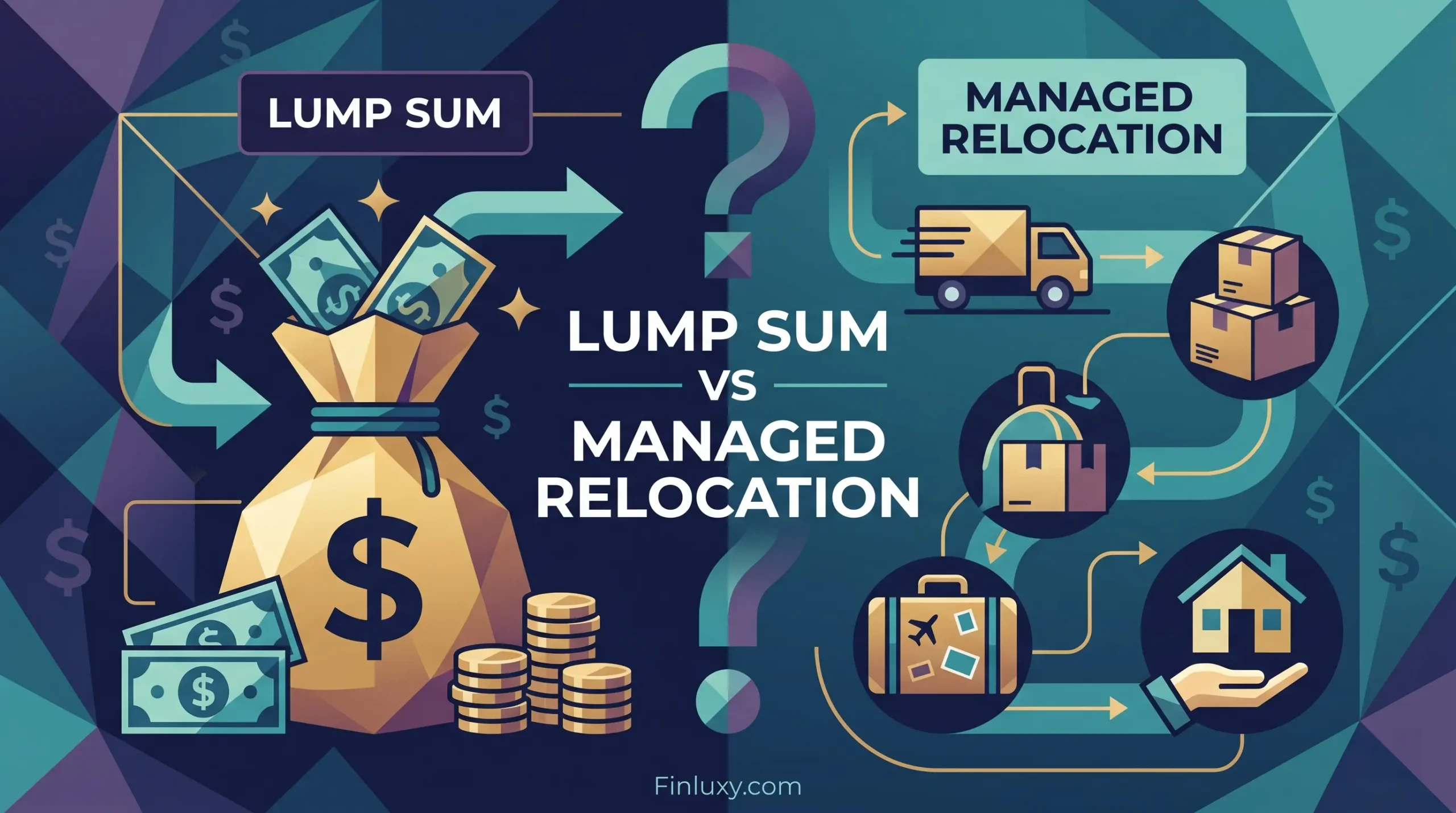
A fully managed relocation package for a homeowner cost employers an average of $85,466 in the most recent Worldwide ERC (Employee Relocation Council) U.S. Domestic Permanent Transfers Volume & Cost survey. A self-directed lump sum relocation? The 2025 WHR Global Mobility Benchmark puts the average at $14,608. That gap — roughly six to one — is the entire story of relocation package value, and most candidates never see the larger number quantified before they accept an offer.
The reason matters more than the spread. A managed relocation moves the cost off your personal balance sheet and onto the employer’s, with a relocation management company coordinating the work. A lump sum hands you cash and a tax bill. Both are “relocation packages.” Only one approaches the actual cost of moving a $150k+ household across state lines.
This analysis covers U.S. domestic, employer-sponsored relocations for households earning $150k+. Figures draw on industry survey data (Worldwide ERC, WHR Global) and federal tax rules current as of June 2026. Relocation package structures vary widely by employer, seniority, and homeowner-versus-renter status; the benchmark figures here are segment averages, not quotes for any specific move. Tax treatment reflects federal law following the One Big Beautiful Bill Act of 2025. State tax treatment is not modeled. This is cost analysis, not financial or tax advice.
The numbers most offer letters leave out
| Metric | Figure | Source & Period |
|---|---|---|
| Average managed relocation cost — homeowner | $85,466 | Worldwide ERC, 2022 survey (latest published) |
| Average managed relocation cost — renter | $33,532 | Worldwide ERC, 2022 survey (latest published) |
| Average lump sum relocation amount | $14,608 | WHR Global Mobility Benchmark, 2025 |
| Top cost component — home sale assistance | $36,910 | Worldwide ERC, 2022 survey |
| Average gross-up cost (employer-paid) | $14,289 | Worldwide ERC, 2022 survey |
Source: Worldwide ERC U.S. Domestic Permanent Transfers Volume & Cost Report (2022, most recent point figures published); WHR Global 2025 Global Mobility Benchmark. ERC reports homeowner and renter costs separately; the two are not interchangeable.
Read the component line carefully. Home sale timing risk in a relocation drives the single largest expense in a managed package — home sale assistance averaged $36,910, with loss-on-sale protection adding another $31,125 on top in the same ERC data. Household goods shipment, the part most people picture when they hear “relocation,” came in at $16,465. The move itself is the cheap part.
Managed relocation versus lump sum: what each actually buys
Worldwide ERC’s client data has historically run about 65% managed policy moves to 35% lump sum or self-service. The split is not random. Employers reserve managed relocation — where a relocation management company handles home sale, shipment, temporary housing, and destination services — for senior or hard-to-fill roles. Lump sum relocation gets offered for junior moves or to candidates the employer expects to absorb the friction themselves.
For a $150k+ household, the structure of the package determines whether the move is financially neutral or a five-figure hit. Consider the same homeowner relocation under both models.
| Cost component | Managed relocation (employer-funded) | Lump sum relocation (self-funded) |
|---|---|---|
| Home sale assistance / commission | Covered (~$36,910 avg) | Paid by employee from sale proceeds |
| Household goods shipment | Covered (~$16,465 avg) | $2,391–$6,868 typical cross-country |
| Temporary housing (30–90 days) | Covered | Paid by employee |
| Tax gross-up | Often included (~$14,289 avg) | None — full amount taxable |
| Cash to employee | None (services delivered directly) | $14,608 avg, before tax |
Source: Worldwide ERC 2022 survey (component averages); WHR Global 2025 (lump sum average); HomeAdvisor 2025 (cross-country shipment range, normal range $2,391–$6,868, average $4,572). Illustrative; individual packages differ.
The lump sum column hides a trap. That $14,608 is taxable wages. At a marginal rate typical for a $150k+ household, a meaningful slice never reaches the move — which is precisely the gap a tax on relocation benefits creates between headline value and spendable value.
Why the tax math changed in 2025 — and why it’s now permanent
Here is the figure the Cluster Brief had dated, and the one I checked first. The 2017 Tax Cuts and Jobs Act suspended both the moving expense deduction and the employer-reimbursed moving expense exclusion — but only through the end of 2025. Everyone planning a 2026 move was watching for the snap-back.
It didn’t come. The One Big Beautiful Bill Act of 2025, enacted in July 2025 under Section 70113, permanently eliminated the Section 217 moving expense deduction and the employer-reimbursement exclusion, carving out only active-duty military and certain intelligence community members. The Journal of Accountancy and multiple tax-firm analyses confirm the permanence. There is no longer a sunset to plan around.
What that means in practice: every dollar an employer pays toward your relocation — whether a lump sum check or a vendor invoice the company pays directly — is taxable income to you. It lands on your W-2, subject to income tax withholding and payroll tax. A tax gross-up — where the employer pays the income tax on the relocation benefit so you don’t — is therefore no longer a nicety. It’s the difference between a package whose stated value matches its real value and one that doesn’t.
The ERC data shows employers budgeting an average of $14,289 for gross-up on managed moves. That line item exists entirely because of the tax treatment above. When an employer offers a lump sum with no gross-up, they have quietly transferred that $14,289-equivalent obligation to you.
Finluxy Relocation Net Cost: the figure that survives the offer letter
Package value before tax tells you what the employer spent. It does not tell you what the move costs you. The Finluxy Relocation Net Cost closes that gap: total out-of-pocket relocation cost after the employer package benefit, expressed in dollars and as months of gross salary.
Net cost = (total relocation costs) − (employer package value, after tax) − (first-year income gain from the new position). A positive number is money out of your pocket. A negative number means the relocation is a net financial gain in year one.
| Scenario | Total relocation cost | Employer package (after tax) | First-year income gain | Finluxy Relocation Net Cost | Months of gross salary |
|---|---|---|---|---|---|
| Managed, with gross-up | $85,466 | $85,466 | $25,000 | −$25,000 (net gain) | −1.5 months |
| Lump sum, no gross-up | $85,466 | ~$9,900 (of $14,608) | $25,000 | $50,566 | 3.0 months |
| Lump sum, no raise | $85,466 | ~$9,900 (of $14,608) | $0 | $75,566 | 4.5 months |
Source: Worldwide ERC 2022 (homeowner relocation cost $85,466); WHR Global 2025 (lump sum $14,608); after-tax lump sum estimated at a blended ~32% effective tax on the benefit for a $200k household — readers should apply their own marginal rate. Income gain illustrative. Net cost rounded.
The same $85,466 move produces a 6-month swing in net cost depending purely on package structure. Note what the managed-with-gross-up row shows: a relocation that registers as a net gain in year one, because the employer absorbed the full cost and the raise is pure upside. That outcome is available only when the package is structured to cover the real cost — which is the case the brief’s “fully managed” model points to, and the reason package type belongs in the negotiation, not just the salary number. For the full mechanics, net relocation cost after the package works the calculation line by line.
What the data shows that most coverage misses
Most relocation guidance frames the decision around the shipment cost — the $4,572 cross-country average, the van-line quote, the boxes. That framing is backwards. In the ERC component data, household goods shipment ($16,465) ranks third behind home sale assistance ($36,910) and loss-on-sale protection ($31,125). The two largest costs in a managed homeowner relocation are both real estate functions, not moving functions.
This has a direct consequence for negotiation. A candidate who pushes for a higher lump sum is optimizing the smallest lever. A candidate who pushes for home sale assistance and loss-on-sale protection — or a gross-up on whatever cash is offered — is optimizing the two largest. The relocation package negotiation that works targets the real estate components first, because that is where the employer’s own cost data concentrates the money. For renters, where home sale costs vanish, the same logic inverts and the ERC renter average of $33,532 reflects it.
The components, priced individually
A managed homeowner package is the sum of distinct line items, each of which an employer can include, exclude, or cap. Pricing them separately is the only way to read an offer letter accurately.
| Component | Average cost | Notes |
|---|---|---|
| Home sale assistance | $36,910 | Agent commission + closing in origin |
| Loss-on-sale protection | $31,125 | Covers shortfall vs. purchase price |
| Household goods shipment | $16,465 | Full-service weight-based move |
| Tax gross-up | $14,289 | Employer pays tax on benefits |
| Cost-of-living support | $11,798 | Differential or allowance |
Source: Worldwide ERC U.S. Domestic Permanent Transfers Volume & Cost Report, 2022 — top five most costly policy components. Component averages reflect moves where the component was offered.
Temporary housing — 30 to 90 days at an extended-stay rate while you bridge two locations — sits just outside this top five but climbed sharply in recent ERC cycles. When a package omits it, the cost of carrying two residences falls on you, a burden detailed in dual-city living cost during a transition and in temporary housing cost during corporate relocation. For households moving school-age children, enrollment and childcare changes add a further line the standard package rarely fully absorbs, covered in relocating with children and school costs.
Practical context for the $150k+ household
At this income level, the relocation package is not a perk to be grateful for — it’s a term to be priced. The decisive question is rarely the salary delta. It’s whether the package is managed or lump sum, and whether a gross-up exists.
Run the math before responding to the offer. A $150k+ homeowner facing an $85,466-equivalent move should treat a no-gross-up lump sum of $14,608 as roughly $9,900 of spendable value against a real cost many multiples larger — a Finluxy Relocation Net Cost that can exceed three months of gross salary even with a raise attached. The same household offered a managed relocation with gross-up may find the move registers as a net gain in year one. Those are not small differences in the same offer; they are functionally different offers wearing the same label.
The second-order risk is the spouse or partner. None of the ERC component figures price income disruption to a second earner, and for a dual-income household at $150k+ that omission can dwarf the gross-up question entirely — the exposure modeled in spouse job loss income gap analysis. Before accepting, the household-level decision is whether the new position’s first-year income gain, plus the after-tax package, clears the total relocation cost including any second-earner gap. For the full cost framework behind that decision, the job relocation cost guide for $150k+ employees assembles every component into one model. Where the package is thin and the raise modest, the threshold question becomes the one in relocating for a $15k raise and the break-even point: whether the move pays off at all.
Is an employer-paid relocation package taxable in 2026?
Yes. Following the One Big Beautiful Bill Act of 2025, which permanently eliminated the moving expense exclusion under Section 217 for non-military employees, all employer relocation payments — lump sum or direct-paid vendor costs — are taxable wages reported on your W-2. Only active-duty military and certain intelligence community members retain the exclusion.
How much is the average relocation package worth?
Worldwide ERC’s most recent published survey put the average managed relocation at $85,466 for homeowners and $33,532 for renters. Lump sum relocation averaged $14,608 in the WHR Global 2025 benchmark. The structure — managed versus lump sum — matters more than the headline figure.
What is a tax gross-up, and should I negotiate for one?
A tax gross-up is an employer payment that covers the income tax owed on your relocation benefits, so the stated package value reaches you intact. ERC data shows employers budgeting an average of $14,289 for it on managed moves. Without a gross-up, a lump sum loses a significant share to tax before it funds anything.
Is a lump sum or managed relocation better for a homeowner?
For a homeowner facing real estate costs — agent commission, closing, potential loss on sale — a managed relocation that covers those components is almost always more valuable than a lump sum. Home sale assistance alone averaged $36,910 in ERC data, far exceeding a typical lump sum. Renters, with no home sale, may find a lump sum closer to adequate.
Methodology
Cost component and managed-relocation figures come from the Worldwide ERC U.S. Domestic Permanent Transfers Volume & Cost Report, the most recent published point figures (2022 survey of corporate mobility managers); ERC reports homeowner and renter costs separately and these were kept distinct throughout. Lump sum relocation figures come from the WHR Global 2025 Global Mobility Benchmark. Cross-country shipment ranges draw on HomeAdvisor’s 2025 long-distance moving data (normal range $2,391–$6,868, average $4,572) as a secondary check on the household goods component.
Federal tax treatment was verified against the One Big Beautiful Bill Act of 2025 (Section 70113) and IRS Publication 521, confirming the permanent elimination of the moving expense deduction and employer-reimbursement exclusion for non-military taxpayers — superseding the earlier “suspended through 2025” framing under the Tax Cuts and Jobs Act. After-tax lump sum values use an illustrative blended effective rate on the benefit for a $200k household; readers should substitute their own marginal rate. The Finluxy Relocation Net Cost was calculated per the cluster definition: total relocation costs, less after-tax employer package value, less first-year income gain, expressed in dollars and months of gross salary. Where employer survey data could not resolve a specific structure, ranges from the named sources were used rather than point estimates.
Sources & References
- IRS Publication 521 — Moving Expenses, federal guidance on deduction and reimbursement treatment
- Journal of Accountancy — tax provisions in the One Big Beautiful Bill Act, permanent moving deduction elimination
- Crowell & Moring — OBBBA Section 70113 employee benefits impact analysis
- WHR Global — 2025 Global Mobility Benchmark, average lump sum and package cost data
- Plus Relocation — analysis of Worldwide ERC U.S. Domestic Volume & Cost Report component figures
- HomeAdvisor — 2025 cross-country moving cost data and ranges
- Worldwide ERC (WERC) — relocation volume trend research, 2022–2024