 Analysis by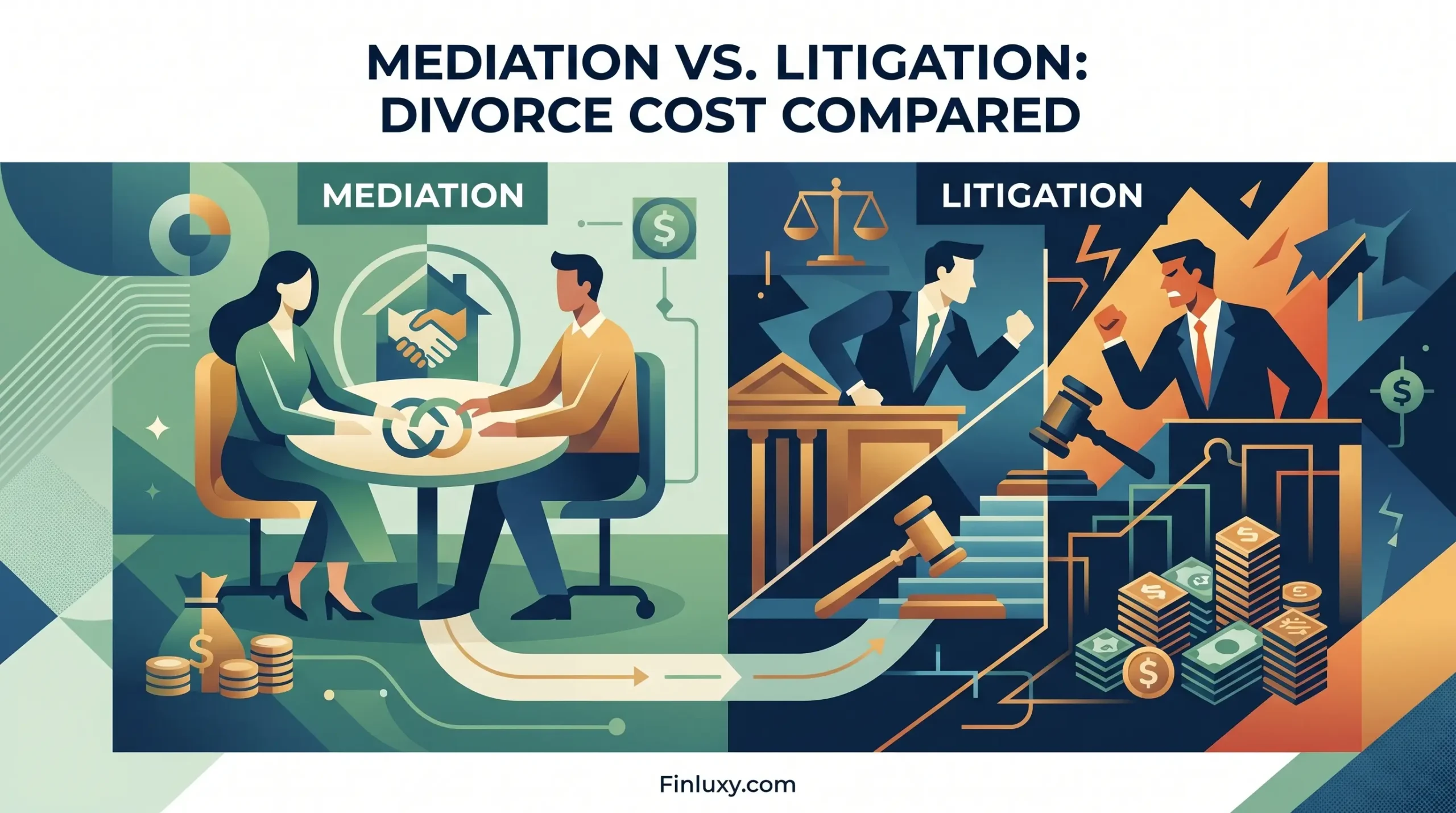
A mediated divorce for a $150k-plus household typically resolves for $5,000 to $10,000 in total, split between both spouses, according to the Martindale-Nolo and American Academy of Matrimonial Lawyers survey data summarized by Pivot Reset in April 2026. A litigated divorce that reaches trial runs $35,000 per spouse at the median — and the top quintile clears $60,000 each. The method, not the size of the marital estate, sets roughly 80% of the bill.
That last sentence is the part most coverage gets backward. Affluent households assume a large high-net-worth divorce cost tier guarantees a high fee. The data says conflict level — whether spouses route disagreements through two attorneys billing simultaneously, or through one neutral — does more to move the final number than asset complexity does. This analysis compares the two paths on hard cost components, calculates the Finluxy Divorce Cost Intensity Index for each, and isolates where the spread actually comes from.
This is a financial cost analysis, not legal advice. Figures reflect national survey ranges and market-rate benchmarks current as of early-to-mid 2026; actual costs vary by state, county, attorney market, and case facts. Mediation suitability depends on factors — power imbalances, hidden-asset suspicion, custody conflict — that no cost table can capture. Consult a licensed family law attorney before choosing a process for your situation.
The numbers at a glance
Five figures frame the entire comparison. Each is drawn from survey or market-rate data and labeled by the exact cost component it measures.
| Figure | Amount | Basis |
|---|---|---|
| Mediated divorce, total (both spouses) | $5,000–$10,000 | Median ~$7,000 per couple |
| Litigated divorce, per spouse (median) | $35,000 | Top quintile exceeds $60,000 |
| Hourly billing rate, litigation attorney | $300–$500/hr | Higher in major metros |
| Retainer fee, per attorney | $5,000–$15,000 | Drawn down against hours |
| Cost when both attorneys bill same hour | $500–$1,200/hr | Conflict multiplier |
Source: Martindale-Nolo / AAML survey data via Pivot Reset (April 2026); AllLaw litigation-range data; The Complete Lawyer rate benchmarks (April 2026).
What the mediation path actually costs
Mediation collapses the cost structure to a single neutral. One attorney-mediator drafts the agreement; each spouse may add a consulting attorney to review the final document before signing. The Complete Lawyer’s April 2026 breakdown puts the attorney-mediator rate at $250 to $500 per hour, with $600 to $800 appearing in higher-cost metros, and the consulting-lawyer review at $500 to $1,500 per spouse.
Session count drives the rest. Most mediated cases run 3 to 10 sessions over one to three months, per Ziegler Law Group’s April 2026 summary. A $150k-plus household with a couple of retirement accounts and a primary residence sits in the middle of that band — call it five to seven sessions. The total lands inside the $5,000 to $10,000 figure cited up top, with 70% of mediating couples spending under $10,000.
Specialist costs do not disappear in mediation; they get scoped tighter. A retirement split still requires a QDRO cost for retirement accounts — a qualified domestic relations order, the court order that divides a 401(k) or pension without triggering early-withdrawal tax. CalcBee’s March 2026 calculator pegs a simple 401(k) QDRO at $500 to $1,200 in preparation, plus a plan qualification fee and a court filing fee. A complex pension QDRO runs $1,500 to $2,500-plus. Karp & Iancu reports the financial-firm fee is commonly $600 to $800, split between parties. These costs are identical whether you mediate or litigate; the order has to be drafted either way.
The mediation total assumes cooperation holds. It does not assume the absence of assets.
What the litigation path adds on top
Two retainers open the litigation meter. Each attorney collects $5,000 to $15,000 up front, then bills against it at $300 to $500 per hour, with major-metro rates reaching higher. The structural problem is parallel billing: every contested motion, every settlement exchange, every hearing runs both clocks at once. Pivot Reset’s April 2026 figure for an hour of attorney-to-attorney argument is $500 to $1,200 — and a single contested motion costs $2,000 to $8,000.
AllLaw’s comparison data, summarized by The Complete Lawyer, splits litigation into two tiers. Settle before trial and the range is roughly $15,000 to $35,000 per spouse. Go to trial and it jumps to $35,000 to $100,000 per spouse. The AAML has published comparable figures for years; the survey median sits at $35,000 per spouse, with the top 20% above $60,000. For the full itemization of what each contested hour buys, the contested divorce attorney fees breakdown tracks it line by line.
Specialists scale up in litigation because each side often retains its own. A forensic accountant — distinct from forensic audit, the specific service of investigating financial records and tracing assets — bills $300 to $500 per hour, and TotTax’s April 2026 guide puts a high-net-worth or business-owner divorce engagement at $15,000 to $60,000 total. When two experts produce dueling reports, depositions, and trial testimony, that cost can double. The forensic accountant fees in high-asset divorce compound fastest in adversarial proceedings.
Business owners face the steepest divergence. A business valuation cost in divorce runs $3,500 to $5,000 as a standalone engagement in mediation, per Families First Mediation’s 2026 data. Litigated, the valuation portion alone often hits $15,000 to $50,000-plus once you add competing experts and court testimony, according to the Benaglio Group’s 2025 analysis. Same asset, same underlying math — the conflict structure multiplies the bill.
Component-by-component comparison
Laid side by side, the cost components reveal where the paths diverge and where they don’t. QDRO preparation and the filing fee are nearly fixed across both. Attorney time and dueling specialists are where litigation pulls away.
| Component | Mediation | Litigation (per spouse) |
|---|---|---|
| Attorney / mediator fees | $5,000–$10,000 total | $15,000–$100,000 |
| Retainer fee structure | None (hourly mediator) | $5,000–$15,000 per attorney |
| Hourly billing rate | $250–$800/hr (one neutral) | $300–$500/hr (×2, parallel) |
| QDRO preparation | $500–$2,500 | $500–$2,500 |
| Court filing fee | ~$400–$450/spouse | ~$400–$450/spouse |
| Forensic accounting | Scoped, $8,000–$25,000 if used | $15,000–$60,000+ (often ×2) |
| Business valuation | $3,500–$5,000 | $15,000–$50,000+ |
| Typical duration | 1–3 months | 12–24 months |
Sources: The Complete Lawyer (April 2026); AllLaw via The Complete Lawyer; CalcBee QDRO calculator (March 2026); TotTax forensic accounting guide (April 2026); Families First Mediation (2026); Benaglio Group (2025); Ziegler Law Group (April 2026).
Finluxy Divorce Cost Intensity Index
Raw dollar figures mislead at high estate values. A $40,000 fee feels enormous against a $400,000 estate and trivial against a $4 million one. The Finluxy Divorce Cost Intensity Index corrects for this: total divorce legal and professional fees divided by total marital estate value, times 100, expressed as a percentage. Contested divorces typically consume 5% to 15% of the marital estate in fees.
Modeled on a representative $150k-plus household with a $2.4 million marital estate — the legally precise term for the combined assets being divided, not “marital assets” — the index separates the two paths cleanly.
| Scenario | Total fees | Intensity Index |
|---|---|---|
| Mediation (both spouses, with QDRO) | $10,000 | 0.4% |
| Negotiated settlement (no trial) | $50,000 | 2.1% |
| Litigation, settles pre-trial (both spouses) | $70,000 | 2.9% |
| Litigation to trial (both spouses) | $180,000 | 7.5% |
| Litigation, dueling experts + custody (both spouses) | $300,000 | 12.5% |
Index = total fees ÷ marital estate value × 100. Fee totals derived from AAML/Martindale-Nolo survey ranges and AllLaw litigation tiers (2026). Illustrative; actual estate values and fees vary.
The spread is the story. Mediation lands near 0.4% of the estate. Full litigation with competing experts pushes into the 12.5% range — the top of the contested band. On a $2.4 million estate, that gap is roughly $290,000 that stays inside the marital estate under mediation and leaves it under litigation.
What the data shows that most coverage misses
Most comparison pieces frame mediation savings as a function of asset simplicity — the cleaner your finances, the more you save. The survey data points elsewhere. Pivot Reset’s April 2026 analysis is blunt: the single biggest cost driver is not asset complexity but conflict level between spouses. Couples who negotiate roughly 80% of issues directly and reserve attorneys for the remaining 20% spend 60% to 70% less.
That reframes the affluent-household calculation. A business owner with a $2.4 million estate and high cooperation can mediate the valuation for $3,500 to $5,000 and keep the Intensity Index under 1%. A salaried couple with simpler assets but entrenched conflict can litigate identical issues into the 7%-to-12% band. Complexity sets the floor on specialist costs; conflict sets the ceiling on everything. The variable affluent households can actually control is the second one — and it is the one that moves the total.
One more underappreciated figure: duration. Mediation resolves in one to three months; litigation runs 12 to 24 months or longer. For a $150k-plus earner, two years of contested proceedings carries an opportunity cost — billable focus, career disruption, delayed financial restructuring — that never appears on the attorney invoice.
Methodology
Figures were synthesized from a tiered source hierarchy. Primary attorney-fee and complexity benchmarks come from the American Academy of Matrimonial Lawyers survey data and the Martindale-Nolo survey of 5,500-plus divorcing Americans, accessed through analytical aggregators (Pivot Reset, April 2026). Litigation tier ranges trace to AllLaw comparison data. Component-level costs — QDRO preparation, forensic accounting, business valuation, mediator rates — were verified against market-rate benchmarks published within the past 24 months (The Complete Lawyer, CalcBee, TotTax, Families First Mediation), each cited inline at first use.
I prioritized survey medians over advertised attorney quotes and excluded divorce-attorney marketing pages and undisclosed-methodology calculators, consistent with avoiding commercial-interest sources. Where figures varied across sources — forensic accounting totals ranged from $8,000 to over $100,000 depending on scope — I reported the band rather than a false point estimate. The Finluxy Divorce Cost Intensity Index was calculated against a single illustrative $2.4 million marital estate to hold the denominator constant across scenarios; readers can recompute it using their own estate value and the fee ranges in the component table.
The $150k+ household decision
For households at this income level, the threshold question is not “can we afford litigation” — it is “what does litigation cost relative to the estate, and is the contested issue worth 7% to 12% of it.” On a $2.4 million estate, choosing trial over mediation is a roughly $290,000 decision. That sum has to be weighed against whatever the litigated outcome might recover beyond a negotiated one. Below a certain delta, the fees consume the prize.
Three structural facts should anchor the choice. First, the high-cost components — attorney hourly rate by market and dueling specialists — only fully engage under litigation; mediation scopes them down or eliminates the duplication. Second, the fixed components — QDRO preparation, filing fees, a single appraisal — are nearly identical across both paths, so they should not factor into the process decision at all. Third, mediation is not appropriate where there is a power imbalance, suspected hidden assets, or a spouse who controls opaque business finances; in those cases the forensic work that justifies litigation cost is exactly the point, and trying to mediate around it forfeits leverage.
After the process concludes, the spend continues. Post-divorce financial setup cost — estate plan updates, insurance restructuring, advisor fees to rebuild a single-income financial architecture — runs independent of which path you took. Budgeting only to the decree understates the true total. The cleanest version of this entire decision still benefits from a licensed family law attorney pricing your specific facts before you commit to a path; the ranges here set expectations, but they do not substitute for that scoping conversation. For the full lifecycle view across every phase, the divorce cost guide for affluent households maps the components in sequence.
Frequently asked questions
Is mediation always cheaper than litigation for a high-asset divorce?
In nearly all cooperative cases, yes — mediation saves 40% to 60% across complexity levels, per Pivot Reset’s April 2026 summary of survey data. The exception is when mediation fails partway and the couple restarts in litigation, paying for both. Switching mid-process raises the total above either path run cleanly.
Do I still need a QDRO if we mediate?
Yes, for any 401(k) or pension division. A qualified domestic relations order is required regardless of process — mediation does not change federal plan-administration rules. Expect $500 to $1,200 for a simple 401(k) and $1,500 to $2,500-plus for a complex pension, plus plan and filing fees.
How does the Finluxy Divorce Cost Intensity Index help me decide?
It converts raw fees into a percentage of your marital estate, so you can judge whether a process is proportionate to what is being divided. A litigated divorce at 7.5% of a $2.4 million estate is a different decision than the same dollar figure against a $500,000 estate. Recompute it with your own numbers before committing.
What makes litigation cost so much more than mediation?
Parallel billing. Two attorneys at $300 to $500 per hour each, often billing the same contested hour, plus duplicated specialists — two forensic accountants, two valuation experts — and 12 to 24 months of duration. Mediation routes the same issues through one neutral over one to three months.
Sources & References
- Pivot Reset — Average divorce cost by method, AAML/Martindale-Nolo survey synthesis (April 2026)
- The Complete Lawyer — Mediation vs litigation cost paths and rate benchmarks (April 2026)
- CalcBee — QDRO cost calculator and component breakdown (March 2026)
- TotTax — Forensic accountant cost guide, divorce engagement ranges (April 2026)
- Families First Mediation — Business valuator and ancillary mediation fees (2026)
- Benaglio Group — Litigated business valuation cost analysis (2025)
- Ziegler Law Group — Mediation session counts and duration (April 2026)
- Karp & Iancu — QDRO financial-firm fees and cost splitting (July 2025)
- Nolo — Divorce cost survey, filing fees and attorney medians (June 2024)