 Analysis by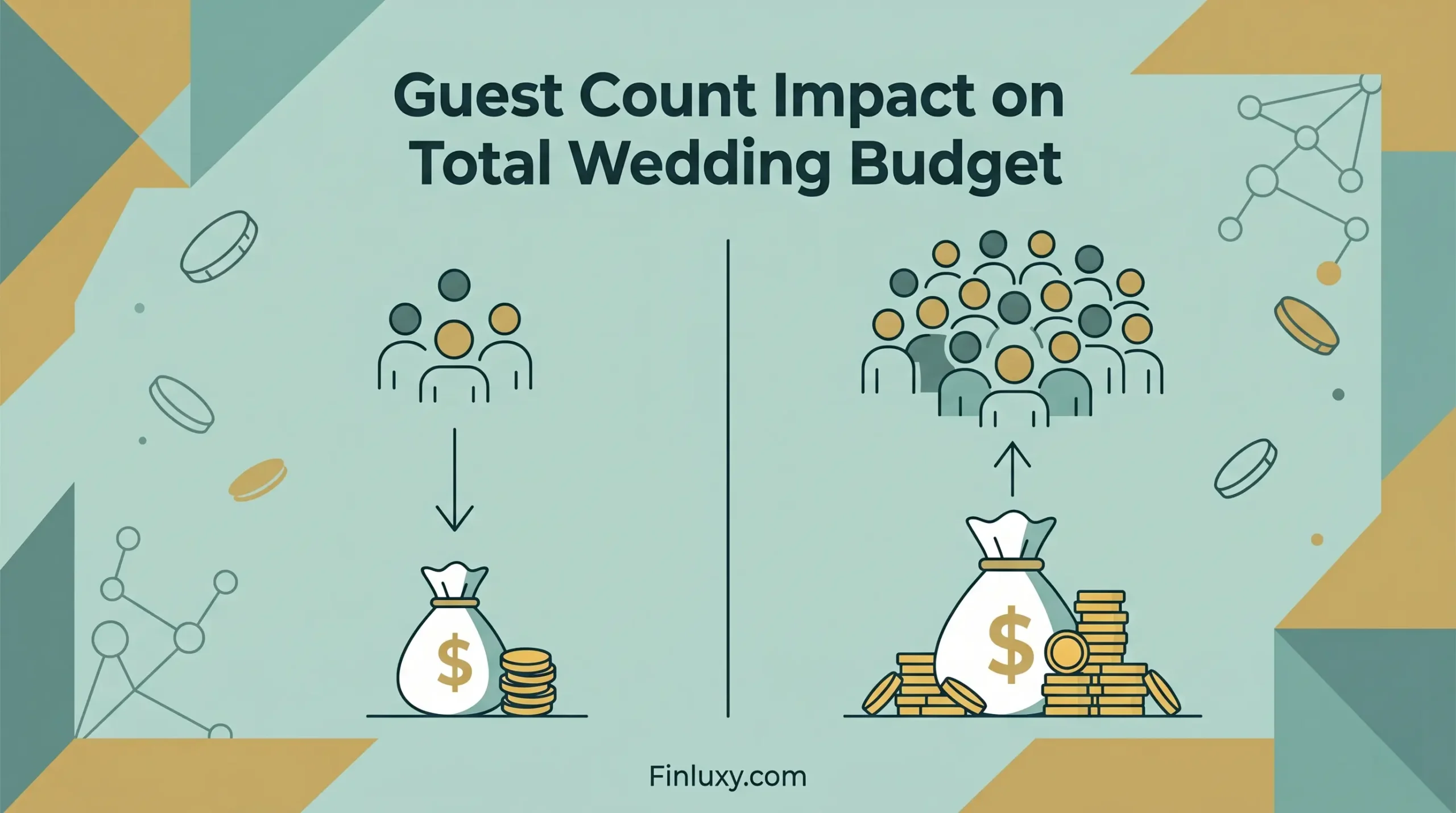
Each guest at the average American wedding now costs $292, according to The Knot 2026 Real Weddings Study, which surveyed 10,474 couples married in 2025. That single number is the most underused planning tool in the entire process. Trim a 150-person list to 120, and the arithmetic alone moves roughly $8,760 — before anyone negotiates a vendor contract.
Guest count is the one budget lever almost entirely within a couple’s control, and the only one that compounds. It touches catering, bar, rentals, stationery, favors, transportation, and a proportional slice of every fixed cost. For households earning $150k+, where the wedding often lands in premium or luxury territory, the per-guest figure is not $292 — it can be three to five times that. The leverage scales with it.
This analysis models total wedding cost as a function of guest count using national averages from The Knot 2026 Real Weddings Study (data collected from couples married in 2025) and secondary pricing from WeddingWire and industry catering benchmarks. Per-guest figures are national blended averages; actual costs vary sharply by market — a New Jersey wedding averaged $57,000 in The Knot’s 2025 study while Utah averaged $18,000. Premium and luxury per-guest figures cited here are drawn from secondary trade sources and represent ranges, not point estimates, because The Knot does not publish guest-count breakdowns segmented by budget tier. Figures are illustrative models for planning, not quotes. This is cost analysis, not financial advice.
The numbers that matter most
Before the tier modeling, here are the anchor figures every couple should know. These come directly from The Knot’s most recent study and govern every calculation that follows.
| Metric | Figure |
|---|---|
| Average total wedding budget | $34,000 |
| Per-person catering cost (national, all-in per guest) | $292 |
| Average guest count | 117 |
| Average cost, 51–100 guests | $30,200 |
| Average cost, 101–150 guests | $36,700 |
Source: The Knot 2026 Real Weddings Study, released February 2026 (couples married in 2025). The $292 figure represents the blended per-guest spend across the full budget, not catering alone.
How guest count actually scales cost
The intuitive model — total cost rises in a straight line with headcount — is wrong, and the error costs couples real money in both directions. Wedding expenses split into two buckets. Fixed costs do not move with guest count: the photographer charges the same to shoot a 60-person wedding or a 200-person one. So does the videographer, the officiant, the planner’s base fee in many structures, and the couple’s attire. Variable costs scale directly: catering, bar, rentals, stationery, favors, and the cake.
The Knot’s own tier data shows the curve. A wedding with 1–50 guests averaged $17,100; 51–100 guests, $30,200; and 101–150 guests, $36,700. Notice the jumps are uneven. Moving from the smallest tier to the middle nearly doubles the total, but the next step up adds only about 21%. That is fixed costs being absorbed across more heads. The per-guest catering cost at premium weddings falls as the headcount rises, because the flat expenses spread thinner.
This produces a counterintuitive result that most coverage skips: the smallest weddings have the highest cost per guest. At 30 guests, the photographer, officiant, and planner divide across 30 plates. At 200, the same fixed total becomes a rounding error per person. A micro wedding is not automatically a cheap wedding on a per-head basis — it is a concentrated one.
The variable-cost math, isolated
Strip out the fixed costs and the variable component is where guest count earns its reputation. Premium catering — the tier a $150k+ household typically encounters — runs $250 to $500 per guest for a plated dinner with an upgraded menu, per Today’s Luxury Weddings 2026 data, and a celebrity-chef tasting menu can reach $1,500 per guest. Add bar service, premium rentals at $15 to $40 per place setting, and stationery, and the true marginal cost of one additional guest at a premium wedding sits well above the $292 national blended figure.
| Tier | Per-guest variable cost | Cost of adding 25 guests |
|---|---|---|
| National average | $292 | $7,300 |
| Premium (plated, upgraded menu + bar) | $300–$550 | $7,500–$13,750 |
| Luxury (tasting menu, top-tier rentals + bar) | $550–$1,650 | $13,750–$41,250 |
National figure: The Knot 2026 Real Weddings Study. Premium and luxury per-guest ranges synthesized from Today’s Luxury Weddings 2026 catering data ($250–$1,500/guest food) plus bar, rental ($15–$40/place setting), and stationery components from WeddingWire 2026 pricing. Ranges, not point estimates; model-specific tier breakdowns were unavailable from primary sources.
Modeling four budget tiers against a fixed guest list
Hold the guest list constant at 150 and watch how the vendor mix — not the headcount — drives the spread between a $50k wedding and a $500k one. This is the inverse of the question above. Here, guests stay fixed and dollars vary, which isolates how much of a luxury budget is choice rather than scale.
At $50k for 150 guests, the math forces discipline: roughly $130 per guest for catering and bar, a single photographer, DIY-adjacent florals, a DJ rather than a band. At $200k, the same 150 guests command a plated tasting menu, a full floral install, a live band, and a full-service planner taking 15% off the top. The guest count did not change. The luxury wedding cost structure reflects vendor tier, not table count.
| Component | $50k tier | $100k tier | $200k tier | $500k tier |
|---|---|---|---|---|
| Venue rental fee | $8,000 | $18,000 | $35,000 | $90,000 |
| Catering + bar (per-person catering cost × 150) | $19,500 | $37,500 | $67,500 | $150,000 |
| Photography + videography | $6,000 | $11,000 | $18,000 | $35,000 |
| Florals and décor | $5,000 | $12,000 | $30,000 | $90,000 |
| Entertainment | $3,000 | $8,000 | $18,000 | $50,000 |
| Planner fee | $3,500 | $8,000 | $25,000 | $60,000 |
| Attire, beauty, stationery, transport, officiant | $5,000 | $5,500 | $6,000 | $25,000 |
| Total wedding budget | $50,000 | $100,000 | $200,000 | $500,000 |
| Per-person catering cost | $130 | $250 | $450 | $1,000 |
Illustrative bottom-up model. Per-person catering cost figures within the upper tiers fall inside the $250–$1,500 plated/tasting range reported by Today’s Luxury Weddings 2026. Planner fees at the $200k and $500k tiers reflect the 15–20% of total budget structure cited by industry sources (AMW, 2026). Component allocations are modeled, not survey medians.
Two components carry the tier increases: catering scales with both quality and headcount, and florals swing the widest, moving from $5,000 to $90,000 across the range. The floral design cost at luxury weddings is the single most elastic line in the budget — it has no natural ceiling. Entertainment shows the band-versus-DJ decision in dollar terms; the gap between a wedding band and a DJ is several thousand at minimum and widens at the top tiers.
The Finluxy Wedding Cost Index
To translate any total into a comparable figure, divide the wedding’s cost by the national average for the same guest count. The Finluxy Wedding Cost Index expresses spend relative to the typical wedding: 1.0 is average, above 2.0 is premium, above 5.0 is luxury. For 150 guests, the national benchmark is The Knot’s 101–150 guest average of $36,700.
| Total wedding budget | National average (150-guest tier) | Finluxy Wedding Cost Index | Classification |
|---|---|---|---|
| $50,000 | $36,700 | 1.36× | Above average |
| $100,000 | $36,700 | 2.72× | Premium |
| $200,000 | $36,700 | 5.45× | Luxury |
| $500,000 | $36,700 | 13.62× | Luxury |
Finluxy Wedding Cost Index = total wedding budget ÷ The Knot 2026 national average for the 101–150 guest tier ($36,700). Index classification per Finluxy scale: >2.0 premium, >5.0 luxury.
The index reframes a number like $200,000. In isolation it sounds extravagant; against the benchmark it lands at 5.45× the national average for that guest count — the threshold of true luxury, not the middle of it. A $500,000 wedding for 150 guests runs 13.62× average, which clarifies how much of ultra-luxury spend is discretionary design rather than the cost of hosting people.
What the data shows that most coverage misses
Standard wedding advice treats “cut your guest list” as a uniform savings tactic. The tier data says otherwise. The dollar value of removing a guest depends entirely on what that guest costs — and at the luxury tier, a single cut is worth four to five times what it is at the national average. Removing 20 guests from a $1,000-per-head wedding saves $20,000 in variable cost. The same cut at a $130-per-head wedding saves $2,600.
This inverts the usual framing. Couples spending the most have the most to gain per name trimmed, yet they are the least likely to cut, because the social cost of an exclusive list rises with the budget. The leverage is largest exactly where it is hardest to use. For a $150k+ household weighing whether to expand from 120 to 175 guests at the luxury tier, that 55-person addition is not a line item — at $700 per head it is roughly $38,500, the price of a separate vehicle or a year of private school.
Context for the $150k+ household
At this income level, the binding constraint is rarely the total — it is the marginal decision. The household can absorb a $150,000 wedding; the question is whether the 51st through 100th guest delivers proportional value, given that those names sit at full per-head cost while contributing the least to the couple’s core experience. The honest move is to set the guest list first and let it dictate the tier, rather than setting a tier and backfilling guests until the budget breaks.
Three thresholds are worth naming. First, the fixed-cost floor: below roughly 75 guests, per-head cost climbs steeply, so an intimate luxury wedding can cost nearly as much as a larger one — the savings from cutting guests stall once fixed costs dominate. Second, the planner-fee inflection: once a budget crosses about $150,000, the 15–20% percentage-based planner fee becomes a five-figure line of its own, and a full-service versus day-of planner decision meaningfully shifts the total. Third, the geographic multiplier: the same 150-guest wedding modeled here costs materially more in a top-five market, and a New York City wedding cost structure can run 40–50% above these national figures. A household comparing what a $150k wedding actually buys against a $300k wedding budget is, in practice, deciding between guest count, vendor tier, and market — and only one of those three is fully under their control on the day they send invitations.
How much does each additional wedding guest actually cost?
At the national average, $292 per guest (The Knot 2026), but that blends all budget levels. At a premium plated wedding the marginal cost runs $300–$550 per guest including bar and rentals, and at the luxury tier with a tasting menu it can reach $1,650 per guest. The figure depends on your vendor tier, not a fixed national number.
Why do smaller weddings cost more per guest?
Fixed costs — photographer, videographer, officiant, attire, and often the planner base fee — do not change with headcount. At 30 guests those costs divide across few people; at 200 they spread thin. The Knot’s tier data shows a 1–50 guest wedding averaged $17,100, which is a high per-head figure once fixed costs are isolated.
What is the Finluxy Wedding Cost Index?
It divides a wedding’s total cost by the national average for the same guest count. A 150-guest wedding at $200,000 against the $36,700 national benchmark produces an index of 5.45×, placing it in luxury territory. Below 2.0 is premium, above 5.0 is luxury, and 1.0 is average.
Does cutting the guest list save more at higher budgets?
Yes, in absolute dollars. Removing one guest saves whatever that guest costs in variable spend — about $130 at a $50k/150-guest wedding versus roughly $1,000 at a $500k one. The per-name leverage is largest at the luxury tier, though fixed costs mean the savings flatten once a list drops below about 75 guests.
Methodology
Primary figures — national average wedding cost, per-guest spend, average guest count, and the guest-count tier averages — come from The Knot 2026 Real Weddings Study, released February 2026, based on 10,474 U.S. couples married in 2025. I prioritized The Knot as the primary source per its standing as the most comprehensive annual wedding cost dataset, and used its press-release headline figure of $34,000 alongside the $34,200 figure published in its consumer guidance; the difference reflects rounding between the two releases.
Budget-tier component allocations and premium/luxury per-guest catering ranges were synthesized from secondary trade sources — WeddingWire 2026 pricing and industry catering and planner benchmarks — because The Knot does not publish cost breakdowns segmented by budget tier within a guest count. Where primary data could not resolve a tier-specific figure, I modeled to a defensible range and labeled it as illustrative rather than reporting a false point estimate. Fixed-versus-variable cost classification follows standard industry treatment, with catering, bar, rentals, stationery, and favors treated as variable, and photography, videography, officiant, and attire as fixed. The Finluxy Wedding Cost Index uses The Knot’s 101–150 guest tier average of $36,700 as the denominator for all 150-guest calculations.
Sources & References
- The Knot Worldwide — 2026 Real Weddings Study press release (national average, per-guest, guest count)
- The Knot — Average Wedding Cost guide and guest-count tier breakdown
- The Knot Worldwide — 2025 study with state-level cost variance
- WeddingWire — Wedding catering cost benchmarks
- Today’s Luxury Weddings — 2026 luxury catering and planner fee ranges
- AMW — 2026 wedding planner fee structures, full-service and percentage-based