 Analysis by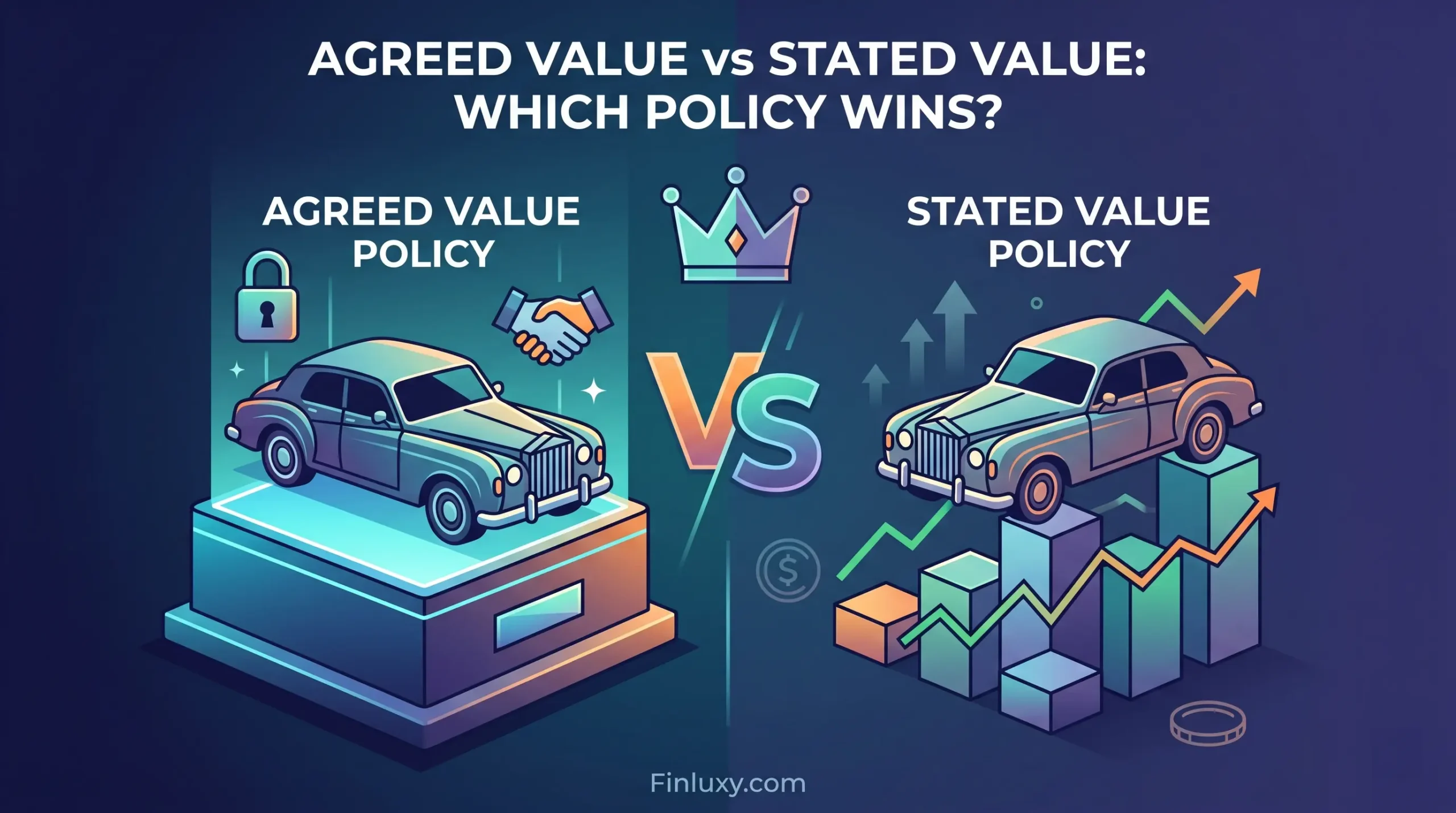
On a $250,000 exotic with a stated value policy, an insurer can legally hand you a check for $180,000 after a total loss — and stay fully within the contract. The gap is the depreciation clause buried in the payout language: stated value policies pay the lesser of the stated amount or actual cash value, and on a depreciating asset, actual cash value almost always loses. luxury car insurance cost data shows the premium difference between the two structures is often a few hundred dollars a year. The payout difference runs into five and occasionally six figures.
That asymmetry is the entire decision. Most coverage of this topic treats agreed value versus stated value as a feature comparison. It isn’t. It’s a question of who absorbs depreciation risk in a total loss — you or the carrier — and the answer is written into one clause most owners never read.
Scope: this analysis covers personal-use luxury, exotic, and collector vehicles valued above roughly $80,000, insured under specialty or standard policies in the United States. Payout figures model total-loss scenarios only; partial-loss and repair settlements follow different rules. Premium ranges reflect Insurify and The Zebra national benchmarks and Hagerty published examples as of 2025–2026; individual quotes vary by garaging ZIP code, driver record, annual mileage, and stated usage. Policy language varies by carrier and state — the “lesser of” clause described here is common but not universal, and exact contract wording governs any actual claim. Nothing here is financial or insurance advice.
The three valuation methods, and why two of them cost you money
Standard auto policies insure on an actual cash value basis. In most standard auto policies, your car is insured on an actual cash value basis, meaning depreciation is baked in. For a daily-driver sedan, that’s fine — the car depreciates, the payout depreciates with it, and the two roughly track. For a vehicle that holds or appreciates, actual cash value is a structural mismatch.
Three structures exist. Actual cash value pays replacement cost minus depreciation. Stated value lets you declare a number — but the contract reserves the insurer’s right to pay less. Agreed value locks in a figure both parties sign off on, with no depreciation applied at claim time. An agreed value policy guarantees you receive the full insured amount of the vehicle, with no depreciation and including all sales taxes, in the event of a covered total loss.
The trap is the name. Stated value sounds like a guarantee. It isn’t one. Most stated value policies pay the lesser of the stated value or the vehicle’s calculated actual cash value, which means the insurer retains the right to fall back on actual cash value at claim time. One specialty carrier put it bluntly: a stated value policy only sets the rate the insurer charges to cover your vehicle, and does not in any way insure the vehicle for how much you will receive in a covered total loss. The declared number controls your premium. It does not control your payout.
| Metric | Figure |
|---|---|
| Agreed value total-loss payout | 100% of agreed value, no depreciation |
| Stated value total-loss payout | Lesser of stated value or actual cash value |
| Typical exotic depreciation gap, yr 1–3 | 20–40% of MSRP (segment range) |
| National full-coverage avg premium (2025) | $2,144 (Insurify) |
| Specialty exotic Insurance Cost Ratio | 1.0–1.8% of vehicle value |
Sources: Hagerty (agreed value mechanics, 2025–2026); Insurify, “Average Cost of Car Insurance,” 2025–2026; Cluster benchmark ranges. Depreciation gap is a segment-average estimate; model-specific figures vary.
Modeling the gap on a real total loss
Numbers make this concrete. Take a two-year-old exotic with a stated value of $250,000. The owner declared that figure, pays premium on it, and assumes it’s the payout. Then the car is totaled. The adjuster runs actual cash value using comparable sales and depreciation curves, and arrives at $180,000 — plausible for a model that’s shed 28% off a $250,000 base. Under the lesser-of clause, the check is $180,000. The $70,000 difference is the owner’s loss, fully contractual.
Run the same loss under agreed value. Owner and insurer set the figure at $250,000 at policy inception, backed by photos or an appraisal. Total loss triggers the full $250,000, minus deductible, no depreciation adjustment. Under stated value, the insurer pays either the stated value or the actual cash value at the time of loss, whichever is lower — and on any vehicle that depreciates faster than the owner expected, “whichever is lower” is the depreciated number every time.
| Scenario | Policy value | Adjuster ACV | Payout (pre-deductible) | Owner shortfall |
|---|---|---|---|---|
| Agreed value | $250,000 | Not applied | $250,000 | $0 |
| Stated value | $250,000 | $180,000 | $180,000 | $70,000 |
| Actual cash value (standard) | None declared | $180,000 | $180,000 | $70,000 |
Illustrative model using documented “lesser of” payout mechanics (Hagerty; The Zebra, Dec 2025; Insurance Panda, Feb 2026). Actual cash value figure is a hypothetical depreciation estimate, not a model-specific Edmunds or NAIC valuation. Salvage and deductible adjustments excluded.
The standard actual cash value column matters because it reveals what stated value actually buys you: in a depreciation scenario, nothing. You paid a premium on $250,000 and received the same payout a basic policy would have produced. The only scenario where stated value beats actual cash value is when the stated number is lower than ACV — which is the inverse of why most luxury owners think they’re buying it.
Where stated value legitimately makes sense
Stated value isn’t a scam. It’s a premium-control tool that gets misapplied. Stated value is frequently used to manage premium rather than maximize payout — you deliberately insure a portion of a vehicle’s value to lower the cost, accepting that you’ll never see full market value back.
Consider a $400,000 hypercar driven 500 miles a year and stored in a climate-controlled garage. The owner is self-insuring most of the catastrophic risk and wants liability plus a partial physical-damage cushion. Declaring a stated value of $150,000 cuts the premium meaningfully while accepting the ceiling. That’s a rational trade for someone whose net worth absorbs the gap. For most owners of a single high-value car they actually drive, it’s the wrong call — they’re paying for protection the contract doesn’t guarantee. The decision tracks closely with high-value vehicle deductible math: both are exercises in deciding how much loss you’re willing to retain.
Finluxy Insurance Cost Ratio across both structures
The Finluxy Insurance Cost Ratio — annual total premium divided by current market value, times 100 — strips premium comparisons down to a single comparable number. A $3,000 premium means something different on a $150,000 car than on a $400,000 one. The ratio normalizes it.
Specialty insurers consistently produce lower ratios because they underwrite limited-use, well-stored vehicles. Hagerty notes that because it only protects vehicles not driven daily, its policies provide coverage at significantly lower prices than standard insurers. The Cluster benchmark bears this out: standard vehicles average 1.5–2.5%, while exotics and classics with specialty carriers often land at 1.0–1.8%.
| Vehicle (example) | Market value | Annual premium | Policy type | Finluxy Insurance Cost Ratio |
|---|---|---|---|---|
| Porsche 911 GT3 (Hagerty example) | $220,000 | $2,640 | Agreed value | 1.2% |
| Exotic, daily-use, standard carrier | $250,000 | $4,500–$6,250 | Actual cash value | 1.8–2.5% |
| Collector, limited-use, specialty | $150,000 | $1,500–$2,700 | Agreed value | 1.0–1.8% |
Sources: Hagerty published example (Porsche 911 GT3, $220,000 value, $2,640 premium = 1.2%); Cluster benchmark ranges for standard and specialty segments. Standard-carrier and collector figures are defensible segment ranges; model-specific premium data was not available from a single primary source for this period.
The ratio exposes a counterintuitive result: the agreed value policy, which pays more in a claim, frequently costs less per dollar of value insured. That’s not a contradiction. Specialty carriers offering agreed value select for low-risk usage profiles, so they can price aggressively despite the richer payout promise. The structure that protects you better is often the cheaper one — provided your vehicle qualifies for it. A Porsche 911 premium by driver age shifts these ratios further depending on who’s behind the wheel.
What most coverage overlooks
Here’s the finding buried in the data: the premium difference between agreed value and stated value is trivial relative to the payout difference, yet owners optimize on premium. National full-coverage premiums illustrate the scale. Insurify reports the average full-coverage premium fell 6% to $2,144 in 2025, after rising 46% from 2022 to 2024. Even a meaningful percentage swing on a specialty premium is a few hundred dollars a year. The stated-value payout gap on a six-figure car is measured in tens of thousands.
Frame it as a ratio of what’s at stake. A $400-a-year premium saving against a potential $70,000 payout shortfall is a 175-to-1 exposure. No financially literate household accepts that trade knowingly — which means most who hold stated value policies on appreciating or slow-depreciating cars don’t know they hold them. The clause is in the contract; the implication never surfaces until a claim. This is the same blind spot that shows up in exotic car coverage costs and Lamborghini annual premium breakdowns, where headline premiums get scrutinized and payout structure gets ignored.
How carriers differ on the guarantee
Not every agreed value policy is identical, and the carrier matters. Specialty insurers built around collector vehicles — Hagerty among them — write agreed value as the default. Hagerty offers a Guaranteed Value policy, more commonly called an agreed value policy, meaning the carrier agrees on a value and guarantees that amount in a covered total loss. High-net-worth carriers like Chubb and AIG Private Client extend agreed value to luxury and exotic vehicles within broader private-client packages, often bundling it with an umbrella policy for car owners for liability above the auto limits.
Standard carriers — State Farm, GEICO — generally don’t offer true agreed value on exotics without a specialty partner. Most standard insurance companies do not typically offer agreed value unless they partner with a specialty provider. The practical upshot: if you’re insuring a six-figure car through a mass-market carrier, confirm in writing whether the payout is agreed value or a stated/actual-cash-value hybrid. The Hagerty and Chubb coverage comparison turns on exactly this distinction, as does the question of how garaging location changes premiums under each carrier’s underwriting.
The $150k+ household decision
For a household above $150k insuring a vehicle worth more than a year’s gross income, the agreed value versus stated value question is a risk-retention decision, not a premium-shopping one. The relevant threshold is simple: if losing the depreciation gap in a total loss would materially disrupt your finances, agreed value is the only defensible structure, and the modest premium difference is noise. If your liquidity could absorb a $70,000 shortfall without consequence, stated value becomes a legitimate premium-reduction lever — but only as a deliberate choice with the ceiling understood, not a default you backed into.
Two trade-offs deserve attention at this income level. First, agreed value requires documentation — appraisals, photos, maintenance records — and requires updating the agreed figure at renewal as values shift, since collector car values move with market trends and should be checked at every renewal. Neglecting that turns an agreed value policy into an under-insured one. Second, agreed value usually comes with usage restrictions — limited mileage, no daily-driver status, secured storage. A car you actually commute in may not qualify, which pushes you back toward standard coverage and its actual-cash-value payout. The owner who wants both daily usability and full-value protection on an exotic frequently can’t get them in one policy, and resolving that tension — sometimes by carrying a separate daily driver — is the real planning question. The premium line item is the least important number on the page; the payout clause and the usage restriction are where the actual money lives.
Does agreed value always pay more than stated value?
In a total loss on a vehicle that has depreciated, yes — agreed value pays the full agreed figure while stated value pays the lesser of the stated amount or actual cash value. The only case where they pay the same is when actual cash value happens to equal or exceed the stated figure, which is uncommon for vehicles owners choose to insure on a stated basis.
Why would anyone choose stated value?
To lower the premium by deliberately insuring less than full value. It’s a rational tool for owners self-insuring most of the catastrophic risk on a rarely-driven car, who accept a capped payout in exchange for a smaller premium. It’s the wrong choice for anyone expecting full market value back after a loss.
Can a standard insurer like State Farm or GEICO offer agreed value on an exotic?
Generally not without a specialty partner. True agreed value is the domain of collector-focused carriers like Hagerty and high-net-worth insurers like Chubb and AIG Private Client. Confirm the payout basis in writing before assuming a mass-market policy guarantees your declared value.
How is the Finluxy Insurance Cost Ratio calculated?
Annual total premium divided by current market value, multiplied by 100. A $2,640 premium on a $220,000 car produces a 1.2% ratio. Standard vehicles average 1.5–2.5%; exotics and classics with specialty agreed value coverage often run 1.0–1.8%.
Do I need to update my agreed value over time?
Yes. Collector and exotic values move with the market, and the agreed figure is only as current as your last renewal. An agreed value policy on a stale number can leave you under-insured if the car has appreciated, or over-paying premium if it has fallen.
Methodology
Payout mechanics for agreed value, stated value, and actual cash value were verified against primary specialty-carrier documentation (Hagerty insurance guides) and corroborated across The Zebra, Insurance Panda, and Velocity Restorations, all published December 2025 through February 2026. The “lesser of stated value or actual cash value” clause is documented consistently across these sources as standard stated-value language. National premium benchmarks come from Insurify’s 2025–2026 average-cost analysis and the Insurance Information Institute’s underwriting projections, with cross-checks against Bankrate and ValuePenguin state-level data.
The Finluxy Insurance Cost Ratio uses the Cluster-defined formula and the Hagerty-published Porsche 911 GT3 example as its anchor point ($220,000 value, $2,640 premium, 1.2%). Total-loss payout figures in the $250,000 scenario are illustrative models built on documented payout mechanics, not model-specific valuations; the actual cash value figure represents a plausible depreciation estimate rather than a primary-source vehicle appraisal. Where model-specific exotic premiums could not be confirmed through a single primary source, defensible segment ranges from Cluster benchmarks are used and labeled as such. Figures appearing in both body text and tables were reconciled to match exactly.
Sources & References
- Hagerty — Stated vs. Guaranteed (Agreed) Value insurance mechanics
- Hagerty — Agreed value vs. stated value payout definitions
- Hagerty — Specialty pricing and limited-use underwriting
- Insurify — Average cost of car insurance, 2025–2026 national benchmarks
- Insurance Journal / Insurify — 2025 premium decline to $2,144
- The Zebra — Agreed value vs. stated value comparison
- Insurance Panda — Stated value as premium-control tool
- Velocity Restorations — Stated value lesser-of-ACV mechanics
- Phoenix Insurance — Exotic car stated value payout risk
- Heacock Classic — Stated value sets rate, not payout
- Bankrate / Triple-I — National premium trend data