 Analysis by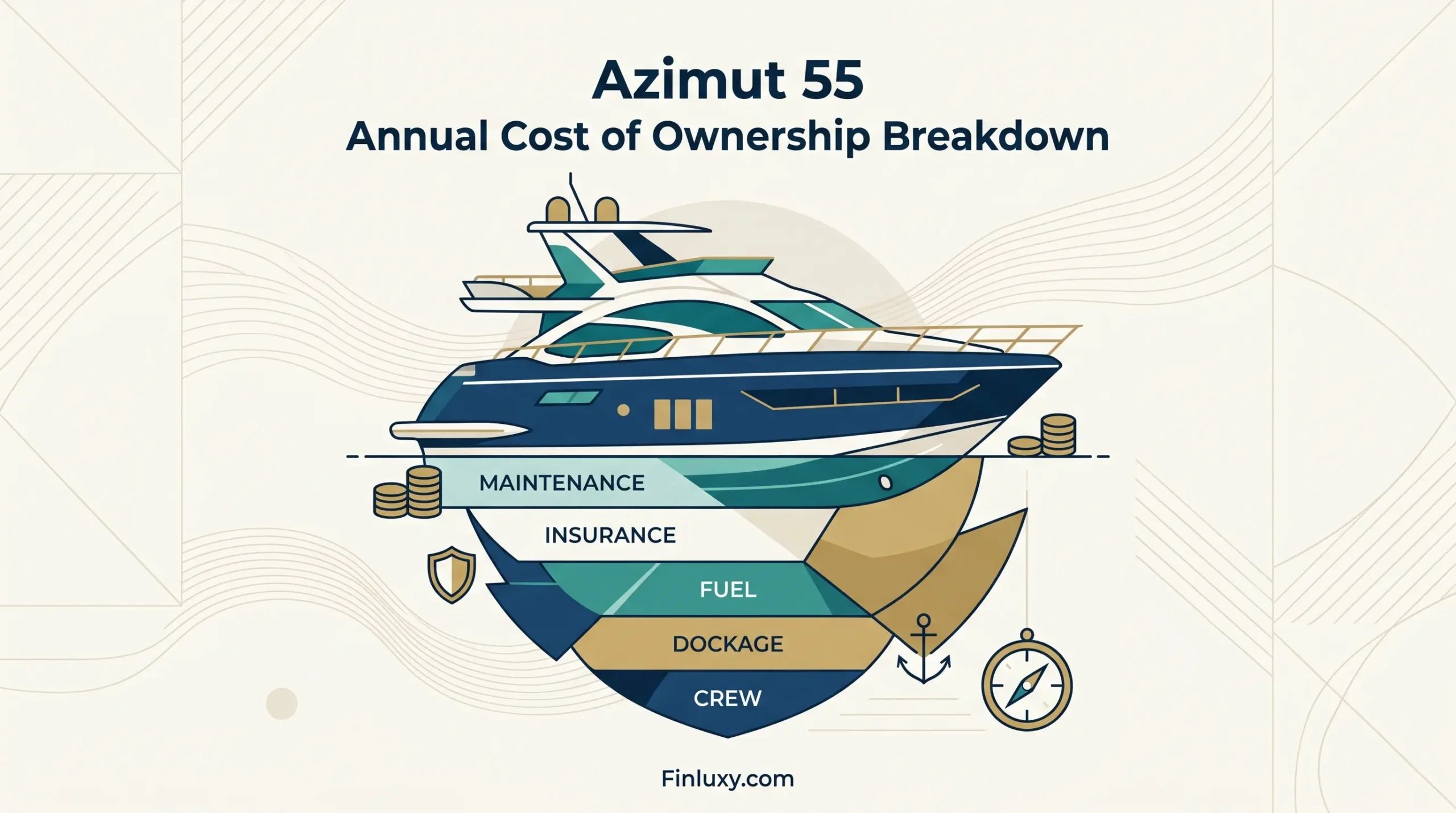
Park an Azimut 55 in a full-service Southeast Florida marina, insure it, and maintain it properly, and the fixed annual bill lands near $57,200 before the engines ever turn over. Add fuel for 30 days of cruising and the total cost of ownership crosses $95,000 a year — on a boat that trades, used, for roughly half a million dollars.
That ratio is the part most listings skip. The sticker price of a pre-owned Azimut 55 sits between $345,000 and $765,000 depending on generation, but the purchase is the cheap part. What follows is a full decomposition of the annual carry, every line attributed to a current source, and a usage-sensitivity model that tells you what a day on the water actually costs.
This analysis models a Generation 2 or Generation 3 Azimut 55 motor yacht with an insured hull value of $500,000, kept and operated in Southeast Florida — the largest US market for vessels of this class. Figures reflect 2026 market data and 2024 NMMA industry statistics, the most current available at publication. Marina rates, fuel prices, and insurance premiums vary materially by region, storm exposure, vessel condition, and owner profile; a Pacific Northwest or Great Lakes owner will see a different fixed-cost base, particularly on insurance and winter storage. This is a cost-structure analysis, not financial or purchase advice. Apply the methodology to your own quotes before budgeting.
The Numbers at a Glance
Five figures define the ownership math for this vessel. The fixed annual cost is the floor — it does not move with how often you run the boat. Fuel is the variable layer stacked on top.
| Metric | Figure |
|---|---|
| Used purchase price range (all generations) | $345,000 – $765,000 |
| Fixed annual cost (slip + insurance + maintenance + documentation) | $57,200 |
| Total cost of ownership at 30 days used | $95,642 |
| Fuel burn at cruise speed | 56.8 GPH |
| Finluxy Yacht Cost Efficiency Ratio (30 days) | $3,188 / day |
Sources: YachtBuyer Market Watch (2026); Yachting sea-trial data; author calculation. Methodology below.
Purchase Price: What the Generation Gap Hides
The Azimut 55 is not one boat. YachtBuyer’s Market Watch separates the line into three generations, and the spread between them is wide enough to make any single “average” price misleading. Second-generation hulls built between 2002 and 2012 currently list between $345,000 and $765,000, averaging around $503,000. First-generation models from 1999–2002 sit lower; the 2018–2022 third generation, with its MAN i6-800 propulsion and Salvagni interior, commands a premium when one surfaces for sale.
Depreciation matters here in a way it does not for a sailing yacht. Powerboats in this class shed value faster than comparable 50-foot sailing yacht ownership costs would suggest, and the engine-heavy Azimut is no exception. YachtBuyer reports third-generation 55s spend an average of 249 days on the market and close roughly 5.8% below asking. The figure analysts overlook: a buyer purchasing at the segment midpoint is not buying a stable asset — the cumulative depreciation over a five-year hold typically exceeds the entire fuel bill for that period. The new versus used boat total cost question turns almost entirely on which generation absorbs that curve.
Slip Fees: The Largest Fixed Line
Dockage is the single biggest controllable cost, and location swings it by a factor of three. Southeast Florida — Fort Lauderdale, Miami, Palm Beach — runs $18 to $40 per foot per month at full-service marinas in 2026, according to Ward Yacht Sales’ market breakdown. At the premium end, a 55-foot vessel needing a 55- to 60-foot slip for maneuvering clearance lands near $2,200 per month, or about $27,000 a year before metered electricity and water.
Public rate sheets confirm the ceiling is higher still. The City of Newport Beach’s Balboa Yacht Basin published a 2025–2026 rate of $59.03 per foot per month for a 50-foot slip — a government schedule, not a resort markup. Run an Azimut 55 there and dockage alone clears $39,000 annually. Regional variance this large is why a single national slip number is useless; the marina slip fees by US port data shows secondary inland markets at a fraction of these rates. This model uses $27,000 — a realistic Southeast Florida full-service figure.
Fuel: Where the Variable Cost Lives
Here is the line that separates a docked trophy from a working cruiser. Yachting‘s sea trial of the third-generation Azimut 55, powered by twin MAN i6-800 diesels, recorded 56.8 gallons per hour at a 2,000-rpm cruise of roughly 23.5 knots. At wide-open throttle that climbs to 81 GPH. The earlier Caterpillar-powered hulls land in a similar band.
Fuel pricing in 2026 has been brutal. The EIA recorded US retail diesel at $5.64 per gallon the week of April 6, 2026 — up 57% from a year earlier — and marine fuel docks carry a 50% to 100% premium over roadside pumps, per Dockwa’s 2026 marina fuel analysis. Using $5.64 as a conservative marina-adjusted figure and four engine hours per outing, a single day of cruising burns about $1,281 in diesel. The arithmetic compounds fast: every additional day on the water adds more than a thousand dollars in fuel alone, which is exactly why usage frequency dominates the cost-per-day calculation. Owners modeling this themselves can pull current figures from the powerboat fuel cost per hour framework and adjust for local dock pricing.
Insurance, Maintenance, and the Rest of the Fixed Stack
Three more lines complete the fixed base. Marine insurance for a motor yacht of this value runs 1% to 5% of insured hull value annually, with most cruising owners near 1.5%, according to multiple 2026 broker breakdowns. Motor yachts rate higher than sailing yachts — more horsepower, more risk — and Florida’s named-storm exposure pushes premiums 20% to 40% above the national average. YATCO’s Azimut 55 buyer guide cites $10,000 to $15,000 annually. This model uses $9,000, reflecting roughly 1.8% of value for a well-maintained, hurricane-plan-compliant vessel; an owner without a documented storm plan should expect the higher end, a point detailed in the yacht insurance cost breakdown.
Maintenance is the line owners most consistently underestimate. The “1% rule” — budget 1% of value annually for upkeep — collapses on a twin-diesel motor yacht with pod or shaft drives, two helm stations, generators, air conditioning, and teak. Scheduled service, annual haul-out, bottom paint, and zinc replacement on a $500,000 Azimut realistically run $18,000 to $22,000; this model uses $20,000, about 4% of value. The true boat maintenance cost beyond the 1% rule is the gap that turns a budgeted year into an over-budget one. Documentation and registration add roughly $1,200. No winter storage applies in Florida, though a Northeast owner would add a winter storage and haul-out cost line of several thousand dollars.
| Component | Annual Cost | Basis |
|---|---|---|
| Marina slip (full-service) | $27,000 | ~$40/ft/mo × 55 ft, SE Florida |
| Insurance (hull & liability) | $9,000 | ~1.8% of insured value |
| Scheduled maintenance & haul-out | $20,000 | ~4% of value |
| Documentation & registration | $1,200 | Federal + state |
| Winter storage | $0 | N/A in Florida |
| Fixed annual total | $57,200 | Before fuel |
Sources: Ward Yacht Sales (2026); 2026 marine insurance broker data; YATCO Azimut 55 guide; author calculation. Insurance and maintenance modeled at the conservative end of cited ranges.
The Finluxy Yacht Cost Efficiency Ratio
Annual cost in isolation tells you little. A boat run 90 days a year and a boat run 15 days carry identical fixed costs but deliver wildly different value. The Finluxy Yacht Cost Efficiency Ratio divides annual net cost of ownership by days used, expressed as cost per day on the water — the metric that actually reflects whether ownership earns its keep.
For the Azimut 55 with no charter income offset, the ratio collapses sharply as usage rises, because fuel is the only variable scaling with days while $57,200 in fixed cost spreads across more outings. The contrast between the 15-day owner and the 90-day owner is the entire argument for buying versus chartering.
| Days used / year | Fuel cost | Total cost of ownership | Finluxy Yacht Cost Efficiency Ratio |
|---|---|---|---|
| 15 days | $19,221 | $76,421 | $5,095 / day |
| 30 days | $38,442 | $95,642 | $3,188 / day |
| 60 days | $76,884 | $134,084 | $2,235 / day |
| 90 days | $115,327 | $172,527 | $1,917 / day |
Author calculation. Fixed cost $57,200; fuel modeled at 56.8 GPH × $5.64/gal × 4 engine hours per day. No charter income offset applied.
The 15-day owner is paying over $5,000 for each day aboard — comparable to chartering a similar vessel outright, without the capital tied up or the depreciation absorbed. At 90 days the ratio drops below $2,000, the threshold where ownership starts to make defensible sense against repeated charter. Placing the vessel in a charter fleet changes the equation again; the yacht charter income offset math can pull net cost down materially at realistic utilization, though management splits and wear erode the headline rate.
Methodology
Figures were synthesized from three source tiers. Primary industry data came from the NMMA 2024 US Recreational Boating Statistical Abstract, which reported $55.6 billion in total recreational boating spending and 85 million annual participants — the macro context confirming this is a stable, not contracting, market. Vessel pricing came from YachtBuyer Market Watch listings data; fuel-burn figures from the Yachting magazine sea trial of the Azimut 55; and 2026 fuel pricing from EIA weekly retail diesel data as reported through Dockwa’s marina fuel analysis.
Cost components were modeled individually rather than applied as a blanket percentage, though the result — $57,200 fixed, or 11.4% of insured value before fuel — sits squarely inside the industry’s 10% to 15% annual rule of thumb. Where sources gave ranges, the conservative end was used: insurance at 1.8% against a 1–5% band, maintenance at 4%, slip at the upper-middle of the Southeast Florida range. I cross-checked the fixed total against the 10–15% guideline as a sanity bound rather than deriving costs from it. The Finluxy Yacht Cost Efficiency Ratio assumes four engine hours per day used and no charter income; both are adjustable inputs.
Frequently Asked Questions
What does it cost to run an Azimut 55 per year?
Fixed annual cost — slip, insurance, maintenance, and documentation — runs about $57,200 for a $500,000 vessel in Southeast Florida. Adding fuel for 30 days of cruising brings total cost of ownership to roughly $95,642. Usage and region move that figure substantially.
How much fuel does an Azimut 55 burn?
Yachting‘s sea trial recorded 56.8 gallons per hour at a 23.5-knot cruise on twin MAN i6-800 diesels, rising to 81 GPH at wide-open throttle. At 2026 marina diesel near $5.64 per gallon, a four-hour outing costs about $1,281 in fuel.
Does an Azimut 55 hold its value?
Not especially. As a twin-diesel powerboat it depreciates faster than a comparable sailing yacht. YachtBuyer reports third-generation 55s sell about 5.8% below asking after averaging 249 days on the market, and cumulative depreciation over a five-year hold typically exceeds total fuel spend for the period.
Is it cheaper to charter than to own an Azimut 55?
Below roughly 30 days of annual use, chartering usually wins on pure cost — the owner’s cost per day exceeds $3,000 and approaches charter day rates without the capital lockup. Above 60 to 90 days, ownership economics improve as fixed costs spread across more outings.
What This Means for a $150k+ Household
For a household earning $150k+, the Azimut 55 is a discretionary commitment that demands honest accounting on one variable: how many days the boat actually gets used. The purchase price is financeable and the depreciation is survivable, but the $57,200 fixed annual carry is not optional and does not flex with usage. A buyer who runs the boat 15 weekends a year is effectively paying charter-level day rates while also absorbing depreciation and capital cost — the worst of both structures.
The threshold that matters sits around 60 days on the water. Below it, the honest comparison is against chartering or a fractional yacht ownership cost structure, both of which strip out the fixed carry. Above it, ownership earns its premium, and a charter placement can offset enough of the fixed base to reshape the math entirely. The deeper framework for this decision — including the income level at which the fixed carry stops being material — is covered in the analysis of income needed for boat ownership. Run your own slip and insurance quotes first; the regional spread on those two lines alone can shift the annual total by $20,000, which is the difference between a boat that fits the budget and one that quietly strains it.
Sources & References
- YachtBuyer Market Watch — Azimut 55 pricing and time-on-market data
- Yachting — Azimut 55 sea-trial fuel consumption data
- Dockwa — 2026 marina fuel price analysis citing EIA retail diesel data
- Ward Yacht Sales — 2026 Florida slip fee and operating cost ranges
- ManageCasa — 2026 boat slip cost data and Newport Beach municipal rate sheet
- Suncoast Insurance — 2026 yacht insurance premium ranges by hull value
- YATCO — Azimut 55 buyer guide, insurance and fuel estimates
- US Energy Information Administration — retail diesel price history