 Analysis by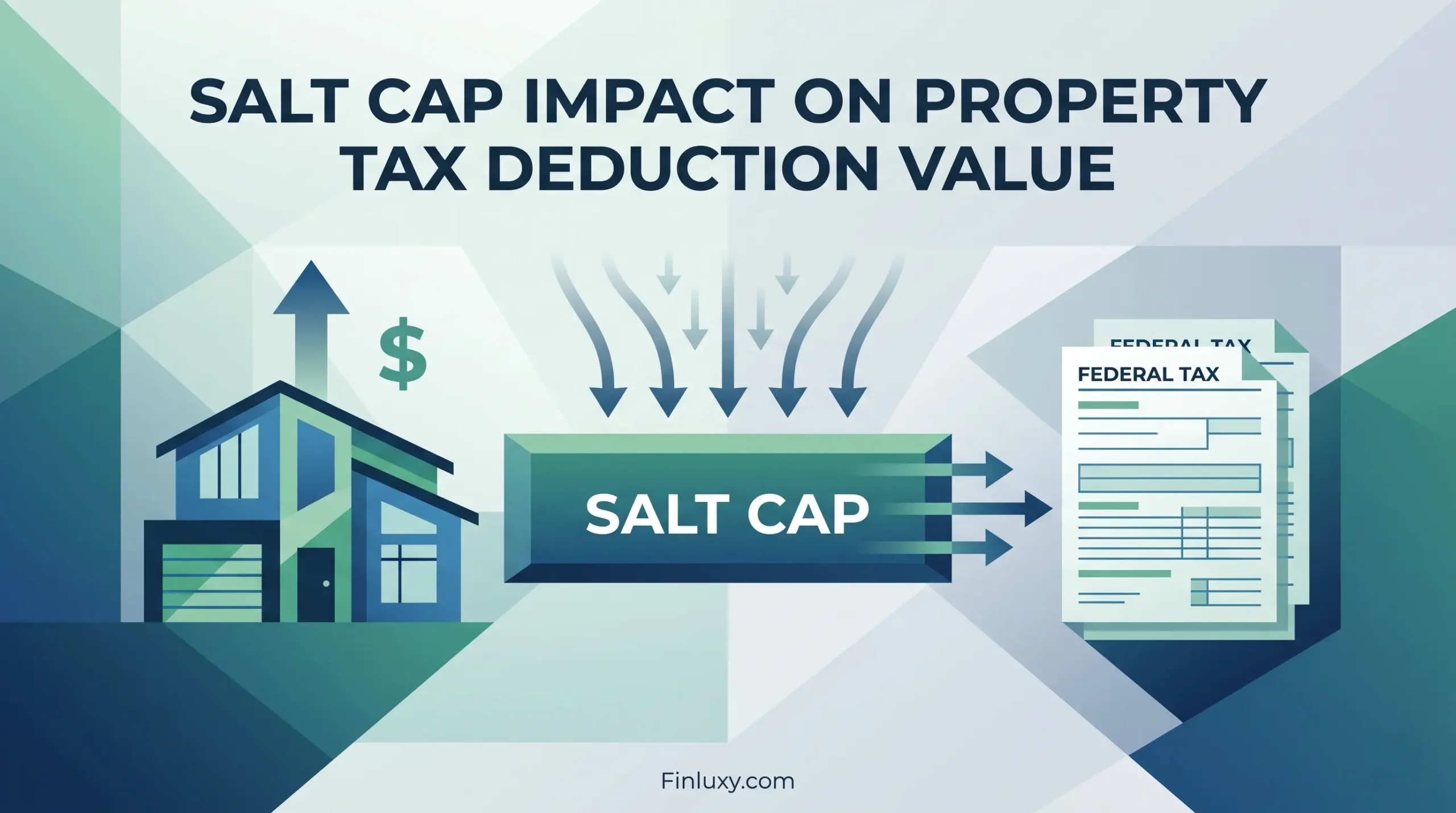
A married New Jersey household with a $900,000 home pays roughly $20,000 a year in property tax. Before July 2025, exactly $10,000 of that was deductible on a federal return — half the bill, gone for federal purposes. The One Big Beautiful Bill Act changed the arithmetic: the property tax deduction cap quadrupled to $40,000 for 2025, then nudged to $40,400 for 2026. For high-property-tax homeowners under the income phaseout, the deductible share of that same $20,000 bill jumped from 50 percent to 100 percent overnight.
That single change resets every calculation in this cluster. The figure most coverage still repeats — the $10,000 SALT cap — is now wrong for the majority of $150k+ itemizers, and right again only for those above roughly $606,000 of modified adjusted gross income. The gap between those two groups is where the real money sits.
Scope: This analysis covers the federal deductibility of property taxes under the state and local tax (SALT) deduction as modified by the One Big Beautiful Bill Act (OBBBA, Pub. L. 119-21), signed July 4, 2025, for tax years 2025 through 2029. SALT cap and phaseout figures are from the enacted statute and IRS guidance; effective property tax rates are from Tax Foundation (2025 release, 2023 American Community Survey data) and the Lincoln Institute of Land Policy. The SALT deduction covers property tax plus either state income tax or state sales tax — not both — so the marginal deductibility of property tax depends on what else fills the cap. This is cost analysis, not tax or financial advice; phaseout interactions with the alternative minimum tax and state conformity are noted but not modeled in full. Figures reflect data available at publication in June 2026.
The Numbers That Changed
| Figure | Value |
|---|---|
| SALT deduction cap, 2025 | $40,000 ($20,000 married filing separately) |
| SALT deduction cap, 2026 | $40,400 ($20,200 married filing separately) |
| MAGI phaseout threshold, 2026 | $505,000 ($252,500 married filing separately) |
| MAGI where cap returns to $10,000, 2026 | ≈ $606,333 |
| Cap upon 2030 sunset (absent new law) | $10,000 ($5,000 married filing separately) |
Source: One Big Beautiful Bill Act (Pub. L. 119-21), enacted July 4, 2025; IRC §164; analysis per Tax Foundation and The Tax Adviser, 2026. Cap increases 1% annually for 2027–2029.
How the Cap Actually Works Now
The structure has three moving parts, and most summaries describe only the first. The headline cap is $40,000 for 2025 and $40,400 for 2026, indexed up 1 percent per year through 2029, after which it reverts to $10,000 unless Congress extends it. That part is simple.
Phaseout is where it gets sharp. For modified adjusted gross income above $500,000 in 2025 — $505,000 in 2026 — the elevated cap drops by 30 cents for every dollar of excess MAGI. The reduction stops at the original $10,000 floor; it never goes lower. Because the increased portion of the cap is $30,400 ($40,400 minus the $10,000 floor), a 30 percent clawback fully exhausts the benefit after about $101,333 of excess income. In 2026 terms, a household crosses back to the old $10,000 cap at roughly $606,333 of MAGI, per analysis from TS CPA and The Tax Adviser.
The third part is the composition rule, and it constrains property owners specifically. SALT includes property tax plus either state and local income tax or state and local sales tax — never both. In a high-income-tax state, state income tax alone can fill or exceed the cap before a single dollar of property tax counts. The marginal deductibility of property tax in that situation is zero, cap increase or not.
The Marginal Value of a Property Tax Dollar
Whether the cap increase helps a given household depends entirely on how much room is left after state income tax. Consider three profiles, each itemizing, each under the phaseout threshold, each in the 35 percent federal marginal bracket for tax year 2026.
| Household profile | State income tax | Property tax | Deductible property tax | Federal value at 35% |
|---|---|---|---|---|
| High-property, no-income-tax state (e.g., Texas) | $0 | $22,000 | $22,000 | $7,700 |
| High-property, high-income-tax state (e.g., New Jersey) | $28,000 | $20,000 | $12,400 | $4,340 |
| Moderate-property, high-income-tax state (e.g., California) | $45,000 | $9,000 | $0 | $0 |
Illustrative model by Finluxy using the OBBBA 2026 cap of $40,400 and a 35% federal marginal rate. State income tax figures are representative, not household-specific. Property tax deductibility is the cap minus state income tax already claimed, floored at zero.
The Texas household captures the full benefit because no state income tax competes for cap space — all $22,000 of property tax fits under $40,400, and the prior $10,000 ceiling would have stranded $12,000 of it. The New Jersey household captures part of it: $28,000 of state income tax leaves only $12,400 of room, so property tax above that line is federally worthless. The California household captures none — state income tax alone blows past $40,400, and property tax never enters the calculation. Same statute, three different outcomes, driven by state tax mix rather than property tax level.
This is the detail that comparing New Jersey and Texas property tax makes concrete: the no-income-tax state, often framed as the high-property-tax villain, is now the cleaner federal beneficiary of the cap increase.
Finluxy Property Tax Burden Index
The Finluxy Property Tax Burden Index expresses a market’s effective property tax rate as a multiple of the US national median of 1.08 percent (Lincoln Institute / Tax Foundation). An index of 1.0 sits at the national median; above 1.5 marks a high-tax market; below 0.5 marks a low-tax market. The point here is that the SALT cap interacts with this index in a non-obvious way — high-index markets that are also high-income-tax states see the smallest federal relief, because income tax eats the cap first.
| State | Effective tax rate | Finluxy Property Tax Burden Index | State income tax? |
|---|---|---|---|
| New Jersey | 2.23% | 2.06× | Yes (high) |
| Illinois | 2.07% | 1.92× | Yes (flat) |
| Connecticut | 1.92% | 1.78× | Yes (high) |
| Texas | 1.58% | 1.46× | No |
| National median | 1.08% | 1.00× | — |
Effective tax rates: Tax Foundation, 2025 release (2023 American Community Survey, owner-occupied homes). Index denominator: 1.08% national median per Lincoln Institute / Tax Foundation, as defined in Finluxy methodology. Index = state effective rate ÷ 1.08%.
New Jersey posts the highest index at 2.06×, but its high state income tax means most NJ itemizers fill the cap on income tax before property tax matters — limited federal upside from the increase. Texas, at 1.46×, has no competing state income tax, so its high property tax bills now deduct in full up to the cap. The index measures local burden; it does not, on its own, predict federal relief. That requires layering the state income tax picture on top, which is why the ranking of highest property tax states tells only half the federal story.
What Most Coverage Misses
The dominant framing treats the cap increase as relief for high-tax blue states — New Jersey, New York, California, Connecticut. The data points the other way for the property tax line specifically. Households in those states tend to carry large state income tax bills that consume the cap before property tax is counted, so the marginal property tax dollar stays non-deductible even at $40,400. The clearest property tax winners are high-property, no-income-tax states — Texas, plus New Hampshire, which leans on property tax in lieu of broad income or sales taxes.
There’s a second overlooked effect: the phaseout creates a narrow band where each additional dollar of income is brutally expensive. Between $505,000 and roughly $606,333 of MAGI in 2026, the cap shrinks by 30 cents per dollar earned, on top of ordinary marginal tax on that same dollar. Tax practitioners have started calling it the “SALT torpedo.” For a $150k+ household nowhere near $500,000, it’s irrelevant. For the slice of this audience clearing half a million, it’s the single most consequential interaction in the whole provision — and it rarely appears in property-tax-focused coverage at all.
Why Assessment Appeals Matter More Below the Cap, Less Above It
Lower the federal cushion and the value of a correct assessment rises. When property tax was capped at $10,000 federally, a homeowner already over that line in deductions got no federal benefit from trimming an over-assessment — the savings were purely at the state and local level. Under the $40,400 cap, more of each property tax dollar is federally deductible for households with room left, which slightly softens the after-tax sting of an inflated assessment.
The mechanics of appealing a property tax assessment don’t change, but the after-tax math does. Take a home over-assessed by $100,000 in a 2.0 percent effective-rate market: that’s $2,000 of excess annual tax. If those dollars sit under the SALT cap and the household is in a 35 percent bracket, a successful appeal saves $2,000 gross but only about $1,300 net of the lost federal deduction. Above the cap, the appeal saves the full $2,000 — the deduction was already worthless. Knowing which side of the cap a household sits on changes the true value of the appeal. Establishing the gap between market value and assessed value remains the first step regardless.
Four Households, Same Statute
The cap’s effect splits cleanly by two variables: state income tax level and MAGI relative to the phaseout. The table maps the combinations for tax year 2026.
| Scenario | MAGI | State income tax | Effective property tax cap available | Property tax relief vs. old $10k cap |
|---|---|---|---|---|
| Texas professional | $300,000 | $0 | $40,400 | Large — up to $30,400 more deductible |
| New Jersey professional | $300,000 | $28,000 | $40,400 (but $28k filled by income tax) | Moderate — $12,400 room for property tax |
| California executive | $560,000 | $45,000+ | ≈ $24,000 after phaseout | Minimal — income tax exceeds reduced cap |
| High earner, any state | $650,000 | varies | $10,000 (fully phased out) | None — back to TCJA cap |
Finluxy scenario model using OBBBA 2026 parameters: $40,400 cap, $505,000 phaseout threshold, 30% reduction rate, $10,000 floor reached near $606,333 MAGI. State income tax figures illustrative. Phaseout cap for the $560,000 case: $40,400 − 30% × ($560,000 − $505,000) = $40,400 − $16,500 = $23,900.
The pattern: the cap increase is most valuable to high-property-tax owners in low-income-tax states with MAGI below $500,000, and least valuable to high earners and to residents of high-income-tax states. For owners of property tax on $2M+ homes, the bills routinely exceed $40,400 on their own, so the cap binds regardless of state mix — the marginal property tax dollar above the cap is non-deductible no matter what.
Methodology
SALT cap, phaseout thresholds, and sunset figures were verified against the enacted One Big Beautiful Bill Act (Pub. L. 119-21, signed July 4, 2025) and IRC §164, cross-checked with practitioner analysis from The Tax Adviser, Thomson Reuters, and Venable LLP published in late 2025 and early 2026. I prioritized the statute and IRS-aligned sources over secondary summaries because the brief’s starting figure — a $10,000 cap labeled 2024 — was superseded by the 2025 legislation; that figure was updated to the enacted $40,000 (2025) and $40,400 (2026) values.
Effective property tax rates are from the Tax Foundation’s 2025 release, built on 2023 American Community Survey data for owner-occupied housing, the most recent state-level comparison available. The Finluxy Property Tax Burden Index uses a fixed 1.08 percent national-median denominator per Lincoln Institute / Tax Foundation, as specified in the cluster methodology; readers should note that aggregate-ratio methods (dividing total taxes by total value) produce somewhat lower state figures than the median-based ACS method used here, so index values are comparable within this dataset but not across methodologies. Federal-value calculations assume itemization and apply a representative 35 percent marginal rate; actual results depend on bracket, filing status, AMT exposure, and state conformity. Where household-specific figures were unavailable, I modeled representative profiles and labeled them as illustrative rather than presenting point estimates as observed data.
What This Means for a $150k+ Household
For most $150k+ households below $500,000 of MAGI, the cap increase is a real, if uneven, gain. The decision it should prompt is whether to itemize at all: with the 2026 standard deduction at $32,200 for joint filers, a household needs SALT plus other itemized deductions to clear that bar before any of this matters. A New Jersey or Texas family with a five-figure property tax bill now likely clears it comfortably; a moderate-property-tax household in a low-income-tax state may still land on the standard deduction.
The trade-offs sharpen near the top of this income band. A household approaching $500,000 of MAGI should treat the phaseout as a planning constraint, not a footnote — deferring income, timing capital gains, or maximizing pre-tax retirement contributions can keep the full $40,400 cap intact, and the value of doing so is highest precisely in the $505,000-to-$606,333 torpedo zone. For owners weighing a move between states, the cap reframes the math: a no-income-tax state with high property taxes may now deliver better federal treatment of those property taxes than a high-income-tax state with lower ones, the reverse of the pre-2025 assumption. And for anyone planning beyond 2029, the $10,000 cap is scheduled to return in 2030 absent new legislation — so strategies built on the elevated cap carry an expiration date that belongs in any multi-year homeownership-cost projection, alongside an honest read of how much of the benefit a given household’s income and state actually capture.
Frequently Asked Questions
Is the SALT cap still $10,000?
No, not for most filers. The One Big Beautiful Bill Act raised it to $40,000 for 2025 and $40,400 for 2026, indexed up 1% annually through 2029. It reverts to $10,000 in 2030 unless Congress acts. The $10,000 figure still applies to filers whose modified adjusted gross income exceeds roughly $606,333 in 2026, because the increased cap phases out above $505,000.
Can I deduct all my property tax now?
Only up to the cap, and only the room left after state income tax. SALT includes property tax plus either state income tax or sales tax — not both. In a high-income-tax state, income tax can fill the entire $40,400 before property tax counts, leaving the marginal property tax dollar non-deductible. In a no-income-tax state like Texas, property tax up to $40,400 is fully deductible.
What is the SALT phaseout, and does it affect me?
For 2026, the $40,400 cap shrinks by 30 cents per dollar of modified adjusted gross income above $505,000, reaching the $10,000 floor near $606,333. Below $505,000, you get the full cap. Households between $505,000 and roughly $606,333 face an unusually high effective tax cost on each added dollar of income, sometimes called the SALT torpedo.
Does the bigger cap make a property tax appeal less valuable?
For households with cap room remaining, slightly — more of each property tax dollar is now federally deductible, so the net savings from correcting an over-assessment shrink after accounting for the lost deduction. For households already over the cap, the appeal still saves the full amount, because those dollars were never deductible. The state and local savings from a successful appeal apply either way.
Sources & References
- One Big Beautiful Bill Act (Pub. L. 119-21) — enacted statute, July 4, 2025
- Tax Foundation — Property Taxes by State and County, effective tax rate data
- Lincoln Institute of Land Policy — 50-State Property Tax Comparison Study
- The Tax Adviser — SALT cap, phaseout, and inflation indexing mechanics
- Thomson Reuters — SALT deduction overview, 2026 cap and threshold figures
- Venable LLP — OBBBA SALT cap and AMT phaseout analysis
- TS CPA — 2026 SALT cap phaseout math and floor calculation