 Analysis by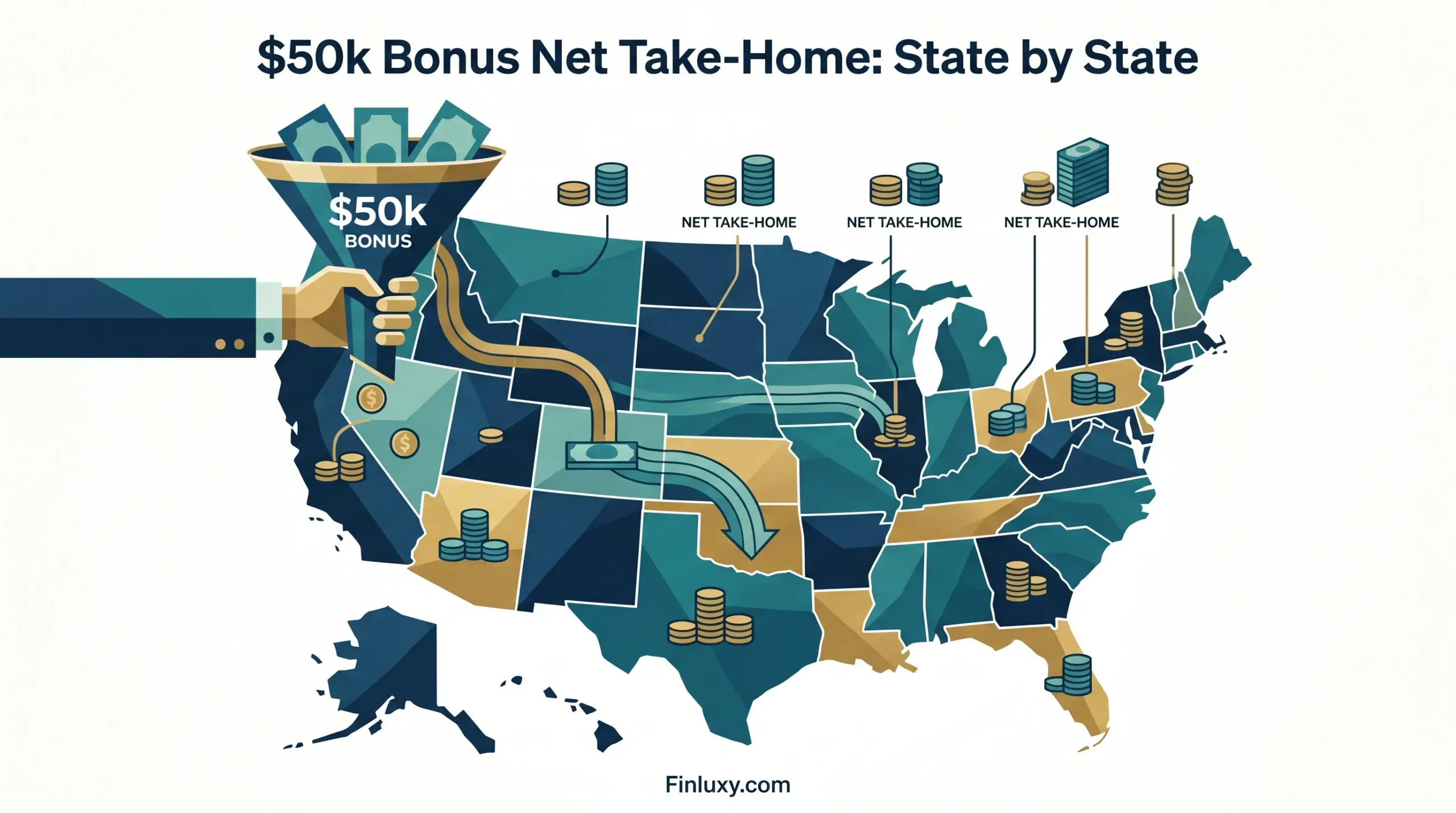
A $50,000 bonus does not net $50,000 anywhere in the United States. For a single filer already earning $200,000 in 2026, the same $50,000 bonus yields roughly $32,275 in take-home pay in Texas and about $27,625 in California — a $4,650 spread driven entirely by state residency, with no difference in federal treatment whatsoever. The 22% your employer withholds at payout is not the number that matters. What matters is the marginal stack: federal bracket, state bracket, and the Medicare components that survive past the Social Security wage base.
This analysis models the bonus where the incremental dollars actually land — not at headline top rates that only apply above $1 million. The supplemental wage withholding you see on the pay stub is a placeholder. The real figure is settled at filing, and for most $150k+ earners the bonus is taxed at a rate well above 22% once every layer is counted.
Scope: This article models a $50,000 bonus paid to a single filer with $200,000 in prior-base wages, using 2026 federal brackets (IRS Revenue Procedure 2025-32) and 2026 state top-of-stack marginal rates (Tax Foundation, February 2026). Figures are marginal-rate estimates on incremental income, not full-return calculations — they exclude itemized deductions, credits, retirement deferrals, local city taxes (NYC and Yonkers add up to 3.876%), and the aggregate withholding method. Married-filing-jointly households will face different bracket thresholds; the relative state-to-state spread holds, but absolute net amounts shift. This is data analysis, not tax or financial advice.
The numbers at a glance
Five figures define the entire question. Here is the summary block for a $50,000 bonus on top of $200,000 in base wages, single filer, 2026.
| Figure | Amount / Rate |
|---|---|
| Supplemental wage withholding at payout | 22% ($11,000) |
| Federal marginal rate on the bonus | 32% |
| Medicare + Additional Medicare on the bonus | 2.35% |
| Net take-home — no-income-tax state (e.g., Texas) | $32,825 |
| Net take-home — California | $27,975 |
Source: IRS Revenue Procedure 2025-32 (federal brackets); IRS Publication 15, 2026 (supplemental withholding, FICA); Tax Foundation, “2026 State Income Tax Rates and Brackets,” February 2026. Net figures are marginal estimates on incremental income.
The gap between the 22% withheld and the 32% federal marginal rate is the trap. At $200,000 of prior income, a single filer is already inside the 24% federal bracket, and the $50,000 bonus pushes the top of that stack into the 32% bracket, which begins at $197,300 of taxable income for single filers under the 2026 schedule. Withholding at 22% leaves a shortfall that surfaces in April — the mechanics of which are covered in detail in this breakdown of bonus withholding versus actual tax.
How the federal layer actually stacks
Start with the federal brackets, because they are identical in all 50 states. The One Big Beautiful Bill Act (Public Law 119-21, signed July 2025) made the seven-rate TCJA structure permanent, so 2026 retains the 10/12/22/24/32/35/37 schedule. In 2026 the 37 percent top rate applies to taxable income above $640,600 for single filers and above $768,600 for married couples filing jointly, per the Tax Foundation’s reading of Revenue Procedure 2025-32. Nobody with a $200k salary and a $50k bonus is anywhere near that.
Where they are: the 32% bracket. A single filer’s 2026 taxable income, after the $16,100 standard deduction, sits around $183,900 before the bonus — inside the 24% bracket, which runs to $197,300. The bonus carries roughly $13,400 of income up through the remainder of the 24% bracket and the remaining ~$36,600 into the 32% bracket. Blended, the federal marginal rate on the bonus is approximately 30%, and the top dollars are taxed at 32%. For modeling simplicity and because the bulk of the bonus lands there, this analysis uses 32% as the federal marginal rate on the incremental income.
Now the payroll taxes. The 2026 Social Security wage base is $184,500, per IRS Publication 15. A $200,000 earner has already crossed it before the bonus is paid, so the bonus escapes the 6.2% Social Security tax entirely. What remains is Medicare at 1.45% with no wage cap, plus the 0.9% Additional Medicare Tax that applies to wages above $200,000. Both apply to the full bonus. That is 2.35% of FICA-equivalent drag — small, but real, and frequently omitted from back-of-envelope bonus math. The interaction between the wage base and high salaries is the single most overlooked variable in bonus planning; for the full treatment see this bonus tax guide for high earners.
| Component | Rate | Amount |
|---|---|---|
| Federal marginal income tax | 32% | $16,000 |
| Medicare | 1.45% | $725 |
| Additional Medicare Tax | 0.90% | $450 |
| Social Security | 0% (above $184,500 wage base) | $0 |
| Total federal drag | 34.35% | $17,175 |
Source: IRS Publication 15 (Circular E), 2026; IRS Revenue Procedure 2025-32. Social Security wage base $184,500; Additional Medicare threshold $200,000 (not inflation-indexed).
Before a single dollar of state tax, the federal layer alone takes $17,175 of the $50,000 — leaving $32,825 in a no-income-tax state. That is the ceiling. Every state with an income tax pulls the net down from there.
State by state: where the bonus lands
Nine states levy no individual income tax on wages. California has the highest top marginal income tax rate at 13.3%, followed by Hawaii at 11.0% and New York at 10.9%, while nine states levy no income tax including Texas, Florida, and Washington, according to Tax Foundation 2026 data. But the headline 13.3% is a decoy for this analysis. California’s 13.3% rate only applies on income above $1 million for single filers — a $250,000 total-income household never touches it.
The rate that matters is the marginal rate at the income level where the bonus actually sits. For a single filer crossing from $200,000 to $250,000, the relevant California bracket is 9.3% (the bracket spanning roughly $73,000 to $375,000 of taxable income), not 12.3% and certainly not 13.3%. In New York, the bonus lands in the 6.85% bracket, which begins around $215,400 for single filers. Using top-of-stack rates instead of headline rates changes the net by thousands of dollars and is the most common error in bonus coverage.
| State | State marginal rate on bonus | Federal + Medicare drag | State tax | Net take-home |
|---|---|---|---|---|
| Texas / Florida / Washington (no income tax) | 0% | $17,175 | $0 | $32,825 |
| Pennsylvania | 3.07% | $17,175 | $1,535 | $31,290 |
| Illinois | 4.95% | $17,175 | $2,475 | $30,350 |
| Georgia | 5.19% | $17,175 | $2,595 | $30,230 |
| New York (excl. NYC) | 6.85% | $17,175 | $3,425 | $29,400 |
| New Jersey | 6.37% | $17,175 | $3,185 | $29,640 |
| California | 9.3% | $17,175 | $4,650 | $28,175 |
Source: Tax Foundation, “2026 State Income Tax Rates and Brackets,” February 2026; IRS Publication 15 and Revenue Procedure 2025-32. State tax = marginal rate × $50,000 bonus. Net = $50,000 − federal/Medicare drag − state tax. Excludes local taxes; New York City residents add up to 3.876%, lowering NY net by roughly $1,900.
The spread from Texas to California is $4,650 on a single bonus. Stretch that across a career of annual bonuses and the state line becomes a six-figure decision. A New York City resident fares worse still: layering the 3.078%–3.876% city tax on top of the state’s 6.85% pushes the combined marginal rate past 10%, and the net take-home below $27,500. The contrast between the all-in burden in a $100k bonus federal and state breakdown shows how the gap widens as the bonus grows and more of it climbs into the 35% federal bracket.
The Finluxy Windfall Net Rate
One number captures all of this: how many cents of each bonus dollar you keep. The Finluxy Windfall Net Rate is the net after-tax amount divided by the gross bonus, expressed as a percentage. It folds federal marginal rate, state rate, and surviving FICA into a single figure you can compare across states at a glance.
| State | Net take-home | Finluxy Windfall Net Rate |
|---|---|---|
| Texas / Florida / Washington | $32,825 | 65.7% |
| Pennsylvania | $31,290 | 62.6% |
| Illinois | $30,350 | 60.7% |
| Georgia | $30,230 | 60.5% |
| New Jersey | $29,640 | 59.3% |
| New York (excl. NYC) | $29,400 | 58.8% |
| California | $28,175 | 56.4% |
Finluxy Windfall Net Rate = net take-home ÷ $50,000 gross × 100. Inputs per IRS Publication 15 (2026), Revenue Procedure 2025-32, and Tax Foundation 2026 state data.
Read it this way: in California, a single filer keeps 56 cents of each bonus dollar at this income level; in Texas, nearly 66 cents. The net rate sits below the often-cited 78% (100% minus the 22% withholding) in every state, because withholding never reflected the true marginal burden in the first place. That divergence is the entire point — and it widens, not narrows, as income rises.
What most coverage misses
Standard bonus articles fixate on the 22% withholding and the 13.3% California headline. Both are misleading at the $150k+ level, but the more interesting omission is the Social Security wage base interaction. Because the 2026 wage base is $184,500, a $200,000 earner’s bonus skips the 6.2% Social Security tax entirely — a roughly $3,100 saving on a $50,000 bonus that a lower earner would not get. The same $50,000 bonus paid to someone earning $120,000 incurs the full 6.2% on most of it, because that worker has not yet hit the wage base.
The counterintuitive result: the high earner keeps a larger share of the bonus on the FICA dimension specifically, even as the income-tax dimension takes more. Most coverage treats the bonus as uniformly worse for high earners. The data shows it is mixed — the federal income bracket bites harder, but the payroll-tax escape partially offsets it. That offset is invisible unless you model the wage base explicitly, which is why it almost never appears in general-audience bonus content.
What the $150k+ household should do with this
Three thresholds drive the decisions here. The first is withholding adequacy. At a 32% federal marginal rate against 22% withheld, a $50,000 bonus under-withholds federal tax by roughly $5,000 — money owed at filing. If that shortfall, combined with any other under-withholding, pushes the total balance due past $1,000, quarterly estimated payment obligations may apply. The safe harbor for AGI above $150,000 is paying 110% of the prior year’s total tax; meeting it avoids the underpayment penalty regardless of how large the April bill turns out to be. The mechanics of timing those payments are detailed in this guide to estimated tax payments after a windfall, and the penalty-avoidance math is worked through in the safe harbor rule for windfall income.
The second threshold is timing. A bonus paid in December lands in the current tax year; the same bonus deferred to January shifts the liability a full year and may alter which bracket the top dollars hit if income differs between years. For households expecting a lower-income year ahead — a sabbatical, a business sale, retirement — the December versus January bonus timing math can be worth several thousand dollars. Where the employer permits it, deferred bonus structures extend the same logic across multiple years.
The third is relocation, and it is the largest lever of all. The $4,650 California-to-Texas spread on one bonus is trivial in isolation and substantial in aggregate. For a household receiving annual bonuses, equity vesting, or a one-time liquidity event, state residency is the highest-leverage variable available — larger than any deduction. A household weighing a move should run the full picture, because the bonus is only one income stream; the same rate differential applies to base salary, capital gains, and an RSU vest treated as a single-year windfall. The marginal-rate framework here generalizes directly to those events — only the character of the income changes, not the method.
Frequently asked questions
Why is only 22% withheld if my real rate is higher?
The 22% is the IRS optional flat rate for supplemental wage withholding under Publication 15, applied to bonuses under $1 million. It is a withholding convention, not your actual tax. Your real liability is settled at filing based on total annual income, and for a $150k+ earner it typically exceeds 22% federal — so the bonus under-withholds, producing a balance due in April.
Does the $50,000 bonus push me into California’s 13.3% rate?
No. California’s 13.3% top marginal rate applies only to income above $1 million for single filers. A household at $250,000 of total income lands in California’s 9.3% bracket, which is the rate this analysis uses for the bonus.
Why does a high earner skip Social Security tax on the bonus?
The 2026 Social Security wage base is $184,500. Once cumulative wages exceed that, no further Social Security tax (6.2%) is withheld for the year. A $200,000 base earner has already crossed it, so the bonus incurs only Medicare (1.45%) plus the Additional Medicare Tax (0.9%) above $200,000.
Will I owe an underpayment penalty on the bonus?
Possibly, if total under-withholding creates a balance due over $1,000 and you have not met a safe harbor. For AGI above $150,000, paying 110% of the prior year’s total tax through withholding and estimated payments avoids the penalty regardless of the final bill.
Methodology
Federal figures are drawn from IRS Revenue Procedure 2025-32 (2026 brackets and standard deduction) and IRS Publication 15 (Circular E), 2026 edition, for supplemental wage withholding, the Social Security wage base, and Medicare rates — both primary sources under the cluster’s data priority. State marginal rates come from the Tax Foundation’s “2026 State Income Tax Rates and Brackets” (February 2026), the secondary analytical source designated for marginal-rate analysis.
Each scenario fixes a single filer at $200,000 in prior-base wages and applies a $50,000 bonus as incremental income. The federal marginal rate on the bonus is taken as 32%, reflecting that the majority of the bonus crosses into the 32% bracket (which begins at $197,300 of 2026 taxable income for single filers) after the standard deduction; the blended rate across the 24% and 32% portions is approximately 30%, and 32% is used as a conservative top-of-stack figure. State tax is computed as the state’s marginal rate at this income level multiplied by the full bonus. The Finluxy Windfall Net Rate divides net take-home by the $50,000 gross. Local income taxes, itemized deductions, retirement deferrals, and the aggregate withholding method are excluded; where they apply, they shift absolute nets but preserve the state-to-state spread. I verified every rate against its primary or designated source before publication rather than relying on prior-year figures, because the OBBBA permanence provisions and 2026 inflation indexing changed several thresholds.
Sources & References
- IRS Publication 15 (Circular E), 2026 — supplemental wage withholding, Social Security wage base, Medicare rates
- IRS Revenue Procedure 2025-32 (via IRS newsroom) — 2026 federal brackets and standard deduction
- IRS Publication 505, 2026 — tax withholding and estimated tax
- Tax Foundation — 2026 State Income Tax Rates and Brackets
- Tax Foundation — 2026 Federal Tax Brackets analysis