 Analysis by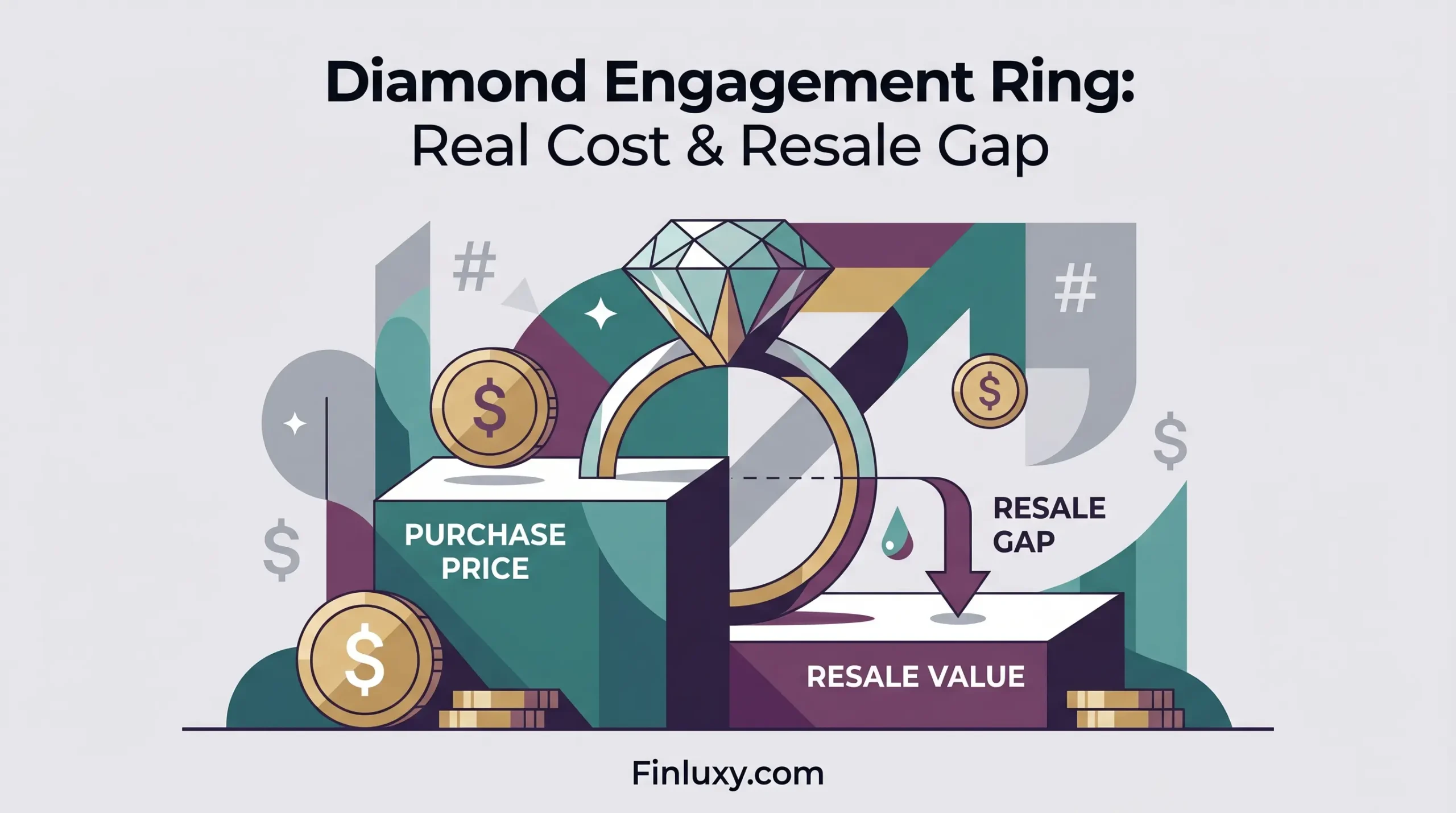
A natural diamond engagement ring that retails near $10,760 returns roughly $2,000 to $5,000 the day its owner tries to sell it. That gap — not the sticker price — is the real cost of the object, and almost no one calculates it before buying.
The Knot’s 2025 Real Weddings Study puts the average natural diamond engagement ring at $10,760 and the average lab-grown ring at $5,188. BriteCo, an insurer that tracks actual insured values rather than survey recall, reports a blended 2025 average of $6,504 across all stone types. Both figures describe what buyers pay. Neither describes what the ring is worth thirty seconds after purchase, which is the number this analysis is built around.
Scope: This is a cost analysis of diamond engagement rings sold in the US retail market, using 2024–2025 data from The Knot, BriteCo, Rapaport, and secondary-market buyers. Resale figures reflect what professional buyers and consignment channels actually pay, which varies by stone quality, certification, and sales channel — a GIA-certified 2-carat stone behaves differently than a generic 0.5-carat one. Diamonds are not a regulated asset class; there is no exchange, no daily settlement price, and no guaranteed bid. Figures here describe central tendencies, not guarantees for any individual stone. This is data analysis, not financial or purchasing advice.
The numbers that matter
| Metric | Figure |
|---|---|
| Average natural diamond ring (retail price) | $10,760 |
| Average lab-grown diamond ring (retail price) | $5,188 |
| Typical secondary market value (% of retail price) | 20%–50% |
| Natural 1-carat price decline, 2022 peak to 2024 | 26% |
| Lab-grown price decline since 2020 | 74% |
Sources: The Knot 2025 Real Weddings Study (retail averages); diamonds.pro / industry resale buyer data (secondary market range); accio.com citing market data and deVere Group (natural and lab-grown declines), 2024–2026.
What you actually pay for
Retail price on a diamond ring is not a measure of the stone. It is a stack of margins. A brick-and-mortar jeweler typically applies a markup of 100% to 200% over wholesale, per FTC-referenced industry data; online retailers operate closer to 18%. The center stone, the metal, the setting labor, the brand premium, and the showroom overhead all sit inside one number, and only two of those components — the diamond and the precious metal — have any meaningful resale floor.
Break a representative $10,760 natural diamond ring into parts and the structure becomes clear. The center stone carries most of the value but resells at wholesale, not retail. The setting — gold or platinum plus labor — resells at scrap metal value for the metal and effectively zero for the labor. Brand premium evaporates entirely on resale, which is why understanding Van Cleef Arpels resale value follows the same logic as any branded jewelry: the name adds to retail and subtracts nothing back.
| Component | Share of retail price | Resale recovery |
|---|---|---|
| Center diamond (wholesale value) | ~55%–65% | Wholesale, not retail |
| Metal setting (gold/platinum) | ~10%–15% | Scrap/melt value |
| Setting labor & design | ~10% | Near zero |
| Retail markup & brand premium | ~20%–30% | Zero |
Component shares are illustrative estimates synthesized from diamonds.pro and FTC-referenced markup data, 2025–2026. Exact splits vary by retailer and stone.
The recovery column is the whole story. Of the four components, one resells below the price paid, two resell at a fraction, and one resells at nothing. That arithmetic produces the 20%–50% recovery range that buyers and consignment channels consistently report.
The resale gap, quantified
Where does the 20%–50% range come from? Multiple independent buyers converge on it. The guide published by diamonds.pro, run by operators with wholesale and retail experience, documents a Tiffany & Co. ring that cost $4,500 at retail and drew a best offer of $1,850 — about 41% of original cost, and that was the strongest of several quotes. Sell Engagement Ring guides from professional buyers cite the same 20%–50% band. A Harvard Business School resale study referenced across the industry places typical recovery at 30%–50% of retail.
Channel choice moves the number within that band but never out of it. A quick sale to a buyer lands near the bottom; a patient direct sale to an end consumer can reach the top. The setting almost never recovers, so the diamond carries the recovery alone. This is the same separation-of-value problem collectors face when they learn how to read the watch secondary market — the branded object and its liquid component are two different assets, and only one of them has a bid.
| Ring type (retail price) | Recovery at 20% | Recovery at 35% | Recovery at 50% |
|---|---|---|---|
| Natural diamond ($10,760) | $2,152 (−$8,608) | $3,766 (−$6,994) | $5,380 (−$5,380) |
| Lab-grown diamond ($5,188) | $1,038 (−$4,150) | $1,816 (−$3,372) | $2,594 (−$2,594) |
Recovery scenarios applied to The Knot 2025 Real Weddings Study average retail prices. Lab-grown stones typically recover at the lower end of the percentage range despite smaller absolute losses (Labrilliante, 2025).
One counterintuitive note on lab-grown stones. They tend to recover a worse percentage of retail than natural stones — often 20%–40% — but because their retail prices are so much lower, the absolute dollar loss is smaller. Labrilliante’s 2025 data documents a 2-carat lab-grown stone bought for $2,400 that resold for $960, exactly 40% recovery and a $1,440 loss. The percentage is grim; the dollar figure is survivable. That distinction matters more than the headline percentage, and the gap between lab and natural keeps widening — a dynamic covered in the lab diamond vs natural cost comparison.
Finluxy Watch Value Retention Score
The Finluxy Watch Value Retention Score divides secondary market value by original retail price and multiplies by 100. A score above 100 means the asset appreciated; below 100 means it depreciated. The metric was built for watches, where some references genuinely cross 100 — but applied to diamond rings, it exposes exactly how far the category sits from being an investment.
| Subject | Retail price | Secondary market value | Finluxy Watch Value Retention Score |
|---|---|---|---|
| Natural diamond ring (50% recovery, best case) | $10,760 | $5,380 | 50.0 |
| Natural diamond ring (35% recovery, typical) | $10,760 | $3,766 | 35.0 |
| Lab-grown diamond ring (35% recovery) | $5,188 | $1,816 | 35.0 |
| Rolex Submariner Date (reference, 2020–2025) | $10,550 | $14,200 | 134.6 |
Score = (secondary market value ÷ retail price) × 100. Ring inputs from The Knot 2025 averages and industry resale ranges. Rolex Submariner reference from Chrono24 sold data, 2020–2025.
The contrast is the point. A mainstream steel sport watch scored 134.6 over five years. A diamond engagement ring, in its best realistic scenario, scores 50.0 — and typically lands at 35.0. No diamond engagement ring at average specifications produces a score near 100. The category is consumption priced like an asset. For readers weighing genuine appreciation candidates, the do luxury watches appreciate data answer offers the comparison set diamonds fail.
The floor is moving down
Resale percentages would be the whole story if retail prices held steady. They are not holding steady. The natural diamond market has been in a structural decline that makes the recovery math worse in real time.
The average price of a one-carat natural diamond fell from $6,819 in May 2022 to $4,997 by December 2024 — a 26% drop, according to market data aggregated by accio.com. Rapaport’s RapNet Diamond Index for 1-carat stones fell 23% across 2024 alone, then slid another 2.6% in November 2025. De Beers, the historical price-setter, saw its effective rough price index fall 25% year over year in 2025 once stock-rebalancing discounts are included, per Rapaport, and the company cut production 12% to 21.7 million carats trying to defend prices. Anglo American absorbed $6.8 billion in De Beers writedowns over three years.
Lab-grown stones fell far harder — down 74% since 2020, per deVere Group and corroborating market data — because supply is effectively unlimited. A buyer purchasing today buys into a falling market, which means the resale value five years out is measured against a retail benchmark that itself keeps dropping. The recovery percentage and the price base are sinking together.
What most coverage misses
Nearly every article on engagement ring resale frames the loss as a percentage of retail and stops there. The percentage hides the more useful figure: the loss is concentrated almost entirely in the parts of the ring that are not the diamond.
Run the component table against the recovery data and a specific conclusion emerges. On a $10,760 natural ring, the roughly $3,200 of setting labor, retail markup, and brand premium is gone the moment the transaction clears — that portion recovers at or near zero regardless of channel, patience, or stone quality. The diamond itself, if GIA-certified and desirable, recovers at wholesale, which is a real and defensible number. So the “diamonds lose half their value” framing is misleading in both directions: the stone holds more than half suggests, and the surrounding ring holds far less. A buyer who spends $4,000 on the setting and brand and $6,760 on the stone has a fundamentally different resale profile than one who spends $1,500 on the setting and $9,260 on the stone, even at identical total retail. Almost no coverage separates these, and it is the single most actionable distinction in the dataset.
What this means for a $150k+ household
At $150k+ in income, the engagement ring decision is rarely a budget constraint — it is an allocation choice, and the resale gap reframes it. A $10,760 natural diamond ring is not a $10,760 purchase that can be partly recovered later; it is functionally a $5,000–$8,600 consumption expense plus a stone with a soft wholesale bid. Treating it as an asset on the household balance sheet overstates net worth by the full size of the resale gap.
Three thresholds are worth setting before buying. First, decide the ring’s category honestly: if it is a meaningful object meant to be kept, resale value is irrelevant and the analysis stops — buy what carries meaning. If there is any expectation of liquidity, the math above applies in full. Second, if liquidity matters, weight spending toward a GIA-certified center stone and away from setting complexity and brand premium, because the stone is the only component with a bid; the certification cost pays for itself by widening the buyer pool. Third, insure on replacement value but plan around resale value — a common and expensive error, flagged in the fine jewelry insurance cost breakdown, is paying premiums on a 2022-peak appraisal while the actual market has dropped 25%–30%, which means over-insuring a depreciating asset.
For households genuinely seeking objects that hold or grow value, the diamond engagement ring is the wrong instrument and the data is unambiguous about it. A buyer drawn to durable luxury value would find more in understanding luxury watch ownership cost or the narrower question of the watch investment price threshold, where a defined subset of references actually clears a Value Retention Score above 100. The engagement ring is a purchase to make for what it means, with full knowledge that the resale market will offer back a third to a half, and that the rest was never going to come home.
Frequently asked questions
How much of an engagement ring’s retail price comes back on resale?
Typically 20% to 50% of the original retail price, with the exact figure driven by stone quality, certification, and sales channel. Quick sales to professional buyers land near the bottom of that range; patient direct-to-consumer sales can reach the top. The setting and brand premium recover little to nothing — the center diamond carries almost all of the recoverable value.
Do lab-grown diamonds resell better or worse than natural ones?
Worse as a percentage — often 20% to 40% of retail versus 20% to 50% for natural — but the absolute dollar loss is smaller because lab-grown retail prices are far lower. Lab-grown prices have fallen 74% since 2020 per deVere Group, and the resale market for them is thin, so they are best treated as consumption rather than any store of value.
Are natural diamond prices still falling in 2025?
Yes. The Rapaport 1-carat index fell 23% across 2024 and another 2.6% in November 2025. The average one-carat natural diamond dropped from $6,819 in May 2022 to $4,997 by December 2024. De Beers cut production 12% in 2025 to defend pricing, and its effective rough price index still fell 25% year over year including rebalancing discounts.
Should an engagement ring be insured at retail or resale value?
Insurance uses replacement value, which reflects retail cost to recreate an identical ring — higher than resale value by design. The risk in a falling market is over-insuring: paying premiums on a peak-era appraisal while the stone’s actual market value has dropped 25%–30%. Reappraising periodically keeps the coverage and the premium aligned with current market reality.
Methodology
Retail averages come from The Knot’s 2025 Real Weddings Study, cross-referenced against BriteCo’s 2025 insured-value data and The Knot’s 2024 Jewelry & Engagement Study, which differ because they sample different populations — survey recall versus insured policies — and are noted at their respective figures. Resale recovery ranges synthesize professional-buyer data from diamonds.pro, consignment-channel guides, and a referenced Harvard Business School resale study, all converging on the 20%–50% band. Price-trend figures draw from Rapaport press releases and the RapNet Diamond Index, De Beers’ own financial disclosures, and market aggregation via accio.com and deVere Group. Where sources conflicted, primary institutional data (Rapaport, De Beers) took priority over secondary aggregators, and ranges were reported rather than single points where the underlying data disagreed. The Finluxy Watch Value Retention Score was calculated as secondary market value divided by retail price times 100, applied to ring averages at multiple recovery scenarios and benchmarked against a documented Rolex Submariner reference. Component cost shares are illustrative estimates, labeled as such, since no single primary source publishes a standardized ring-component breakdown.
Sources & References
- The Knot — Average Engagement Ring Cost 2025, Real Weddings Study
- BriteCo — Average Engagement Ring Cost 2025 insured-value research
- Diamonds.pro — Diamond resale value guide and buyer-quote data
- Rapaport — RapNet Diamond Index press release, December 2025
- Rapaport — 1-carat RAPI down 23% in 2024 press release
- De Beers Group — Preliminary financial results for 2025
- Accio — Natural vs lab-grown diamond price trend analysis
- deVere Group — Why diamond prices are falling, 2022–2025 data
- Labrilliante — Lab diamond resale retention rate case data 2025
- PGS — Selling an engagement ring, resale value guide 2025