 Analysis by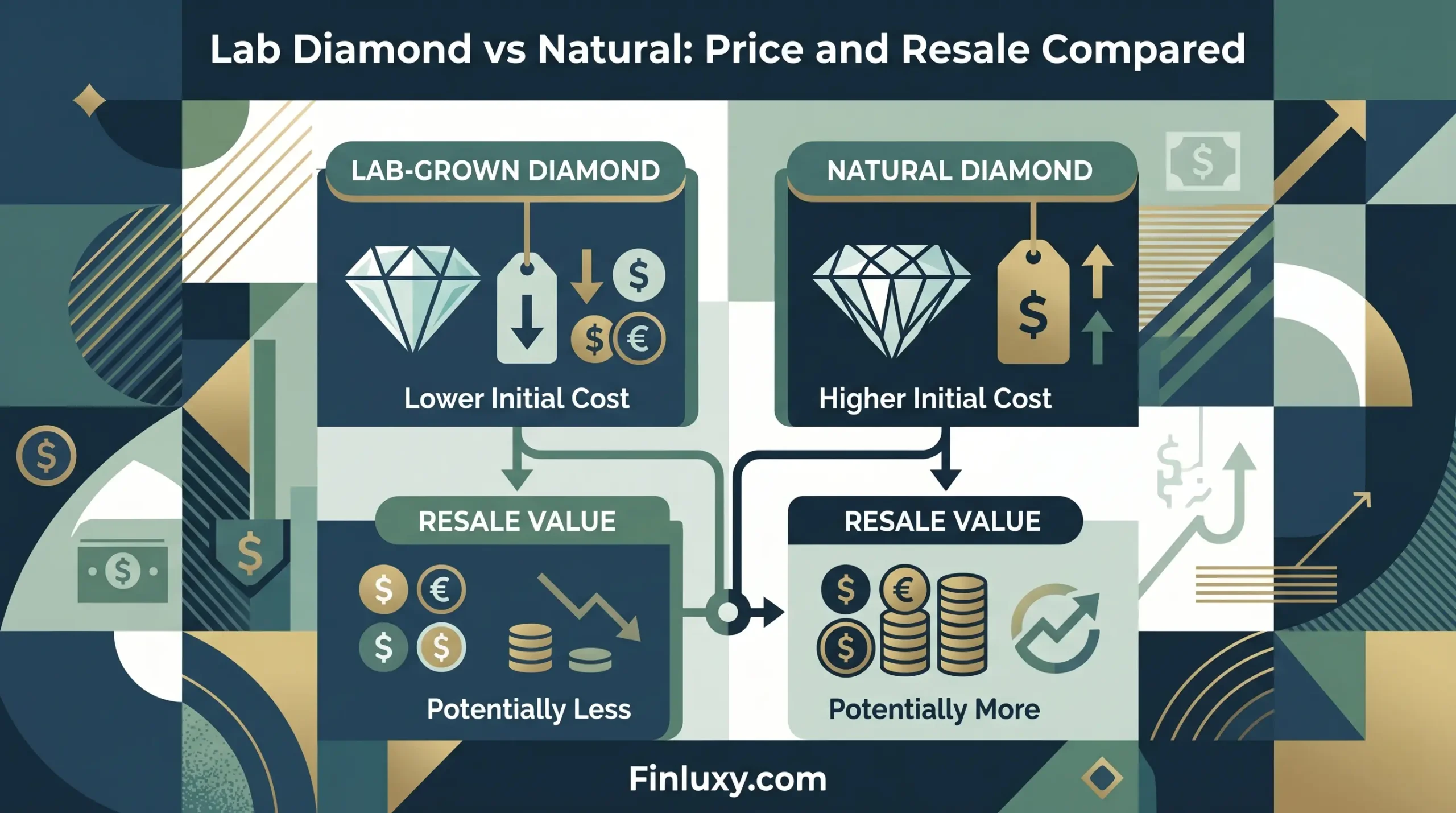
A 1-carat lab-grown diamond that fetched roughly $4,000 at retail a few years ago now resells for a fraction of that, and many jewelers will not buy it back at any price. diamond ring cost and resale gap data tells a similar story across the category: lab-grown stones typically recover 20–40% of purchase price on the secondary market, while natural diamonds hold closer to 25–50%, per Buchroeders Jewelers and GIA-cited figures from 2025–2026. The percentages look adjacent. The dollar outcomes are not — and that is where most coverage stops short.
This analysis treats the diamond as a financial asset with a defined ownership lifecycle, not a sentiment purchase. The question is narrow and answerable: per-carat acquisition cost, the secondary market value haircut, and what the spread means when you are spending discretionary income rather than stretching for a milestone purchase.
Scope: This is a cost and resale-value comparison for round, 1-carat-equivalent diamonds in the US market, drawing on wholesale and retail data from 2025 through Q2 2026. Figures vary by cut, color, clarity, and seller markup; the natural diamond market in particular has been in a multi-year price decline that complicates any “value retention” claim. Lab-grown wholesale pricing is volatile quarter to quarter, so per-carat figures here represent recent snapshots, not stable benchmarks. This is data analysis for informational purposes, not financial or investment advice. Diamonds — natural or lab-grown — are not liquid investment vehicles, and no figure here should be read as a return forecast.
The numbers that matter
Five figures frame the entire comparison. Everything downstream is interpretation.
| Metric | Lab-Grown | Natural |
|---|---|---|
| Average retail price, 1-carat round | ~$1,000 or less (2025) | ~$4,200 (2025) |
| Secondary market value retained | 20–40% of retail | 25–50% of retail |
| Wholesale price trend, 2025 | −26% year on year | −11.3% (1-ct RAPI, 2025) |
| Typical retail markup over wholesale | ~73% gross margin | 100–300% over wholesale |
| Share of US engagement rings | ~47.7% (2025) | ~52% (2025) |
Sources: BriteCo Lab-Grown vs. Natural Diamond Report (2026); Edahn Golan Lab-Grown Diamond Wholesale Price List (Q4 2025); Rapaport/RapNet Diamond Index via Leon Diamond (Jan 2026); Buchroeders Jewelers resale data (2026); The Knot 2025 Jewelry Study via Rapaport.
What you actually pay at acquisition
BriteCo’s 2026 report puts the average retail price of a 1-carat lab-grown diamond at $1,000 or less in 2025, against roughly $4,200 for a natural 1-carat stone — a gap of about 76% on identical-spec material. The chemistry is the same. The price divergence is entirely a function of supply and rarity narrative.
Wholesale tells a sharper story than retail. By mid-2025, select lab-grown stones traded as low as $80–$105 per carat at wholesale, according to Edahn Golan’s data reported by InStore and OM Jewels. The average retail cost for a round, 1-carat, IGI-certified lab-grown stone sat near $191 per carat in Q2 2025 — roughly double the wholesale trading price, per Professional Jeweller’s reporting of Golan’s price list. The implied markup is enormous: US jewelry dealers run an average gross margin of about 73–74% on 1–3 carat lab-grown rounds, with the top-selling 2.23-carat round selling at roughly $917 per carat on that margin.
Natural diamond retail markup runs differently. Washington Diamond and Mavilo both place traditional-chain markup at 100–300% over wholesale cost. The mechanics of overpaying are real on both sides; understanding how to read the secondary market for any luxury asset starts with separating wholesale reality from retail sticker.
The resale haircut, measured in dollars not percentages
Percentage retention is the trap. Buchroeders Jewelers reports natural diamonds typically hold 25–50% of retail on resale, while lab-grown stones recover 20–40% — and many jewelers decline lab-grown buybacks entirely because their replacement cost keeps falling. M-Diamond, citing GIA-sourced insight, frames lab-grown losses more bluntly at 50–70% of purchase price.
Run the dollars. A $4,200 natural 1-carat stone retaining 35% returns roughly $1,470 — a realized loss of about $2,730. A $1,000 lab-grown stone retaining 30% returns roughly $300 — a realized loss of about $700. The natural diamond holds a “better” percentage and loses nearly four times as many actual dollars. For a buyer who never intends to sell, that distinction collapses to irrelevance. For one who treats the purchase as a quasi-asset, it inverts the conventional wisdom entirely.
| Scenario | Retail Paid | Secondary Market Value | Dollars Lost |
|---|---|---|---|
| Natural, 35% retained | $4,200 | ~$1,470 | ~$2,730 |
| Lab-grown, 30% retained | $1,000 | ~$300 | ~$700 |
| Natural, 50% retained (best case) | $4,200 | ~$2,100 | ~$2,100 |
| Lab-grown, 20% retained (worst case) | $1,000 | ~$200 | ~$800 |
Calculation applies Buchroeders Jewelers (2026) retention ranges to BriteCo (2026) average retail prices. Secondary market value = retail × retention rate. Figures are illustrative; actual resale depends on cut, color, clarity, certification, and channel.
Finluxy Watch Value Retention Score
The cluster’s proprietary metric — (secondary market value after 5 years ÷ original retail price) × 100 — was built for watches, where appreciation is plausible. Applied to diamonds, it functions as a depreciation gauge: any score below 100 signals value loss, and both stone types land well under that line. No diamond in this comparison appreciates. The score quantifies how far each falls.
| Subject | Original Retail Price | Secondary Market Value | Finluxy Watch Value Retention Score |
|---|---|---|---|
| Lab-grown 1-ct round | $1,000 | ~$300 (30% midpoint) | 30.0 |
| Natural 1-ct round | $4,200 | ~$1,575 (37.5% midpoint) | 37.5 |
Score = (secondary market value ÷ original retail price) × 100, per Finluxy cluster metric definition. Retention midpoints derived from Buchroeders Jewelers (2026) ranges. A score of 100 = break-even; below 100 = depreciation. Compare to a Rolex Submariner Date at 134.6.
For contrast, the same metric scores a Rolex Submariner Date at 134.6 — appreciation. The gap between a depreciating diamond and an appreciating steel sport watch is the entire reason the watch cluster exists. Anyone weighing whether luxury watches actually appreciate against jewelry should note the structural difference: watches have brand-controlled supply, diamonds increasingly do not.
Why the natural diamond floor keeps moving
The “natural holds value” claim rests on a market that has been falling for three straight years. The Rapaport 1-carat index dropped 23% in 2024 and a further 11.3% across 2025, per Rapaport press releases and Leon Diamond’s reporting of the index. De Beers’ effective price index fell about 25% year over year heading into 2026, and the company’s EBITDA loss widened to $511 million in 2025 as rough production was cut to match collapsing demand, per TheStreet’s reporting of Mining Weekly and Rapaport data.
Lab-grown supply is the proximate cause. Global production scaled from roughly 1 million carats in 2010 to over 9 million by 2023, per GoodStone’s summary of industry data, and capacity grew more than 300% between 2020 and 2023. That flood compressed lab-grown wholesale prices 26% in 2025 alone, though Edahn Golan notes the quarterly pace of decline slowed to 4.7% by year end — the smallest drop since the category emerged, suggesting a production-cost floor may be near.
One regulatory shift matters for resale liquidity. GIA replaced its digital lab-grown grading reports with a simplified “Premium” and “Standard” quality assessment effective October 1, 2025, per National Jeweler and PriceScope, after finding that more than 95% of lab-grown stones cluster in a narrow D–F color, VVS range. Removing granular 4Cs differentiation from lab-grown reports further commoditizes them — and commodities do not hold resale value.
The overlooked insight
Most coverage frames this as natural-wins-on-resale. The data says something more uncomfortable: both stone types are depreciating assets, and the natural diamond’s “advantage” is a percentage that masks a larger absolute loss while sitting on a declining index. A natural 1-carat stone retaining 35% of a $4,200 retail price still hands back a ~$2,730 loss — and that retail anchor itself fell 11.3% in 2025. The lab-grown buyer loses fewer real dollars precisely because they committed fewer dollars to a depreciating object in the first place.
Put differently: the rational resale-minded choice in 2025–2026 is not “buy natural for resale.” It is “minimize capital committed to any diamond,” because the entire category — natural index falling, lab-grown approaching production cost — is structurally unfavorable to the seller. The only diamond purchase that escapes this logic is the one made with zero resale intent.
Methodology
Pricing figures prioritize named primary and secondary sources from the cluster’s data hierarchy. Natural diamond index movements come directly from Rapaport/RapNet Diamond Index releases (2024–2026). Lab-grown wholesale data comes from Edahn Golan’s Lab-Grown Diamond Wholesale Price List, an analyst source cited by InStore, Professional Jeweller, and the official edahngolan.com release. Retail averages draw from BriteCo’s Lab-Grown vs. Natural Diamond Report (2026) and The Knot’s 2025 Jewelry Study. Resale retention ranges come from Buchroeders Jewelers and corroborating GIA-cited figures via M-Diamond.
Where sources conflicted — lab-grown retention is variously cited at 20–40% (Buchroeders) and 50–70% loss (M-Diamond/GIA) — I reported the range rather than a point figure, because retention depends heavily on certification, channel, and whether a buyback market exists at all. Dollar-loss scenarios apply published retention percentages to published retail averages; they are arithmetic illustrations, not transaction records. The Finluxy Watch Value Retention Score uses midpoints of the cited retention ranges against average retail price, per the cluster metric definition. Brand-owned “investment” marketing and unverified forum claims were excluded per cluster sourcing rules.
Frequently asked questions
Do lab-grown diamonds have any resale value at all?
Some, but it is thin and shrinking. Buchroeders Jewelers reports lab-grown stones recover roughly 20–40% of retail, and many jewelers decline buybacks entirely because their replacement cost keeps dropping. A GIA or IGI grading report improves resale odds versus an uncertified stone, but does not restore meaningful value.
Why do natural diamonds hold a higher percentage if they lose more dollars?
Because the percentage is calculated against a much higher retail price. A natural stone retaining 35% of $4,200 loses about $2,730 in absolute terms; a lab-grown stone retaining 30% of $1,000 loses about $700. The higher retention percentage coexists with a larger dollar loss.
Is now a bad time to buy a natural diamond for resale?
The Rapaport 1-carat index fell 23% in 2024 and 11.3% in 2025, and De Beers cut production and prices into 2026. Buying any diamond specifically for resale runs against a multi-year declining market. Diamonds are not liquid investment vehicles, and neither category is appreciating.
Did GIA change how it grades lab-grown diamonds?
Yes. Effective October 1, 2025, GIA replaced detailed 4Cs reports for lab-grown stones with a simplified “Premium” and “Standard” assessment, citing that over 95% of lab-grown diamonds fall into a narrow D–F color, VVS clarity band. This further standardizes — and commoditizes — the lab-grown category.
What this means at $150k+
For a household earning $150k+, a 1-carat diamond purchase is discretionary, not a financial stretch — which changes the calculus entirely. The resale-value debate that dominates buyer forums is close to noise at this income level, because the loss on either stone is a rounding error against annual income, not a recoverable asset position. The genuine decision is not natural-versus-lab on resale grounds; it is whether you are allocating to sentiment or to a store of value, and diamonds serve the former poorly and the latter not at all.
If value retention is the actual goal, the data points away from diamonds altogether and toward supply-controlled assets — which is why the luxury watch ownership cost guide and pieces on the Patek Philippe Nautilus price and resale reality or the Audemars Piguet Royal Oak as investment or expense exist as separate analyses. A natural diamond’s resale floor is set by a falling index; a steel sport watch’s is set by brand-managed scarcity. If you want the stone for what it signifies, buy lab-grown and pocket the ~$3,200 difference — the resale gap is real but trivial at this income, and the dollars not committed to a depreciating object are the only ones you keep. For those who still want a natural stone, treating it as a consumption purchase with a known, accepted loss is the honest framing; pretending it is an investment is the one position the 2025–2026 data does not support, and where a conversation with an independent appraiser beats any jeweler’s resale promise.
Sources & References
- BriteCo — Lab-Grown vs. Natural Diamond Report, retail prices and market share (2026)
- Edahn Golan — Lab-Grown Diamond Wholesale Price List, 26% 2025 decline (Jan 2026)
- Professional Jeweller — Q2 2025 lab-grown wholesale and retail per-carat data
- Rapaport — RapNet Diamond Index press release, 1-carat trend (Dec 2025)
- Leon Diamond — Rapaport index 11.3% annual decline summary (Jan 2026)
- TheStreet — De Beers losses and natural diamond price collapse (Apr 2026)
- Buchroeders Jewelers — secondary market retention ranges for both stone types (2026)
- M-Diamond — GIA-cited lab-grown resale loss figures (2026)
- National Jeweler — GIA lab-grown quality assessment change, Oct 2025
- PriceScope — GIA October 2025 grading policy detail
- The Knot via Rapaport — 2025 engagement ring spend and share data
- GoodStone — lab-grown production volume and price history