 Analysis by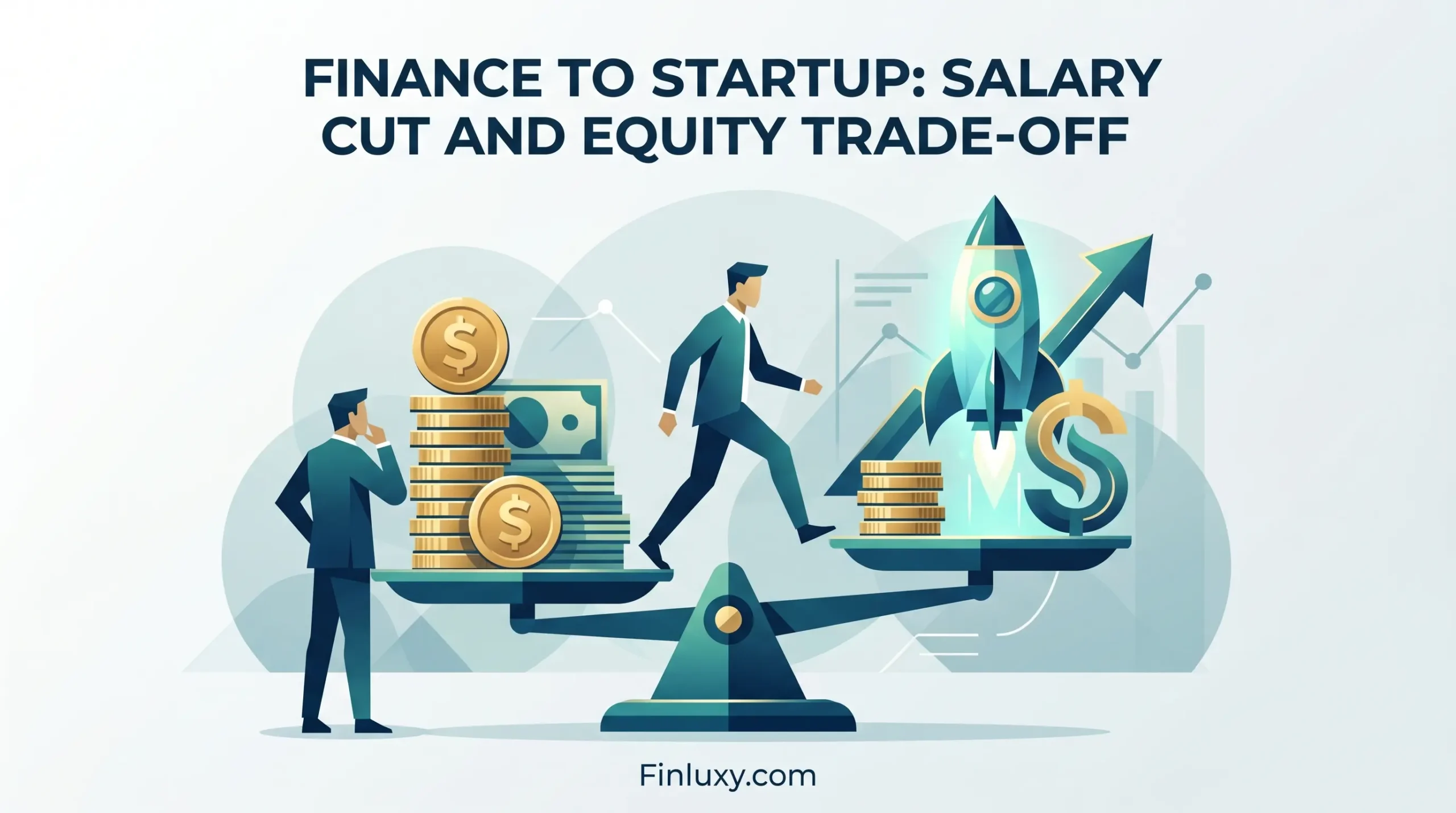
A finance professional clearing $300,000 in total compensation who leaves to found a seed-stage startup will, on average, pay themselves $153,000 — and that figure assumes the round closes, the company survives, and the board signs off on a “sustainable” salary instead of a founder discount. Pilot’s data tells a harsher story: the average founder salary it tracked fell to roughly $75,000, with 60% of founders paying themselves under $100,000.
The pitch is familiar. Trade a predictable seven-figure-trajectory finance career for a founder seat, eat a few lean years, and collect on the equity. The math underneath that pitch is where most coverage stops thinking. The salary cut is knowable and immediate. The equity is a probability-weighted lottery ticket, and the transition cost compounds whether or not the ticket ever pays.
This analysis models cash compensation only and uses median and average wage data, which compress an extremely wide distribution — finance pay in particular ranges from sub-$80,000 base roles to multi-million-dollar carry-and-bonus packages. Startup founder salaries come from advisory-firm survey data (Kruze Consulting, Pilot), not government wage surveys, because the BLS Occupational Employment and Wage Statistics program does not collect self-employed founder pay. Equity outcomes are not modeled as point estimates because no defensible median exists for an individual founder’s realized exit value; the equity discussion is framed as expected-value reasoning, not a forecast. All BLS figures are May 2024 estimates; startup compensation figures are 2024–2026 survey data, noted inline.
The starting number depends entirely on which finance job you’re leaving
“Finance” spans a wage range wide enough to make any single comparison misleading, so the transition cost has to start from a specific seat. The Bureau of Labor Statistics reports a May 2024 median wage by occupation of $161,700 for financial managers and $78,140 for securities, commodities, and financial services sales agents — though that sales-agent category’s top 10% earned above $215,210, and the figure excludes the bonus and carry structures that define front-office pay.
| Metric | Figure | Source & Period |
|---|---|---|
| Financial managers — median annual wage | $161,700 | BLS OEWS, May 2024 |
| Chief executives — median annual wage | $206,420 | BLS OEWS, May 2024 |
| Seed-stage startup CEO — average salary | $153,000 | Kruze Consulting, 2026 |
| Series A startup CEO — average salary | $203,000 | Kruze Consulting, 2026 |
| Founders paying themselves under $100k | 60% | Pilot, 2024 |
Sources: U.S. Bureau of Labor Statistics, Occupational Employment and Wage Statistics (May 2024); Kruze Consulting Startup CEO Salary Report (2026); Pilot founder compensation data (2024).
Total compensation, not base salary, is the number that matters here. A vice president in investment banking or a mid-level private equity professional often carries a bonus that doubles or triples base pay — which is precisely why BLS medians understate the income sacrifice for the people most likely to read this. For modeling, this analysis uses a $300,000 prior total-compensation figure as a representative front-office finance seat, and notes where the conclusion shifts for someone leaving the $161,700 financial-manager median instead.
The income valley has a floor you can calculate and a ceiling you can’t
Founder pay is not a fixed cut — it scales with funding stage. Kruze Consulting’s 2026 report, drawn from more than 400 mostly-B2B startups, puts the average seed-stage CEO salary at $153,000, Series A at $203,000, and Series B at $216,000. Those numbers have climbed since 2024, when seed CEOs averaged $132,000 and Series A averaged $179,000, reflecting better fundraising conditions for the companies that survive to raise.
Survivorship is doing heavy lifting in that data. Kruze’s clients are funded companies that have closed priced rounds; they are not the median person who quits to start something. Pilot, with a broader and earlier-stage customer base, found the average founder salary it tracked dropped to roughly $75,000, a level at which 60% of founders pay themselves under $100,000. The gap between $153,000 and $75,000 is the gap between “raised a real round” and “still proving it.” A finance professional modeling this transition should price the first 12 to 24 months at the Pilot floor, not the Kruze average, because the higher number is only available after milestones that haven’t happened yet.
Against a $300,000 prior package, a founder paying themselves $75,000 in year one absorbs an income sacrifice of $225,000 — before any retraining cost, which in this transition is typically near zero. Finance skills transfer to running a company; there’s no bootcamp, no degree, no retraining cost by field to amortize. The transition cost here is almost entirely forgone earnings, which makes it cleaner to model than a career change requiring a credential — and larger than most founders admit.
Modeling the transition cost without the equity fantasy
The transition cost in a finance-to-startup move has three components, and only two are reliably positive. Forgone earnings during the income valley dominate. Retraining cost rounds to zero. And the job-search component that burdens most career changes is replaced by the runway question — how long savings sustain the household before the equity does anything.
| Period | Founder pay (Pilot floor, $75k → scaling) | Prior comp | Cumulative income sacrifice |
|---|---|---|---|
| Year 1 (pre-seed/seed) | $75,000 | $300,000 | $225,000 |
| Year 2 (seed) | $153,000 | $300,000 | $372,000 |
| Year 3 (Series A, if raised) | $203,000 | $300,000 | $469,000 |
| Year 5 (Series B, if raised) | $216,000 | $300,000 | $637,000 |
Founder pay: Kruze Consulting (2026) by stage, with Year 1 set to Pilot (2024) floor. Prior comp held flat at a representative $300,000 front-office package; in practice finance comp would also grow, widening the gap. Years 4–5 assume the Year 3 differential persists. Figures assume the company raises each subsequent round — a generous assumption.
By year five, a founder who has successfully raised through Series B has still sacrificed roughly $637,000 in cash compensation relative to staying in finance — and that figure treats the prior package as frozen, which it wouldn’t be. Hold finance comp growth at even 5% annually and the five-year sacrifice clears $700,000. This is the number the equity has to beat, and it’s the number that rarely appears in the founder’s own spreadsheet.
The Finluxy Career Change Break-Even, applied two ways
Because this is an income sacrifice scenario rather than an income-gain scenario, the Finluxy Career Change Break-Even can’t be expressed as a payback period in years — there’s no annual income gain to divide into. Cash compensation in the new path is lower, so the metric is expressed as cumulative lifetime cost of lower earnings, and the only thing that can flip it positive is an equity event.
| Scenario | Prior comp | Founder cash path | Finluxy Career Change Break-Even |
|---|---|---|---|
| Front-office finance → seed founder | $300,000 | $75k → $153k → $203k | $637,000 cumulative cash cost by year 5; equity must clear this after tax and dilution to break even |
| Financial manager → seed founder | $161,700 | $75k → $153k → $203k | ~$140,000 cumulative cash cost by year 5; break-even reachable on cash alone if Series A salary holds |
Prior comp: BLS OEWS (May 2024) for financial managers; representative figure for front-office. Founder path: Kruze (2026) and Pilot (2024). Equity outcomes not modeled; see methodology.
The two rows diverge sharply, and the divergence is the whole story. Someone leaving the $161,700 financial-manager median reaches near-parity on cash alone by Series A — their Finluxy Career Change Break-Even is roughly $140,000 of cumulative sacrifice, recoverable within a few years if the company keeps raising. Someone leaving a $300,000 front-office seat faces a far deeper hole that cash compensation will never fill, because founder salaries top out around the Series B average of $216,000. For that person, the entire economic case rests on equity — which means the honest break-even isn’t a salary question at all.
What the data shows that founder narratives skip
Here’s the insight buried in these numbers: the higher your finance compensation, the worse startup founding pencils out on cash, and the more completely your decision depends on an equity outcome no dataset can price. The financial manager at $161,700 can break even on salary. The front-office professional at $300,000 cannot — founder pay simply doesn’t scale high enough. This inverts the common assumption that the highest earners are best positioned to take the founder leap. On a cash basis, they have the most to lose and the least chance of recovering it through salary, which loads the entire bet onto equity.
And equity expected value is brutal once you apply the actual base rates. Most seed-stage startups return nothing to founders. Dilution across multiple rounds routinely takes a founder’s stake from majority ownership to a minority position by the time of any exit. The equity has to clear not just the cumulative cash sacrifice but the after-tax, post-dilution version of it — and it has to do so probability-weighted against a high failure rate. A $637,000 cash sacrifice doesn’t break even on a $2 million exit if the founder owns 15% after dilution and pays capital gains on it. The career change financial framework for high earners applies with unusual force here, because the gap between the salary you can calculate and the equity you can’t is the entire risk.
The runway test most founders fail before they start
Whether the household can survive the income valley is a separate question from whether the move is a good bet, and it’s the one that should be answered first. The rule is simple: liquid savings minus transition cost must stay above zero without liquidating long-term investments or retirement accounts. A founder absorbing a $225,000 first-year income sacrifice needs that much in accessible bridge income or savings just to hold the line for 12 months — and the seed-to-Series-A gap can run 18 months or longer, which means the realistic income valley duration for career changers demands closer to two years of cushion.
This is where the $150k+ household has both an advantage and a trap. The advantage: higher prior earnings often mean a larger savings base and the ability to self-fund a longer runway. The trap: higher earnings usually come with a higher fixed cost structure — mortgage, private school, lifestyle — that doesn’t compress to a $75,000 founder salary without real disruption. Running the same move from a $300,000 base with a $300,000 lifestyle is categorically different from running it with a $120,000 lifestyle and $180,000 in annual savings, even though both households “earn” the same.
Practical context for the $150k+ household
For a household at or above $150,000, the finance-to-startup decision resolves into three thresholds, not one. First, the cash floor: can you fund a 24-month income valley at the Pilot $75,000 founder-salary level without touching retirement or long-term investments? If not, the equity upside is irrelevant — you’ll be forced to liquidate at the worst possible time. Second, the comp-band reality: if you’re leaving a $161,700 financial-manager seat, the cash break-even is genuinely reachable and the equity is upside; if you’re leaving a $300,000 front-office package, accept that you are making a pure equity bet and that your salary will likely never recover the difference. Third, the diversification question: a finance professional’s human capital and a startup founder’s equity are both bets on the same risk appetite, and a household with most of its net worth already tied to market-correlated assets is concentrating, not diversifying, by adding founder equity on top.
The cleanest version of this move belongs to the household that can treat the income sacrifice as a sunk, survivable cost — funded from savings, not from selling the future — and that goes in clear-eyed that the founder salary, even at the Kruze Series A average of $203,000, is a consolation prize rather than the point. The point is the equity, and the equity is unknowable. A household that needs the equity to work to stay solvent has already lost the bet; the household that can lose the entire cash sacrifice and still retire on schedule is the only one positioned to make it. That distinction, not the salary figures, is what separates a calculated career change from an expensive one.
How much does a startup founder actually pay themselves?
It depends heavily on funding stage and which dataset you trust. Kruze Consulting’s 2026 report puts the average seed-stage CEO salary at $153,000, rising to $203,000 at Series A and $216,000 at Series B. Pilot’s broader, earlier-stage data is far lower — an average around $75,000, with 60% of founders paying themselves under $100,000. The Kruze figures reflect companies that have successfully raised; the Pilot figures better represent the pre-traction reality most founders face first.
Is the income sacrifice worse for higher-earning finance professionals?
Yes, and counterintuitively so. Because founder salaries cap out around the Series B average of $216,000, someone leaving a $161,700 financial-manager role can reach cash break-even within a few years, while someone leaving a $300,000 front-office package faces a gap that founder salary alone will never close. The higher earner’s entire economic case shifts onto equity, which no dataset can reliably value.
What’s the transition cost if there’s no retraining involved?
For finance-to-startup, retraining cost rounds to zero — finance skills transfer directly to running a company. The transition cost is almost entirely forgone earnings during the income valley. Against a $300,000 prior package and a $75,000 first-year founder salary, that’s a $225,000 income sacrifice in year one, accumulating to roughly $637,000 by year five even assuming each subsequent funding round closes.
How much savings do I need before making this move?
Enough to cover the full income valley without liquidating long-term or retirement assets. The seed-to-Series-A gap commonly runs 18 months or longer, so a realistic cushion is closer to two years of the income sacrifice — on the order of $225,000 or more per year against a high prior salary, adjusted down for whatever lifestyle compression the household can absorb.
Methodology
Wage figures for finance occupations come from the U.S. Bureau of Labor Statistics Occupational Employment and Wage Statistics program, May 2024 estimates — the most current release confirmed at publication — prioritized as the primary government source for occupational pay. Startup founder compensation is drawn from Kruze Consulting’s 2026 Startup CEO Salary Report (400+ mostly-B2B funded startups) and Pilot’s founder compensation data, used as secondary trade sources because the BLS does not collect self-employed founder pay. Where the two startup sources diverge, both are reported as a range rather than reconciled to a single point, because they measure different populations — funded survivors versus a broader early-stage base.
The cumulative income sacrifice and Finluxy Career Change Break-Even were calculated using the cluster break-even framework: total transition cost equals income lost during the income valley plus retraining cost, with retraining set to zero for this transition. Because the new path pays less in cash, the break-even is expressed as cumulative dollar cost rather than a payback period in years. Prior compensation is modeled at a representative $300,000 front-office figure and, separately, at the BLS financial-manager median, to show how the conclusion shifts across the finance pay band. Equity outcomes are deliberately not assigned point values; no defensible median exists for an individual founder’s realized, post-dilution, after-tax exit, so equity is treated as the unpriced variable the entire decision turns on. I verified each headline figure against its primary source before publication rather than relying on prior recall.
Sources & References
- BLS Occupational Outlook Handbook — Financial Managers wage and outlook data (May 2024)
- BLS Occupational Outlook Handbook — Top Executives, chief executive median wage (May 2024)
- BLS Occupational Outlook Handbook — Securities, Commodities, and Financial Services Sales Agents (May 2024)
- Kruze Consulting — Startup CEO Salary Report by funding stage (2026)
- SaaStr — analysis of Kruze and Pilot founder compensation data
- BLS Occupational Employment and Wage Statistics program overview