 Analysis by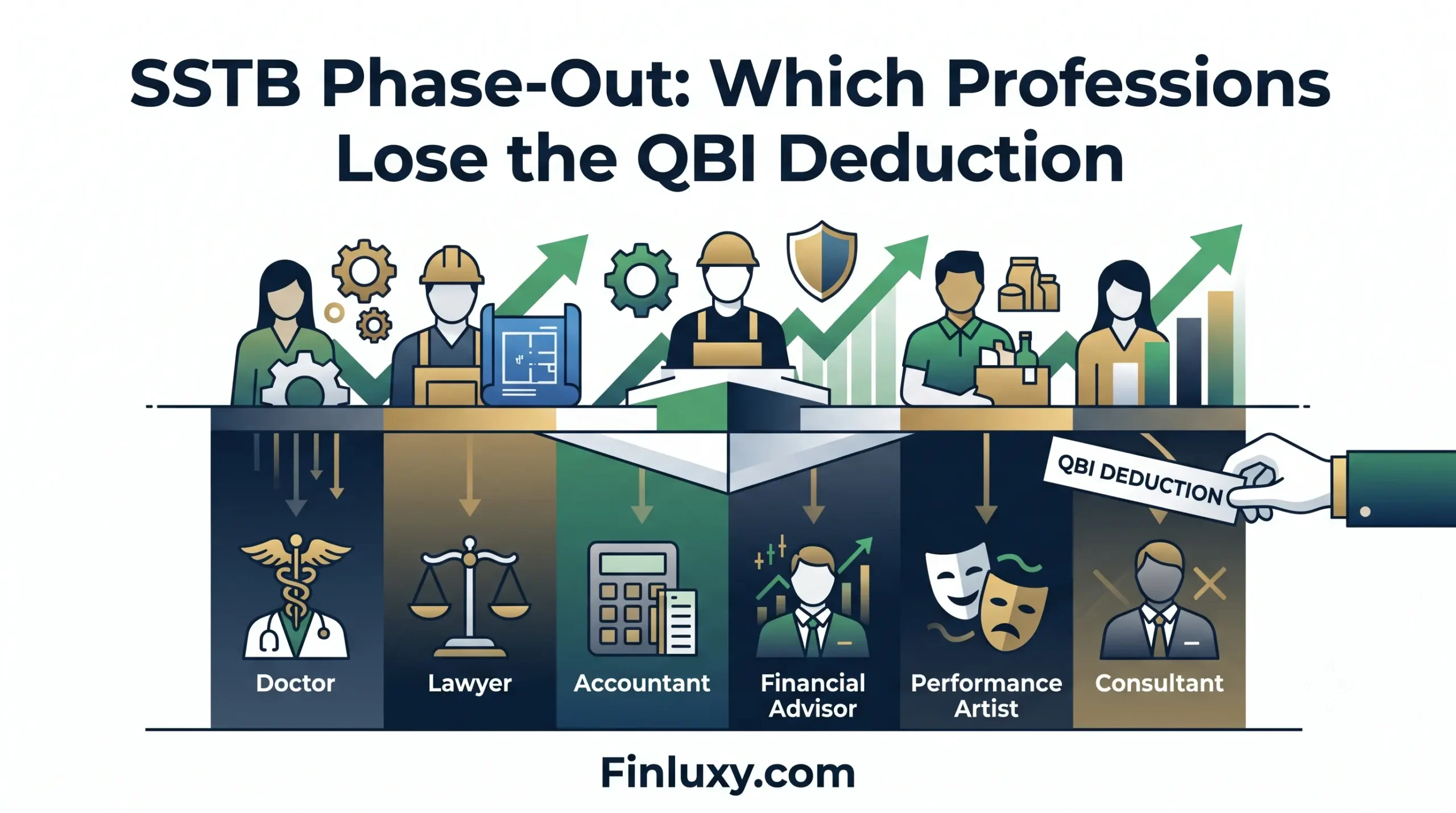
A married consultant with $500,000 of taxable income in 2025 gets a qualified business income (QBI) deduction of exactly zero. A married engineer with the same $500,000 keeps a deduction worth up to $100,000 against taxable income. Same income, same pass-through structure, same 20% statutory rate — and a five-figure swing in federal tax that turns entirely on how the IRS classifies the work.
That classification is the specified service trade or business (SSTB) rule, and it is the single most consequential fork in the QBI deduction at higher income levels. For owners below the income thresholds, SSTB status is irrelevant — everyone gets the full 20%. Above the thresholds, it decides whether the deduction survives, shrinks, or disappears. This is an analysis of which professions lose it, at what income, and what the lost deduction actually costs in dollars.
Figures reflect the 2025 tax year (the most recent year with finalized inflation-adjusted thresholds under IRS Rev. Proc. 2024-40) unless a 2026 figure is noted inline. SSTB classification depends on the specific facts of a business and, in close cases, turns on regulatory definitions and the “principal asset” reputation-or-skill test under IRC §199A(d)(2) — two businesses in the same nominal field can be classified differently. State tax treatment of pass-through income and the QBI deduction varies and is not modeled here; several states decouple from §199A entirely. This is data analysis, not tax advice. Confirm classification and thresholds with a licensed CPA or tax attorney before filing.
The numbers that decide it
| Figure | Amount (2025) |
|---|---|
| SSTB phase-out range — married filing jointly | $394,600 to $494,600 taxable income |
| SSTB phase-out range — single / other filers | $197,300 to $247,300 taxable income |
| QBI deduction rate (below threshold) | 20% of qualified business income |
| Deduction for an SSTB above the upper threshold | $0 |
| Self-employment tax rate (context) | 15.3% on net SE income to the wage base |
Source: IRS Rev. Proc. 2024-40; IRS Form 8995-A instructions (2025); IRS self-employment tax guidance. Thresholds measure taxable income before the QBI deduction, not AGI or gross receipts.
Three taxable-income bands govern the entire mechanism. Below the lower threshold — $394,600 MFJ or $197,300 for other filers in 2025 — every pass-through owner takes the full 20%, SSTB or not. Inside the band, an SSTB’s deduction phases out on a straight-line “applicable percentage.” Above the upper threshold, an SSTB’s QBI deduction is gone. A non-SSTB above the threshold faces a different test — the W-2 wage and property limitation — but never an outright denial based on what it does.
Which professions are SSTBs
The statute names the categories directly. Under IRC §199A(d)(2), a specified service trade or business covers any trade or business in the fields of health, law, accounting, actuarial science, performing arts, consulting, athletics, financial services, brokerage services, and investing, investment management, trading, or dealing in securities. It also sweeps in a catch-all: any business whose principal asset is the reputation or skill of one or more of its owners or employees.
Two professions people assume are caught are explicitly excluded. Engineering and architecture were deliberately carved out of the SSTB definition — an engineering firm and a law firm with identical economics land on opposite sides of the line. The exclusion traces to the drafting of the Tax Cuts and Jobs Act and survived into the permanent version of the deduction.
| Profession / field | SSTB? | Deduction above 2025 upper threshold |
|---|---|---|
| Physicians, dentists, nurses, other health providers | Yes (health) | $0 |
| Attorneys and law firms | Yes (law) | $0 |
| Accountants, CPAs, tax preparers | Yes (accounting) | $0 |
| Management / strategy / IT consultants | Yes (consulting) | $0 |
| Financial advisors, wealth managers, brokers | Yes (financial services) | $0 |
| Performing artists, athletes | Yes (performing arts / athletics) | $0 |
| Actuaries | Yes (actuarial science) | $0 |
| Engineers | No (excluded) | Up to 20%, wage-limited |
| Architects | No (excluded) | Up to 20%, wage-limited |
| Real estate agents/brokers (real property) | Generally no | Up to 20%, wage-limited |
| Manufacturing, retail, most product businesses | No | Up to 20%, wage-limited |
Source: IRC §199A(d)(2); IRS Form 8995-A instructions (2025). “Brokerage services” refers to securities brokerage; real estate and insurance brokerage are treated differently. Borderline cases turn on the reputation-or-skill catch-all and the de minimis gross-receipts rules.
The catch-all clause is where classification gets contested. A business earning fees primarily from the personal brand of its principal — a celebrity-endorsement operation, a solo practitioner trading on name recognition — can be pulled into SSTB territory even outside the named fields. Regulations narrowed this to endorsement income, licensing of an individual’s likeness, and appearance fees, but the line stays fact-specific.
What the lost deduction costs
Consider a married radiologist running a pass-through practice with $500,000 of taxable income, all of it QBI, in 2025. Above the $494,600 upper threshold, the SSTB deduction is zero. A non-SSTB owner — say an engineering practice — at the same income with adequate W-2 wages keeps a deduction of roughly 20% of QBI, on the order of $100,000 against taxable income. At a 35% marginal rate, that deduction is worth about $35,000 in federal tax. The radiologist pays it; the engineer does not.
The phase-in band is where planning earns its keep. An SSTB owner at $440,000 MFJ sits roughly midway through the 2025 band, so only about half the deduction remains. Push taxable income down to $394,600 — through retirement deferrals, for instance — and the full deduction snaps back. The marginal value of a dollar of deferral inside that band is unusually high, because each dollar both lowers the tax on itself and restores a slice of a deduction worth multiples of itself. That dynamic is why year-end income timing for business owners matters far more for SSTBs than for product businesses.
| Taxable income (MFJ) | Position in band | Approx. SSTB deduction allowed | Approx. federal tax value at 32–35% |
|---|---|---|---|
| $380,000 | Below threshold | Full 20% of QBI | Full benefit |
| $394,600 | Threshold (start) | Full 20% of QBI | Full benefit |
| $444,600 | ~50% through band | ~50% of the 20% | ~Half benefit |
| $494,600 | Upper threshold | $0 | $0 |
| $550,000 | Above band | $0 | $0 |
Source: IRS Form 8995-A instructions (2025); phase-in mechanics under Treas. Reg. §1.199A. Deduction amounts depend on QBI level, W-2 wages, and qualified property; figures shown are directional for an SSTB with QBI roughly equal to taxable income.
The entity question SSTB status forces
Here is where the SSTB rule collides with the older S corp versus LLC savings math. For most $150k+ owners, the case for an S corporation rests on self-employment tax (SE tax): splitting income between a reasonable W-2 salary subject to FICA and a distribution that escapes the 15.3% SE tax. That logic is independent of QBI. But for an SSTB owner above the threshold, the S corp election does something extra and slightly counterintuitive.
Because an S corporation pays its owner a W-2 salary, that salary is not QBI — it reduces the QBI figure. For a non-SSTB constrained by the wage limitation, paying W-2 wages can help the deduction. For an SSTB above the upper threshold, the deduction is already zero, so the QBI interaction is moot and the entire S corp case reverts to pure SE tax savings. The deduction the SSTB owner mourns isn’t recoverable through entity choice; it’s recoverable only by getting taxable income down into or below the band.
The Finluxy Business Entity Tax Differential isolates the entity-structure piece — the SE tax saved by the most favorable structure versus the least favorable — for an SSTB owner who has already lost the QBI deduction. The calculation below uses the 2025 Social Security wage base of $176,100 (SSA) and assumes a reasonable W-2 salary that withstands IRS scrutiny.
Finluxy Business Entity Tax Differential
| Net business income | Least favorable: sole proprietor / LLC SE tax | Most favorable: S corp FICA on reasonable salary | Differential ($) | Differential (% of income) |
|---|---|---|---|---|
| $300,000 | $24,011 | $18,360 (salary $120,000) | $5,651 | 1.9% |
| $400,000 | $26,911 | $22,950 (salary $150,000) | $3,961 | 1.0% |
| $500,000 | $29,811 | $27,540 (salary $180,000) | $2,271 | 0.5% |
Methodology and sources: SE tax computed as 15.3% on the first $176,100 of net SE earnings (after the 92.35% adjustment) plus 2.9% Medicare above, per IRS Schedule SE and SSA 2025 wage base ($176,100). S corp column applies 15.3% FICA to the reasonable W-2 salary only; distributions bear no SE/FICA. Salaries shown are illustrative reasonable-compensation assumptions, not IRS-set figures. Medicare’s additional 0.9% above $250,000 MFJ is excluded for comparability. Differential = least favorable minus most favorable structure for the same income.
Two patterns stand out. The differential is real but compresses as income rises, because once net earnings clear the $176,100 wage base, the sole proprietor only pays the 2.9% Medicare portion on the excess — the SE tax advantage of an S corp narrows to the Medicare spread on the income shifted to distributions. And note what this number is not: it is the entity-structure saving, entirely separate from the QBI deduction the SSTB owner already forfeited. Stacking the two — the lost 20% deduction plus the SE tax differential — is the full cost picture, and they are governed by completely different rules. The reasonable-salary assumption drives the whole S corp column, which is why the IRS reasonable salary standard deserves as much attention as the threshold itself.
What most coverage gets wrong
Most explainers frame the SSTB rule as a list: are you a doctor, lawyer, or consultant, yes or no. The data shows the more important variable is the width of the band relative to your income volatility. The 2025 MFJ phase-out spans exactly $100,000, from $394,600 to $494,600. For a household whose taxable income swings $50,000–$80,000 year to year — common for owners with variable billings, bonuses, or capital gains — the deduction can appear and vanish annually with no change in the underlying business. The rule isn’t a static on/off switch by profession; for a large slice of $150k+ SSTB owners it’s a moving target controlled by total taxable income, including a spouse’s W-2 wages, that has nothing to do with the practice.
This is also why the threshold is measured on taxable income before the QBI deduction rather than business income. A consultant with $250,000 of QBI and a spouse earning $200,000 is over the MFJ threshold on household income alone, even though the practice never approached it. Coverage that anchors on business revenue misses the households most exposed: dual-earner couples where one runs an SSTB.
What changes in 2026
The One Big Beautiful Bill Act, enacted in July 2025, made the QBI deduction permanent and widened the phase-in range. For 2026, the MFJ phase-in band expands from $100,000 to $150,000, and the single-filer band from $50,000 to $75,000 (Thomson Reuters; IRS Rev. Proc. 2025-32 inflation adjustments). With the inflation-adjusted lower threshold near $403,500 MFJ, the 2026 upper threshold lands around $553,500 rather than 2025’s $494,600.
The wider band is genuinely better for SSTB owners caught in the middle — more of the deduction phases out gradually instead of cliff-edging to zero, and the income level at which it fully disappears rises by roughly $59,000 for joint filers. The core rule is untouched: an SSTB above the top of the band still gets nothing. The legislation moved the goalposts; it did not remove them. OBBBA also added a $400 minimum deduction for taxpayers with at least $1,000 of active QBI starting in 2026 — immaterial at the income levels in this analysis.
Methodology
Threshold and rate figures were verified against primary sources before drafting. The 2025 SSTB phase-out ranges ($394,600–$494,600 MFJ; $197,300–$247,300 other filers) come from IRS Rev. Proc. 2024-40 as reflected in the 2025 Form 8995-A instructions. The SSTB definition and the engineering/architecture exclusion are drawn from IRC §199A(d)(2) and the Form 8995-A instructions. Self-employment tax mechanics (15.3% = 12.4% Social Security + 2.9% Medicare) and the deductible employer-equivalent half come from IRS self-employment tax guidance and Schedule SE; the 2025 Social Security wage base of $176,100 and the 2026 figure of $184,500 come from the Social Security Administration’s contribution and benefit base. The 2026 phase-in expansion reflects the One Big Beautiful Bill Act and IRS Rev. Proc. 2025-32 inflation adjustments.
The Finluxy Business Entity Tax Differential is computed as the difference in employment-related tax between a sole proprietor/LLC (full SE tax on net earnings) and an S corporation (FICA on a reasonable W-2 salary only) at matched income levels, using the 2025 wage base. QBI deduction values in the cost tables are directional, scaled to an SSTB whose QBI approximates taxable income; actual deductions depend on W-2 wages paid, qualified property basis, and aggregation elections, computed on Form 8995-A. Where model-specific deduction amounts depend on facts not fixed here, ranges and “up to” framing are used rather than point figures. Secondary analytical sources were used only to confirm primary figures, never as the sole citation for a threshold or rate.
Does an SSTB lose the entire QBI deduction the moment income crosses the threshold?
No. Crossing the lower threshold ($394,600 MFJ in 2025) starts a gradual phase-out across the band. The deduction reaches zero only at the upper threshold ($494,600 MFJ in 2025). Inside the band, an applicable-percentage calculation on Form 8995-A reduces the deduction proportionally.
Is the threshold based on my business income or my total income?
Total taxable income before the QBI deduction, on the full return — not business income alone. A spouse’s wages, investment income, and other earnings all count, which is why dual-earner households can lose the deduction even when the SSTB itself is modest.
Can switching to an S corporation restore the QBI deduction for an SSTB?
Not above the upper threshold, where the SSTB deduction is already zero — entity choice cannot revive it. The S corp election can still reduce self-employment tax by shifting income to a non-SE distribution, but that is a separate benefit from the QBI deduction. The only way to recover the deduction is to bring taxable income into or below the phase-out band.
Are engineers and architects really exempt from the SSTB rules?
Yes. IRC §199A(d)(2) specifically excludes engineering and architecture from the SSTB definition. Above the threshold they are still subject to the W-2 wage and qualified-property limitation like other non-SSTBs, but they are never denied the deduction simply because of their field.
Did the 2025 tax legislation change who qualifies?
The One Big Beautiful Bill Act made the deduction permanent and widened the phase-in band for 2026 (to $150,000 MFJ / $75,000 single), raising the income at which an SSTB fully loses the deduction. It did not change the underlying SSTB classification or remove the denial above the top of the band.
For the $150k+ household
The decision this rule forces is not “which profession am I” — that’s fixed — but “where does my total taxable income land, and can I move it.” For an SSTB household clustered near or inside the 2025 MFJ band of $394,600 to $494,600, the highest-leverage moves are the ones that compress taxable income: maximizing a solo 401(k) or defined benefit plan, timing receivables and deductible expenses across the year-end, and coordinating a spouse’s compensation deferrals. Each dollar pulled below a band threshold can be worth far more than its face value because it restores deduction as well as lowering tax on itself.
For households comfortably above the upper threshold — a successful two-physician or two-attorney couple well past $494,600 — the QBI deduction is realistically out of reach, and energy is better spent on the levers that still work: retirement plan architecture, the SE tax savings an S corp structure delivers regardless of QBI, and entity-level planning including whether a C corporation structure changes the calculus for retained earnings. The trade-off to weigh honestly is complexity against savings: an S corp election layers payroll, a separate return, and reasonable-compensation documentation onto the business, and at the upper income levels in the differential table above, the annual SE tax saving narrows even as the compliance cost stays fixed. A household with a stable, high SSTB income and no realistic path under the threshold should run that cost-benefit explicitly with a CPA rather than assuming the election pays for itself — and should treat the lost QBI deduction as a settled fact to plan around, not a problem entity choice can solve. The same framework underpins the broader business tax guide for owner-operators and connects to the everyday mechanics of the 15.3% self-employment tax that drives entity decisions in the first place.
Sources & References
- IRS Form 8995-A Instructions (2025) — SSTB phase-out mechanics, thresholds, and definitions
- IRS — Self-Employment Tax (Social Security and Medicare Taxes), 15.3% rate breakdown
- Social Security Administration — Contribution and Benefit Base (wage base by year)
- Thomson Reuters — QBI deduction thresholds and OBBBA 2026 phase-in expansion
- Journal of Financial Planning (Oct 2025) — QBI bucket framework and SSTB phase-in math
- IRS Publication 334 — Tax Guide for Small Business (entity and SE tax reference)