 Analysis by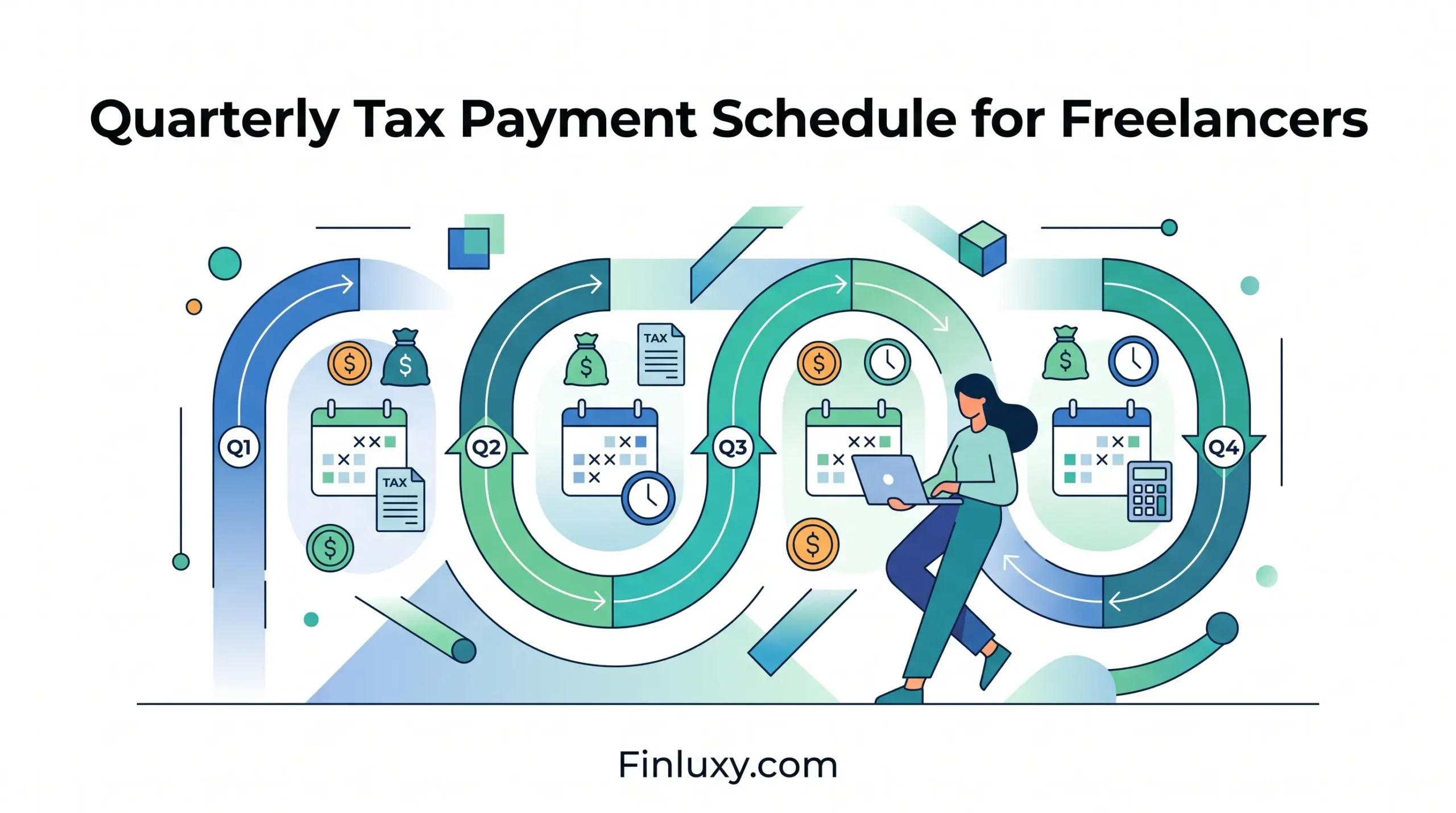
A freelancer earning $200,000 in net profit owes the IRS roughly $24,400 in self-employment tax alone before a single dollar of federal income tax enters the calculation — and the IRS expects most of it in four installments spread across the year, not in one April lump sum. Miss the rhythm and the penalty meter runs at the federal short-term rate plus three percentage points, compounded per quarter.
The freelance tax guide for high earners covers the full waterfall. This piece isolates one mechanism: the estimated tax payment calendar, what each installment should contain, and the specific safe harbor rule that changes once your adjusted gross income clears $150,000.
Figures here reflect the 2026 tax year (returns filed in 2027) and rely on IRS Revenue Procedure 2025-32, the 2026 Form 1040-ES, and the Social Security Administration’s announced wage base. State figures use the California 2025 Franchise Tax Board schedules, the most recent published at the time of writing, applied to a single-filer illustration. Self-employment situations vary by entity structure, deductions, multi-state income, and spousal withholding; the worked examples are modeling exercises, not a substitute for a return prepared on your actual numbers. Dollar outputs are rounded.
The four dates, and why June is closer than it looks
The IRS structures estimated tax payments around four installments per tax year. For 2026, the 2026 Form 1040-ES sets the due dates at April 15, 2026; June 15, 2026; September 15, 2026; and January 15, 2027. The labels suggest even quarters. The spacing does not.
Count the days. The first installment covers January through March — three months. The second covers only April and May, then falls due June 15. That is a two-month “quarter.” The third stretches June through August. The fourth runs September through December, four months, but isn’t due until the following January. A freelancer who budgets in literal calendar quarters will consistently underfund the June payment and overfund nothing to compensate.
| Item | Figure |
|---|---|
| Installment due dates (2026 tax year) | Apr 15, 2026 · Jun 15, 2026 · Sep 15, 2026 · Jan 15, 2027 |
| Income period for the June installment | April–May only (2 months) |
| Safe harbor — AGI over $150,000 | 110% of prior-year total tax |
| Underpayment penalty rate basis | Federal short-term rate + 3 points, per quarter |
| Filing threshold to trigger estimates | Expecting to owe $1,000+ at filing |
Sources: IRS Form 1040-ES (2026); IRS Publication 505; IRC §6654. Verified June 2026.
One scheduling note that trips people up: when a due date lands on a weekend or federal holiday, it shifts to the next business day. In 2026, all four dates fall on weekdays, so no adjustment applies — a clean year, which is not always the case.
What goes into each installment
An estimated tax payment is not just income tax. For a freelancer it bundles three liabilities into one transfer to the Treasury: self-employment tax, federal income tax, and — for residents of taxing states — a parallel state estimated payment filed separately. The federal portion is where the arithmetic gets unintuitive, because the real 15.3% self-employment tax sits on top of, not inside, the income tax brackets.
Work the waterfall for a single filer with $200,000 in Schedule C net profit, no other income, taking the standard deduction in 2026.
Self-employment tax comes first. SE tax applies to 92.35% of net profit: $200,000 × 0.9235 = $184,700. The Social Security component (12.4%) stops at the 2026 wage base of $184,500, per the Social Security Administration; the Medicare component (2.9%) has no ceiling. So the Social Security piece is $184,500 × 12.4% = $22,878, and the Medicare piece is $184,700 × 2.9% = $5,356. Total self-employment tax: roughly $28,234. Half of that, $14,117, is deductible above the line in computing adjusted gross income.
Now federal income tax. Start from net profit, subtract the half-SE-tax deduction ($14,117) and the 2026 single standard deduction of $16,100 (IRS Rev. Proc. 2025-32), reaching taxable income before the qualified business income deduction of about $169,783. The QBI deduction — 20% of qualified business income, made permanent under the One Big Beautiful Bill Act — applies here because taxable income sits below the 2026 single phase-in threshold of $201,750. Twenty percent of QBI (capped at 20% of taxable income) trims roughly $33,957, leaving taxable income near $135,826.
Run that through the 2026 single brackets (rates unchanged at 10/12/22/24/32/35/37% under Rev. Proc. 2025-32) and federal income tax lands at approximately $25,300. The math behind that QBI step is its own subject; eligibility rules sit in the QBI deduction eligibility breakdown.
| Step | Amount |
|---|---|
| Schedule C net profit | $200,000 |
| SE tax base (× 92.35%) | $184,700 |
| Self-employment tax | $28,234 |
| Deductible half of SE tax | $14,117 |
| Standard deduction (single) | $16,100 |
| QBI deduction (20%) | $33,957 |
| Taxable income | $135,826 |
| Federal income tax | $25,300 |
| Federal total (SE + income tax) | $53,534 |
Sources: IRS Rev. Proc. 2025-32 (2026 brackets, standard deduction, QBI threshold); IRS Schedule SE instructions; SSA 2026 wage base ($184,500); OBBBA §70105. Author calculation, June 2026.
Divide the $53,534 federal total by four and each installment runs about $13,384 — before state tax. That is the number that surprises people who set aside “a quarter of income for taxes” and find it short.
Adding the state layer: a California illustration
State estimated payments travel on their own track with their own vouchers, and the burden varies enormously by state. To show the full picture, take the highest-tax case. A single Californian with the same $200,000 net profit, after the federal-style deductions that California partially conforms to, faces 2025 Franchise Tax Board brackets running 1% to 9.3% across the relevant range, with marginal rates climbing to 12.3% only far above this income. California does not allow the federal QBI deduction, which widens the state taxable base relative to the federal one.
State income tax on this profile lands in the neighborhood of $14,500 to $16,000 depending on exact California adjustments — California-specific figures for the full set of states sit in the effective tax rate by state breakdown. Model-specific California liability for an individual return depends on conformity adjustments that this illustration approximates; treat the range as a planning band, not a filed number.
The Finluxy Freelancer Effective Tax Rate
Total tax tells the story that a marginal rate hides. The Finluxy Freelancer Effective Tax Rate is total annual tax paid (self-employment tax + federal income tax + state income tax) divided by gross freelance income, expressed as a percentage. Below it sits the comparison most coverage skips: what a W-2 employee at the identical gross income would pay, where the employer silently absorbs half of FICA.
| Component | Freelancer | W-2 Employee |
|---|---|---|
| Self-employment / employee FICA | $28,234 | $11,376 |
| Federal income tax | $25,300 | ~$28,900 |
| California income tax | ~$15,200 | ~$13,400 |
| Total tax | ~$68,734 | ~$53,676 |
| Finluxy Freelancer Effective Tax Rate | 34.4% | 26.8% |
Sources: IRS Rev. Proc. 2025-32; IRS Schedule SE; SSA 2026 wage base; California FTB 2025 schedules. W-2 column applies employee-side FICA only (employer pays the matching 7.65%) and no QBI deduction. Author calculation; figures rounded and illustrative.
The delta is roughly 7.6 percentage points. The freelancer’s higher FICA burden — both halves of the 7.65%, not one — drives most of the gap, partially offset by the QBI deduction the W-2 worker can’t claim. That offset is exactly why the freelancer figure isn’t a flat 10 points higher; the comparison between freelancer and W-2 net income at $200k shows where the lines actually cross.
The safe harbor: the rule that changes at $150,000
Here is the threshold that matters most for this audience, and the one most general guidance states incompletely. The IRS does not penalize underpayment if you hit a “safe harbor.” Under IRC §6654, the safe harbor is the smaller of 90% of the current year’s total tax or 100% of the prior year’s total tax. But the 100% figure rises to 110% when the prior-year adjusted gross income exceeds $150,000.
For a household earning $150,000-plus in gross freelance income, the 110% rule is effectively the operative one. It means a freelancer whose income is climbing can sidestep penalties entirely by paying 110% of last year’s tax in four equal installments — regardless of how high this year’s income runs — and settle the remainder at filing without interest. The mechanism rewards looking backward, not forward.
A concrete version: if your 2025 total tax was $60,000 and your 2025 AGI cleared $150,000, paying $66,000 across the 2026 installments ($16,500 each) satisfies the safe harbor even if your 2026 income jumps and your actual liability hits $80,000. The extra $14,000 comes due April 15, 2027, penalty-free. The full cost mechanics of getting this wrong sit in the underpayment penalty cost analysis.
What most coverage overlooks
Nearly every freelance-tax explainer frames estimated payments as a forecasting problem: project your income, compute the tax, divide by four. For a high earner with volatile income, that framing is actively worse than the alternative. The 110% prior-year safe harbor converts an uncertain forward-looking estimate into a fixed, known number anchored to a return you’ve already filed. You stop guessing. A consultant who bills $180,000 one year and $320,000 the next does not need to predict the $320,000 — paying 110% of the tax on $180,000 keeps the IRS satisfied, and the large balance simply waits until April without penalty.
The trade-off is cash flow, not penalties: you hand the Treasury a large April payment instead of spreading it. For a disciplined saver earning interest on the float, that is often the better deal. The data point coverage misses is that the safe harbor is a planning instrument, not just a penalty shield — it lets a high, lumpy earner decouple payment timing from income timing entirely.
Do I owe a penalty if I pay everything by April 15 of the following year?
Generally yes, if you owed $1,000 or more and didn’t meet a safe harbor during the year. The U.S. system is pay-as-you-go; paying the full balance at filing doesn’t retroactively cure missed installments. The penalty is computed per quarter at the federal short-term rate plus three percentage points on the shortfall for the days it was outstanding.
Can I pay all four installments at once in April?
Yes. Paying the full annual estimate by the first deadline (April 15, 2026 for the 2026 tax year) satisfies every installment. You can also overpay early quarters and reduce later ones, as long as each period’s cumulative total meets its required amount.
Does the safe harbor use AGI or taxable income for the $150,000 test?
Adjusted gross income from the prior year. If your prior-year AGI exceeded $150,000 ($75,000 if married filing separately), the required percentage of prior-year tax rises from 100% to 110%.
What if my income is uneven across the year?
You can use the annualized income installment method, which lets you pay based on income actually earned in each period rather than four equal amounts. It reduces early-quarter payments for back-loaded income but requires period-by-period bookkeeping and Form 2210.
Methodology
Figures were prioritized from primary IRS sources: Revenue Procedure 2025-32 for 2026 brackets, the standard deduction, and the QBI phase-in threshold; the 2026 Form 1040-ES for installment due dates; Schedule SE instructions for the self-employment tax computation; and IRC §6654 for safe harbor rules. The Social Security wage base ($184,500 for 2026) comes from the Social Security Administration’s announced figure. State illustration figures use the California Franchise Tax Board 2025 rate schedules, the most recent published. Every rate, threshold, and limit was verified by targeted search against the issuing authority rather than recalled. The proprietary metric synthesizes self-employment tax, federal income tax, and state income tax into a single rate over gross freelance income; the W-2 comparison applies employee-side FICA only, reflecting that an employer absorbs the matching share. Worked examples assume a single filer taking the standard deduction with no other income, and are modeling exercises rather than prepared returns.
The $150k+ household calculation
At this income level the decision isn’t whether to pay estimates — you will — but which safe harbor to anchor to and where to park the cash between deadlines. The 110% prior-year rule gives a household with rising income a known floor that removes penalty risk without requiring an accurate forecast, which is the single most valuable feature for anyone whose freelance income swings by six figures year to year. The counterweight is that 110% can overshoot in a down year, parking money with the Treasury that earns nothing; in a year you expect lower income, the 90%-of-current-year harbor may free up cash, at the cost of needing a reliable projection. Households that clear $150,000 and itemize should also weigh the entity question, because the S corp election’s annual savings can compress the self-employment tax that dominates the installment math shown here — a structural change that resets every figure above, and one worth modeling against your own numbers before the next April deadline rather than after it.
Sources & References
- IRS Form 1040-ES (2026) — Estimated tax for individuals, installment due dates
- IRS — Self-employment tax (Social Security and Medicare taxes)
- IRS Publication 509 (2026) — Tax calendars
- Tax Foundation — 2026 tax brackets and standard deduction (Rev. Proc. 2025-32)
- Congressional Research Service — Federal brackets and standard deductions through 2026
- Thomson Reuters — QBI deduction overview, OBBBA changes and 2026 thresholds
- California Franchise Tax Board — 2025 rate schedules and Form 540