 Analysis by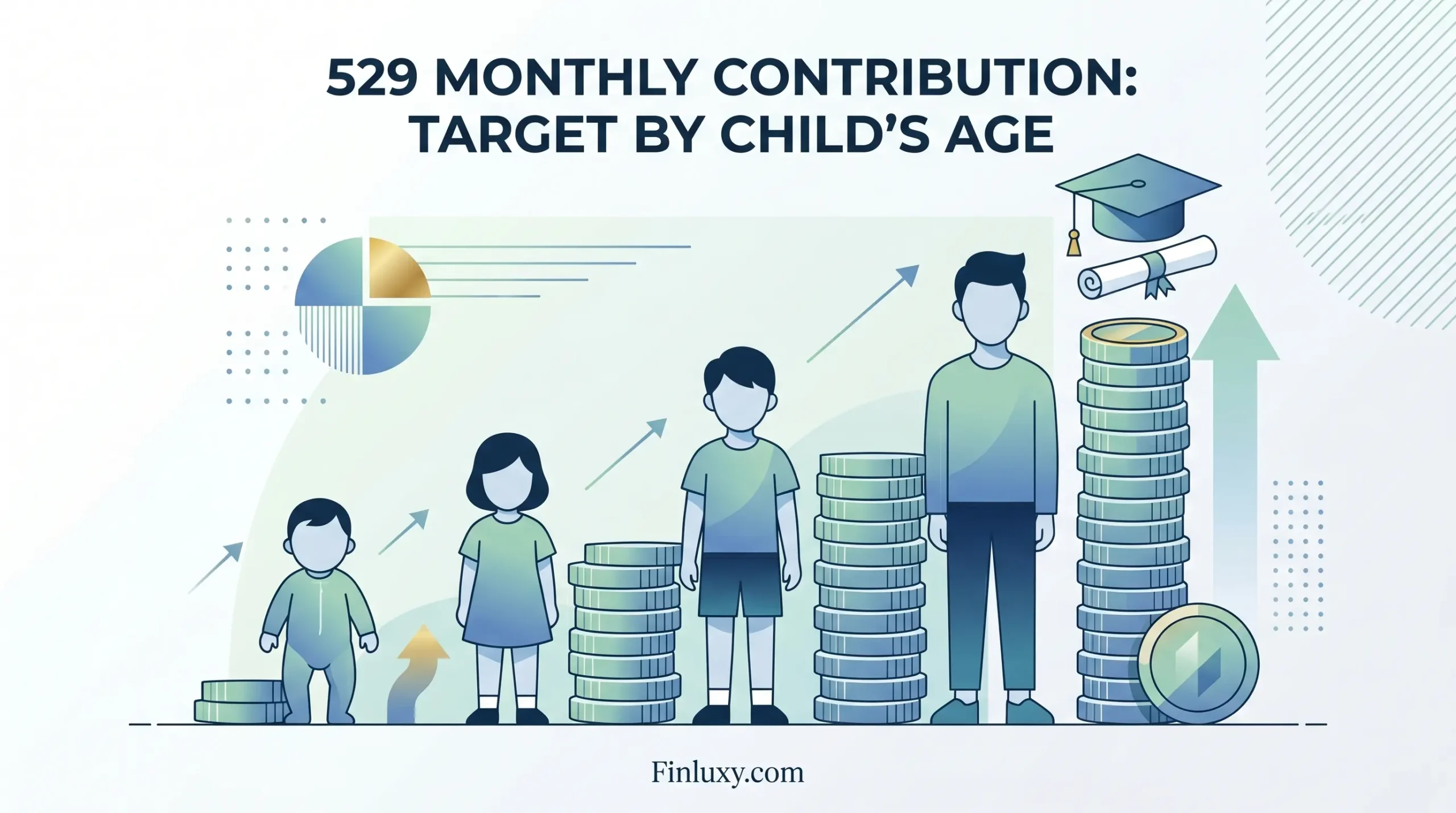
A newborn whose parents want to fully fund a private nonprofit education without loans needs their family to contribute roughly $1,294 per month starting at birth — and that figure nearly doubles if the first 529 deposit lands on the child’s tenth birthday. The math is unforgiving, and it compounds in both directions.
For households earning $150k or more, this is less a question of whether to save and more a question of how much compression is acceptable. Need-based aid is largely off the table at this income level. The full cost of attendance lands on the family budget, inflated by the years between now and enrollment.
This analysis uses 2025–26 cost of attendance figures from the College Board’s Trends in College Pricing and Student Aid 2025 report. Monthly contribution targets are modeled projections using a 4% annual cost of attendance inflation assumption and a 6.5% annual 529 portfolio return (the midpoint of a 6%–7% range typical of equity-weighted age-based allocations). Neither assumption is guaranteed. Actual results will vary based on investment performance, school selection, and enrollment year. This is cost analysis, not financial advice. Figures reflect total sticker-price cost of attendance — $150k+ households receive minimal need-based aid at most institutions and should not assume grant reductions to these figures.
Key figures at a glance
| Metric | Private Nonprofit 4-Year | Public In-State 4-Year |
|---|---|---|
| 2025–26 annual sticker COA | $65,470 | $30,990 |
| 4-year sticker COA (today’s dollars) | $261,880 | $123,960 |
| Projected 4-year COA at enrollment (child born today, 18-year horizon) | $530,447 | $251,148 |
| Monthly 529 contribution needed — newborn | $1,294 | $613 |
| Annual gift tax exclusion per donor (2026) | $19,000 individual / $38,000 married couple | |
Sources: College Board Trends in College Pricing and Student Aid 2025; IRS gift tax exclusion confirmed for 2025–2026 (Kiplinger, Saving for College). Projections assume 4% COA inflation and 6.5% annual 529 return.
What the 2025–26 cost baseline actually contains
The College Board’s 2025–26 average full-time undergraduate budgets are $65,470 per year for private nonprofit four-year institutions and $30,990 for public four-year in-state students. These figures include tuition and fees, housing and food, books and supplies, transportation, and personal expenses — the complete cost of attendance (COA). A sticker price comparison that looks only at tuition misses roughly $20,000 in annual costs that hit the family budget regardless of which school is chosen.
At the tuition-only level, the 2025–26 numbers are $45,000 for private nonprofit schools (up 4.0% from the prior year) and $11,950 for in-state public institutions (up 2.9%). The room and board component alone averaged $15,920 at private schools and $13,900 at public four-year schools in 2025–26, according to the College Board. These are enrollment-weighted national averages. Schools in high cost-of-living markets routinely exceed them by $5,000–$10,000 per year.
For the college cost guide relevant to $150k+ families, the operative number is always full COA, not sticker tuition — because room, board, and fees are non-negotiable expenditures regardless of how much aid the family receives on the tuition line.
The inflation assumption: why 4%, not 5%
The Cluster Brief methodology suggests 5% annual COA inflation for projection purposes. The actual long-run record is more nuanced. Private nonprofit tuition increased 4.0% in nominal terms in 2025–26, while public in-state tuition rose 2.9%. The Education Data Initiative’s historical analysis puts the 21st-century average annual tuition inflation rate at roughly 3.9%, and the BLS CPI component for college tuition and fees has run at approximately 2% over the past year through April 2026.
This analysis uses 4% as the planning inflation assumption — slightly above recent trends but below the long-run historical peak rates, and appropriately conservative given the current policy and enrollment environment. Families who want stress-test scenarios should run figures at both 3% and 5%; the spread between those scenarios on an 18-year horizon is substantial. At 3%, the private four-year projected COA at enrollment for a newborn today is $445,000. At 5%, it is $629,000. The 4% figure used here — $530,447 — sits in the defensible middle.
Monthly contribution targets by child’s age
The tables below show what a family must contribute monthly, starting today, to fully fund COA at enrollment with no remaining shortfall. The model assumes contributions earn 6.5% annually inside the 529 (a midpoint estimate for an equity-weighted age-based portfolio in the early years, gliding toward fixed income at enrollment). All figures assume zero starting balance. Families who already have a balance should subtract the future value of existing assets before applying these targets.
| Child’s Current Age | Years to College | Projected 4-Year COA at Enrollment | Required Monthly Contribution |
|---|---|---|---|
| Newborn (age 0) | 18 | $530,447 | $1,294 |
| Age 2 | 16 | $490,493 | $1,459 |
| Age 5 | 13 | $435,979 | $1,785 |
| Age 8 | 10 | $387,611 | $2,302 |
| Age 10 | 8 | $358,435 | $2,857 |
| Age 13 | 5 | $318,639 | $4,508 |
| Age 15 | 3 | $294,606 | $7,432 |
Methodology: Baseline 4-year COA = $261,880 (College Board, 2025–26 private nonprofit), inflated at 4% annually to enrollment year. Monthly contribution = FV × (r/12) ÷ [(1 + r/12)^(12n) − 1], where r = 6.5% annual return. Assumes zero starting balance.
| Child’s Current Age | Years to College | Projected 4-Year COA at Enrollment | Required Monthly Contribution |
|---|---|---|---|
| Newborn (age 0) | 18 | $251,148 | $613 |
| Age 2 | 16 | $232,197 | $691 |
| Age 5 | 13 | $206,414 | $845 |
| Age 8 | 10 | $183,531 | $1,090 |
| Age 10 | 8 | $169,657 | $1,352 |
| Age 13 | 5 | $150,832 | $2,135 |
| Age 15 | 3 | $139,424 | $3,517 |
Methodology: Baseline 4-year COA = $123,960 (College Board, 2025–26 public in-state), inflated at 4% annually to enrollment year. Monthly contribution = FV × (r/12) ÷ [(1 + r/12)^(12n) − 1], where r = 6.5% annual return. Assumes zero starting balance.
The jump between age 10 and age 13 is where most families feel the most financial pain. From a newborn to age 10, the required monthly contribution for a private school target roughly doubles — from $1,294 to $2,857. Between age 10 and age 13, it jumps again by another $1,651 per month. Compounding time is not a renewable resource.
Finluxy College Investment Ratio: what the degree costs relative to what it pays
Monthly savings targets tell you what you need to put in. The Finluxy College Investment Ratio tells you whether the output justifies the input. The metric divides the 4-year net COA by the median starting salary for the institution’s top major — the result is expressed in years of starting salary required to recover the degree’s cost.
For $150k+ households receiving minimal need-based aid, net COA approximates sticker COA. Using current 2025–26 figures and NACE’s Winter 2025 Salary Survey data for starting salaries — engineering at $78,731 and business at approximately $61,000:
| School Type | 4-Year COA (Sticker) | Major | Median Starting Salary | Finluxy College Investment Ratio | Assessment |
|---|---|---|---|---|---|
| Private nonprofit | $261,880 | Engineering | $78,731 | 3.3 years | Moderate — within range |
| Private nonprofit | $261,880 | Business | $61,000 | 4.3 years | Elevated — career certainty matters |
| Public in-state | $123,960 | Engineering | $78,731 | 1.6 years | Strong ROI |
| Public in-state | $123,960 | Business | $61,000 | 2.0 years | Strong ROI |
COA: College Board Trends in College Pricing and Student Aid 2025. Engineering starting salary ($78,731): NACE Winter 2025 Salary Survey, Class of 2025 projected average. Business starting salary ($61,000): NACE Winter 2025 Salary Survey estimated range. Finluxy College Investment Ratio = 4-year COA ÷ median starting salary. Ratio thresholds: under 1.5 = strong ROI; over 4.0 = financial risk depending on career certainty.
The ratio for a private school business degree sits at 4.3 — inside the financial risk zone by the metric’s definition. That does not mean the degree is a bad decision; career trajectory, network access, and graduate school positioning matter. But it does mean the margin for career disruption is thin. A public university engineering path, by contrast, delivers a ratio of 1.6 — essentially optimal by this framework. The full public vs. private university net cost gap analysis explores this further across a wider set of institutions.
The gift tax architecture for $150k+ households
The IRS annual gift tax exclusion for 2026 is $19,000 per individual donor, per beneficiary — or $38,000 for a married couple contributing jointly. That means a two-parent household can contribute $38,000 per child per year to a 529 without triggering a gift tax return. Monthly, that annualizes to $3,167 — comfortably above the newborn targets for private or public school paths, but below the required contributions for children aged 13 or older targeting private schools.
The superfunding option — formally a five-year election under IRC Section 529(c)(2) — allows a lump-sum contribution of up to $95,000 per individual ($190,000 per married couple) in a single year by treating it as five years of annual exclusion gifts. For $150k+ households with liquidity available at or before the child’s birth, superfunding at $190,000 changes the monthly math entirely: at a 6.5% annual return, $190,000 invested today grows to approximately $570,000 over 18 years, covering the projected private school target with margin to spare. State-level tax deduction caps vary widely and may not accommodate superfunding in a single year — check your specific plan’s rules. The prepaid tuition plan vs. 529 growth plan comparison is worth reviewing before committing to a lump-sum approach.
One 2026 update worth noting: the One Big Beautiful Bill Act, signed July 4, 2025, expanded qualified 529 withdrawals for K-12 expenses from $10,000 to $20,000 per beneficiary per year and broadened the eligible expense categories. For families with children in private K-12 schools before college, this changes the draw-down calculus on existing accounts — but it does not change the college-funding math above.
The insight most coverage misses: the contribution cliff at age 13
Most 529 articles present a linear relationship between starting age and required monthly contribution — start later, pay more. What the data actually shows is a discontinuous jump in the cost of delay. Between newborn and age 10, each two-year delay in starting contributions adds approximately $250–$350 to the required private-school monthly payment. Between age 10 and age 13 — a gap of only three years — the monthly requirement for a private school target increases by $1,651, from $2,857 to $4,508. The age 13-to-15 interval adds another $2,924 per month.
This cliff exists because the accumulation period compresses faster than the projected college cost inflates. At age 13, a family has 60 months of contribution opportunity. At 10, they have 96. The difference in accumulation time — 36 months — costs proportionally more than the difference in the inflated COA target ($318,639 vs. $358,435). Time compression, not cost inflation, drives the late-start penalty. Families who started late should run the math on partial funding paired with federal Direct loans for the balance, since the total repayment math on $100k of student debt may be more manageable than the cash-flow requirement of full self-funding at age 13.
For the comparable analysis at a lower income tier, see the 529 contribution targets at $100k income by child’s age — the structural patterns are identical, though the COA assumptions and aid eligibility differ materially.
What the aid environment looks like at $150k+
Need-based aid at this income level is largely theoretical. The Free Application for Federal Student Aid (FAFSA) — now using the Student Aid Index (SAI), which replaced the former Expected Family Contribution under the FAFSA Simplification Act — will produce an SAI that effectively disqualifies most $150k+ households from Pell Grants and most institutional need-based grants at typical schools. At highly endowed private schools, the income threshold for meaningful aid is higher — some institutions with large endowments provide aid to families earning up to $200k — but these are outliers, not the norm.
The financial aid reality at $200k+ household income and the Ivy League net price at $175k household income both document the specific schools where the aid calculus shifts. For planning purposes at $150k, the COA tables above should be treated as the full financial obligation unless a specific institution’s Net Price Calculator confirms otherwise. NCES IPEDS data allows families to verify net price by income bracket at specific schools — this is the only reliable source for institution-specific net price verification. Marketing materials and average aid figures are not substitutes.
Merit aid is a different variable entirely. It is school-dependent, not income-dependent, and highly competitive. It should not be assumed in any savings model until it has been awarded in writing. For context on how merit aid actually affects the private university 4-year cost at $150k income, the scenario analysis there covers this directly.
Practical framework for $150k+ households
Two households earning the same income face very different 529 math depending on one variable: how many children they are funding and at what ages. A single child born today requires $1,294 per month for a private school target — a meaningful but manageable commitment at $150k income. Two children three years apart, starting at ages 0 and 3, require roughly $1,294 plus approximately $1,612 simultaneously — over $2,900 per month before accounting for any investment return on the older child’s existing balance.
The gift tax architecture matters most for households with high liquidity events — RSU vests, business sales, bonus years. A $190,000 superfund on a newborn eliminates the monthly contribution requirement entirely in the private school scenario; a $95,000 contribution from one parent reduces the ongoing monthly need by roughly 45%. For families with irregular income, aligning large 529 contributions with liquidity events and treating monthly contributions as a floor rather than the ceiling is a more robust strategy than attempting consistent high monthly deposits.
Out-of-state public options are also worth calculating explicitly. The out-of-state tuition vs. in-state true cost gap shows that many flagship public universities cost nearly as much as private schools on a COA basis once the out-of-state premium is applied. The in-state vs. out-of-state break-even analysis provides the specific thresholds where establishing state residency ahead of enrollment makes financial sense. The 4-year out-of-state public COA in 2025–26 averages $50,920 — not far from private school territory, and before the four-year inflation projection is applied.
The college ROI by major with earnings vs. total debt analysis is the natural follow-on to the Finluxy College Investment Ratio work here — it disaggregates the salary side of the ratio across a wider major set, which changes the risk assessment for degrees outside engineering and business. Similarly, families weighing name-brand private school costs against flagship state school outcomes should review the prestigious school vs. state school income outcome data before anchoring on a school type in their savings model.
Finally, for households whose children are already in high school with limited 529 assets: the partial-funding scenario paired with federal Direct Unsubsidized Loans is worth modeling rigorously. The student loan repayment math on an $80k starting salary shows what manageable debt service looks like across different loan amounts and repayment terms. For a $150k household co-signing Parent PLUS loans, the repayment dynamic is different — and the graduate school ROI for MBA, law, and medical paths is relevant if the undergraduate plan includes professional school costs in the long-range financial model.
Frequently asked questions
What if I already have some money saved in the 529 — how do I adjust these targets?
Calculate the future value of your existing balance at 6.5% annual return over the remaining years to enrollment. Subtract that figure from the projected COA target shown in the table. The difference is the remaining shortfall, and you then apply the monthly contribution formula to that reduced figure. For example, if your child is age 5 with $50,000 already in the 529 and you’re targeting a private school, the $50,000 grows to approximately $50,000 × (1.065)^13 ≈ $113,900 by enrollment. Your remaining shortfall from the $435,979 projected COA is approximately $322,000 — and the monthly contribution needed to accumulate that amount over 13 years at 6.5% is around $1,325, significantly below the $1,785 zero-balance figure in the table.
Are these monthly figures before or after taxes?
529 contributions are made with after-tax dollars — there is no federal income tax deduction for contributions. Many states offer a state income tax deduction or credit on contributions, subject to varying annual limits. The monthly figures in this analysis represent after-tax cash outflows. The tax benefit, where it exists, occurs on the growth side: investment earnings inside the 529 accumulate tax-deferred and are withdrawn tax-free when used for qualified education expenses, which is a meaningful advantage over equivalent taxable investing at higher income brackets.
What happens to 529 money if my child doesn’t attend a four-year college?
Several options exist. The beneficiary can be changed to another family member — a sibling, cousin, or even the account owner — who has qualifying education expenses. As of 2024, up to $35,000 in unused 529 assets (lifetime cap per beneficiary) can be rolled into a Roth IRA for the beneficiary, provided the account has been open at least 15 years, subject to annual IRA contribution limits. The One Big Beautiful Bill Act, effective July 4, 2025, also expanded qualified withdrawals to include a broader set of K-12 and credentialing expenses. Non-qualified withdrawals are subject to income tax plus a 10% federal penalty on earnings — not on the principal contributed.
Should 529 contributions be prioritized over retirement savings?
This is a sequencing question with a generally accepted framework: maximize employer retirement match first (it is an immediate guaranteed return), then fund Roth or traditional retirement accounts to the statutory limit, then direct surplus cash flow to the 529. The logic is that retirement has no outside financing mechanism — students can borrow for college, parents cannot borrow for retirement. At $150k+ income, the priority sequence matters less because the household generally has capacity for both once high-interest debt is eliminated. The practical constraint is usually cash flow timing: a household with two children under age 5 and high housing costs may face genuine trade-offs that require explicit prioritization rather than a general rule.
Methodology
Cost of attendance baseline figures are from the College Board’s Trends in College Pricing and Student Aid 2025 report (published November 2025), which provides enrollment-weighted 2025–26 average budgets by sector. These are the primary data source for all COA figures in this article. Annual COA inflation is modeled at 4% — consistent with the long-run nominal average documented by the Education Data Initiative and slightly above the 2025–26 private sector nominal increase of 4.0% and public sector increase of 2.9%. The 529 return assumption is 6.5% annually, representing the midpoint of a 6%–7% range for equity-weighted age-based allocations in the early years of a child’s life; this is a planning assumption, not a guaranteed figure, and declines as the portfolio glides toward more conservative allocations near enrollment.
Monthly contribution figures are computed using the standard future-value-of-annuity formula: PMT = FV × (r/12) ÷ [(1 + r/12)^(12n) − 1], where FV is the inflation-adjusted projected 4-year COA, r is the assumed annual return, and n is the number of years to enrollment. All figures assume zero starting balance. Gift tax figures are drawn from IRS guidance confirmed for 2025 and 2026 by Kiplinger and Saving for College. Starting salary data for the Finluxy College Investment Ratio is sourced from the National Association of Colleges and Employers (NACE) Winter 2025 Salary Survey for the Class of 2025. Sources to avoid per cluster guidance — university marketing materials and college ranking publications — were not used for any numerical claims.
Sources & References
- College Board — Trends in College Pricing and Student Aid 2025 Highlights
- College Board Newsroom — Trends in College Pricing 2025 Press Release, November 2025
- College Board — Trends in College Pricing and Student Aid 2025 Full Report (PDF)
- Kiplinger — 529 Plan Contribution Limits for 2026, including gift tax exclusion figures
- Saving for College — 529 Contribution Limits 2026 by State
- Saving for College — Gift Tax Annual Exclusion and 529 Contributions, 2026
- NACE — Winter 2025 Salary Survey: Engineering and Computer Sciences Lead Class of 2025 Projections
- Education Data Initiative — College Tuition Inflation Rate, historical analysis through 2025
- US Inflation Calculator — BLS CPI Data for College Tuition and Fees, 1978–2026
- Surgent CPE — 529 Plan Rules 2026: OBBBA Changes Including K-12 Withdrawal Limit Expansion