 Analysis by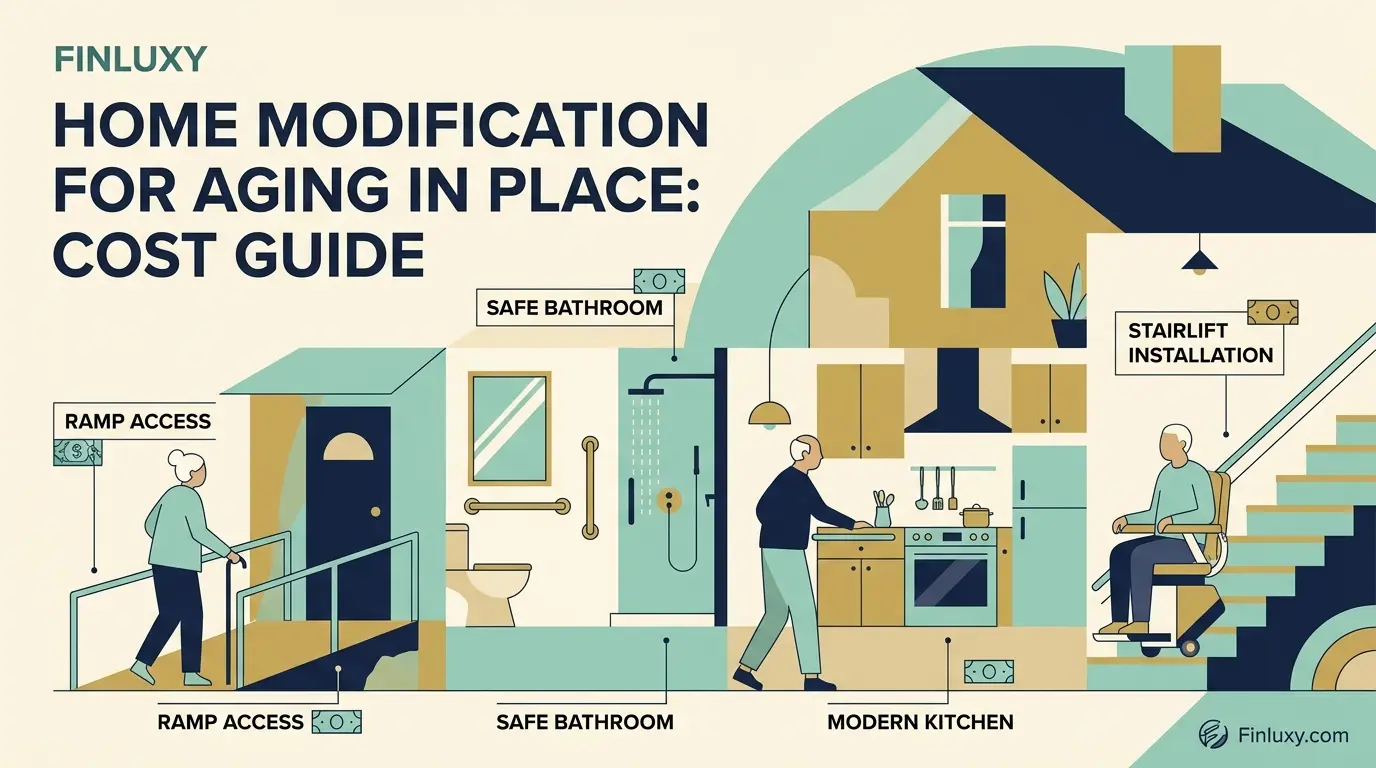
A complete bathroom retrofit for wheelchair access runs $15,000 or more, while three grab bars cost about $140. That 100-fold spread is the entire problem with budgeting for aging in place: the category stretches from a screw-in part you install yourself to a six-figure home elevator, and most cost coverage flattens it into a single misleading “average.”
For households earning $150k+, the relevant question isn’t whether modifications are affordable — they almost always are relative to the alternatives. According to the Genworth Cost of Care Survey for 2024, assisted living runs a national median of $70,800 per year and a private room in a nursing home reaches $127,750. A one-time $20,000 home retrofit that defers a facility move by even two years is not a close call. The question is which modifications actually buy independence, and at what point the spending stops being a renovation and becomes a parallel care infrastructure.
Scope: This analysis covers one-time home modification costs for aging in place in the United States, drawn from 2024–2026 data. Facility benchmarks come from the Genworth 2024 Cost of Care Survey (rates collected July–December 2024). Modification component costs are inherently variable — they depend on home configuration, regional labor rates, material grade, and whether work is bundled into an existing remodel. Where a single authoritative point figure was unavailable, ranges are reported from named industry and remodeling sources and labeled as such. These are cost figures, not financial or medical advice; a Certified Aging-in-Place Specialist should assess any specific home.
The numbers that matter first
Falls drive most of the urgency, and the fall economics are stark. The CDC reports that more than one in four adults aged 65 and older falls each year, with roughly 3 million treated in emergency departments. The National Council on Aging, citing CDC data based on 2020 figures, puts the total health care cost of non-fatal older adult falls at $80 billion per year, up from $50 billion in 2015. The same source estimates the average inpatient cost per fall injury at $18,658 — which means a single prevented fall can pay for a fully retrofitted bathroom.
| Metric | Figure |
|---|---|
| Grab bar installation (one bathroom) | $600–$750 |
| Straight stair lift (installed) | $2,200–$8,500 |
| Full accessible bathroom retrofit | $15,000+ |
| Residential elevator | $30,000–$60,000+ |
| Assisted living, annual median (2024) | $70,800 |
Sources: Bankrate/Gehman Design Remodeling and CostToRenovate 2026 contractor data (modification ranges); Genworth Cost of Care Survey 2024 (assisted living). Modification figures are ranges reflecting home and regional variation.
Demand confirms the trend. AARP’s 2024 Home and Community Preferences Survey, fielded June–July 2024 across 3,090 adults, found that 75% of adults aged 50 and older want to remain in their current homes as they age. More than half — 51% — say they need a home that supports independent aging, and among the modifications they anticipate, grab bars (72%) and entryway enhancements (71%) lead the list.
Cost breakdown by modification tier
The most useful way to map this category is by construction intensity, not by room. Three tiers separate cleanly: DIY-grade safety fixes, professionally installed mobility equipment, and structural reconfiguration. Each tier roughly an order of magnitude more expensive than the last.
Tier one is the low-cost safety layer. Suction-cup grab bars install in minutes for under $30, per ElderLife Financial’s 2026 cost guide, though properly anchored bars screwed into wall studs run $600–$750 for a full bathroom when professionally installed, according to figures from Gehman Design Remodeling published by Bankrate. Non-slip flooring runs under $3 per square foot. Lever-style door handles, rocker light switches, and motion-sensor lighting fall here too — converting an entire home to rocker switches costs $1,500–$2,000. This tier addresses the majority of fall risk for a few thousand dollars.
Mobility equipment defines the middle tier, and it is where costs become serious. A straight stair lift runs $2,200–$8,500 installed, per CostToRenovate’s 2026 contractor survey; a curved staircase pushes that to $7,500–$15,000 or more because the rail must be custom-fabricated. Walk-in tubs span $4,000–$18,000. A tub-to-shower conversion runs $1,800–$2,500 at the low end, climbing to $6,000–$12,000 for a roll-in shower built for wheelchair access. Modular aluminum ramps and comfort-height toilets also live in this band.
Structural work is the top tier, where modification becomes renovation. Widening a doorway for a wheelchair costs roughly $2,000–$2,500 per door. A residential elevator runs $30,000–$60,000 or more, with some sources citing $80,000 as a practical floor for retrofit installations. Converting first-floor living space into a full bedroom-and-bathroom suite — often the single most valuable modification for genuine aging in place — can exceed $100,000. These projects require permits, architectural plans, and sometimes structural engineering.
| Modification | Cost Range | Tier |
|---|---|---|
| Suction-cup grab bars (DIY) | Under $30 each | Safety layer |
| Grab bars, one bathroom (installed) | $600–$750 | Safety layer |
| Non-slip flooring | Under $3/sq ft | Safety layer |
| Rocker switches, whole home | $1,500–$2,000 | Safety layer |
| Tub-to-shower conversion | $1,800–$2,500+ | Mobility |
| Straight stair lift | $2,200–$8,500 | Mobility |
| Roll-in shower conversion | $6,000–$12,000 | Mobility |
| Curved stair lift | $7,500–$15,000+ | Mobility |
| Walk-in tub | $4,000–$18,000 | Mobility |
| Widen doorway (per door) | $2,000–$2,500 | Structural |
| Residential elevator | $30,000–$60,000+ | Structural |
| First-floor suite conversion | $100,000+ | Structural |
Sources: ElderLife Financial (2026), CostToRenovate (2026), Bankrate/Gehman Design Remodeling. All figures are ranges; model-specific and region-specific point figures were not available from a single primary source, consistent with the variable nature of remodeling work.
Finluxy Care Cost Daily Rate
The proprietary benchmark for this cluster expresses all-in care cost as a daily rate, which makes the home-modification trade-off concrete. Home modifications are one-time capital expenditures, not daily operating costs — so the honest comparison is to amortize a modification budget against the daily rate of the facility care it defers.
| Care path | Finluxy Care Cost Daily Rate | Basis |
|---|---|---|
| Home health aide (44 hrs/week) | $175/day | Genworth 2024, $77,792/yr |
| Assisted living | $148/day | Genworth 2024, $70,800/yr ÷ 12 ÷ ~30 |
| Nursing home, private room | $374/day | Genworth 2024, $127,750/yr |
| $20,000 modification, amortized over 5 yrs | ~$11/day | $20,000 ÷ 1,825 days |
| $100,000 first-floor suite, amortized over 10 yrs | ~$27/day | $100,000 ÷ 3,650 days |
Sources: Genworth Cost of Care Survey 2024 for facility rates; amortization calculated by Finluxy. Facility Finluxy Care Cost Daily Rate figures use Genworth cluster benchmarks; amortized modification rates exclude maintenance and assume no additional in-home care.
The amortized math is the entire argument. A $20,000 modification spread over five years costs about $11 per day — roughly 7% of the home health aide daily rate and a fraction of any facility benchmark. Even a $100,000 first-floor suite, amortized across a decade, lands near $27 per day. None of this captures the in-home care a person may still need alongside the modified home, which is the line item that actually dominates aging-in-place budgets. The modification is cheap. The ongoing care is not, and analysis comparing Medicare versus private pay coverage shows how little of that recurring cost public programs absorb.
What most coverage overlooks
Standard aging-in-place articles present modification costs as a substitute for facility care. The data shows the opposite for the affluent household: modifications are almost never a substitute, and they are not the expensive part. The expensive part is the human labor that a modified home enables but does not replace.
Consider the arithmetic. The most aggressive plausible one-time modification budget — say $150,000 for a full structural reconfiguration with elevator and accessible suite — equals roughly two years of the Genworth 2024 home health aide median of $77,792, or just over one year in a private nursing home room. A modified home does not feed, bathe, or supervise anyone. It makes it physically possible for an aide to do so more efficiently and for the resident to do more independently. The capital expenditure on the structure is the small, finite number; the operating expenditure on care is the large, open-ended one. Coverage that frames a stair lift as the cost of aging in place is measuring the wrong line. The real budget question for a $150k+ household is the recurring cost of part-time versus full-time in-home aides, against which the modification is a rounding error.
Funding offsets worth knowing
Few modification costs are reimbursable, which surprises households expecting Medicare to help. Original Medicare does not cover home modifications as a general rule; it treats grab bars and ramps as non-covered home improvements rather than durable medical equipment. Certain Medicare Advantage plans have begun offering limited supplemental benefits for safety modifications, but coverage is plan-specific and capped.
Veterans represent the clearest exception. Per VA regulations in effect for 2024, the Special Housing Adaptation (SHA) grant provides up to $23,444 toward home modifications for eligible veterans with qualifying service-connected disabilities, and the larger Specially Adapted Housing grant covers substantially more for severe disabilities. State and local Area Agencies on Aging also offer means-tested retrofit assistance and equipment lending, though income thresholds typically exclude $150k+ households. For most affluent families, modifications are an out-of-pocket capital expense — which is also why the amortized daily-rate framing matters more than chasing reimbursement.
The $150k+ household decision
At this income level, the binding constraint is rarely the modification budget itself. It is sequencing and resale. Two decisions dominate.
First, bundle proactively. NAHB’s remodeler data shows 91% of remodelers report clients planning accessibility upgrades before they are strictly necessary, and the reason is cost. Adding grab-bar blocking and a curbless shower to a bathroom you are already gutting costs a fraction of doing the same work later as a standalone emergency project. For a household already contemplating a renovation, the marginal cost of aging-in-place features is small; the cost of retrofitting after a fall is not. This is the single highest-leverage move available.
Second, weigh resale honestly. Most home renovations do not fully recoup their cost at resale, and highly specialized modifications — a residential elevator, a medically configured bathroom — can narrow the buyer pool. A $150k+ household can afford to treat these as consumption rather than investment, but should price them that way: the value is years of independence retained, not equity built. Where the modification doubles as a broadly appealing upgrade — a curbless shower, wider doorways, better lighting, a main-floor suite — the resale penalty largely disappears. The planning calculus extends well beyond the house itself; modifications are one input into a larger parent care savings target, alongside the recurring care costs that ultimately determine whether aging in place is financially durable. For families weighing the home route against the alternatives, the full elder care cost guide for affluent families sets the modification decision in the context of assisted living costs by state and memory care facility pricing, where the daily-rate gap makes the case for modification most forcefully. Those whose planning began at a lower income tier may find the elder care planning approach at $100k income a useful baseline before scaling assumptions upward.
Does Medicare pay for home modifications like grab bars or ramps?
Original Medicare generally does not cover home modifications, classifying grab bars, ramps, and similar improvements as non-covered home upgrades rather than durable medical equipment. Some Medicare Advantage plans offer limited supplemental safety-modification benefits, but these are plan-specific and capped. Most $150k+ households should plan to fund modifications out of pocket.
What is the single most cost-effective aging-in-place modification?
Professionally installed bathroom grab bars at $600–$750, combined with non-slip flooring under $3 per square foot, address the largest single source of fall risk for a few thousand dollars. Given that the National Council on Aging cites an average inpatient fall-injury cost of $18,658, this tier offers the strongest cost-avoidance return.
How does a one-time modification budget compare to facility care?
A $20,000 modification amortized over five years costs roughly $11 per day. By comparison, the Genworth 2024 benchmarks underlying the Finluxy Care Cost Daily Rate put assisted living at $148/day and a private nursing home room at $374/day. The modification is inexpensive; the recurring in-home care it enables is the dominant cost.
Should I install modifications before they are needed?
Bundling accessibility features into a renovation you are already doing costs a fraction of standalone emergency retrofits, and NAHB data shows 91% of remodelers now report clients planning ahead. Broadly appealing upgrades — curbless showers, wider doorways, a main-floor suite — also carry little resale penalty.
Methodology
Facility care benchmarks come from the Genworth Cost of Care Survey for 2024, the designated primary source for this cluster, with rates collected from more than 15,000 provider surveys between July and December 2024. The Finluxy Care Cost Daily Rate for each facility type uses Genworth’s published cluster benchmarks ($175/day home health aide, $148/day assisted living, $374/day nursing home private room); amortized modification daily rates were calculated by dividing one-time costs by the number of days in the stated horizon.
Fall prevalence and cost data come from the CDC and the National Council on Aging, citing CDC figures based on 2020 data. Aging-in-place preference data comes from AARP’s 2024 Home and Community Preferences Survey (3,090 adults, fielded June–July 2024). Modification cost ranges were synthesized from named industry and remodeling sources — ElderLife Financial (2026), CostToRenovate (2026), and Gehman Design Remodeling figures published by Bankrate — because no single government primary source publishes standardized modification pricing. Consistent with this cluster’s protocol, where model-specific or region-specific point figures were unavailable, defensible ranges are reported and labeled rather than fabricated as point estimates. Where industry sources differed, the wider reported range was retained.
Sources & References
- Genworth Cost of Care Survey 2024 — national and state long-term care cost benchmarks
- AARP 2024 Home and Community Preferences Survey — aging-in-place preferences and anticipated modifications
- National Council on Aging — fall prevalence and cost facts citing CDC data
- CDC MMWR — nonfatal and fatal falls among adults aged 65 and older
- ElderLife Financial — home modification cost tiers for aging in place
- CostToRenovate — 2026 contractor pricing for mobility equipment and structural work
- Bankrate / Gehman Design Remodeling — modification cost estimates and resale impact
- AARP / VA — Special Housing Adaptation grant figures for 2024