 Analysis by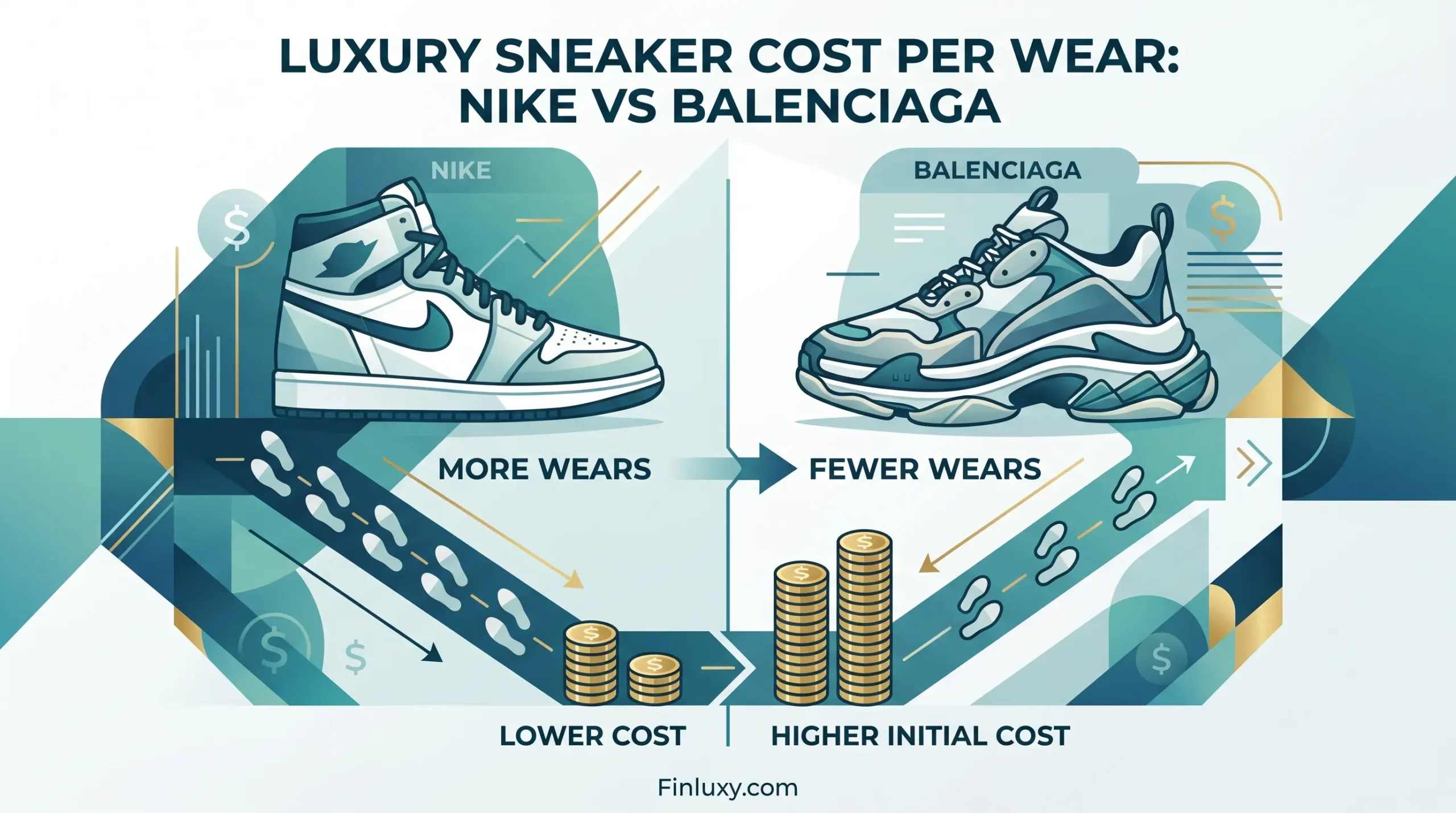
A Balenciaga Triple S retails for roughly $1,100. A Nike Air Force 1 ’07 retails for $130, per Nike.com as of June 2026. That is an 8.5x price gap on two shoes that occupy the same slot in a wardrobe — the everyday casual sneaker. The marketing pitch for the luxury pair leans on durability, craftsmanship, and the idea that a designer sneaker is an investment that holds value. The completed-sale data says otherwise, and the gap between the pitch and the resale ledger is the entire story here.
This analysis runs both shoes through a single framework: net cost per wear methodology, which subtracts estimated resale value from retail price and divides by projected wears. Then it indexes each against a $50 fast-fashion sneaker to produce a relative figure. The numbers reorder the usual ranking, but not in the direction the luxury sneaker’s defenders would predict.
Scope: This compares the Balenciaga Triple S (retail clustered at $1,100–$1,290) against the Nike Air Force 1 ’07 ($130), both as everyday casual footwear for US buyers. Retail figures are current as of June 2026; resale figures draw from The RealReal and Vestiaire Collective completed-sale and active-listing data observed in 2025. Sneaker resale is volatile, colorway-dependent, and sensitive to condition in a way handbags are not — soles and uppers degrade with wear, so a single resale “value” is a range, not a point. Wear counts are stated assumptions, not measured data; the BLS Consumer Expenditure Survey tracks footwear spending but not individual garment wearings. Treat every cost-per-wear figure as a modeled estimate, not a guaranteed outcome.
The numbers at a glance
| Metric | Balenciaga Triple S | Nike Air Force 1 ’07 |
|---|---|---|
| Retail price | ~$1,100 | $130 |
| Estimated resale value (used, good condition) | $200–$565 | $40–$70 |
| Net cost (retail − resale, midpoint) | ~$717 | ~$75 |
| Cost per wear (100 wears assumed) | ~$7.17 | ~$0.75 |
| Finluxy Cost-Per-Wear Index | 1.43× | 0.15× |
Sources: Nike.com (retail, June 2026); The RealReal and Vestiaire Collective completed-sale and listing data (resale, 2025); Finluxy calculation. Resale midpoints used for net cost: Balenciaga $383, Nike $55.
What each shoe actually costs to own
Start with the retail price, because the two figures are not in the same universe. The Triple S sits at roughly $1,100 across most colorways, with The RealReal listing several pairs at an estimated retail of $1,100 and a few special editions at $1,190 or higher in its 2025 marketplace data. Nike lists the Air Force 1 ’07 at $130, a price that has held remarkably steady and dropped to $73 during Nike’s 2025 Black Friday event, per The Street.
Resale is where the durability narrative gets tested. On The RealReal, used Triple S pairs in 2025 listed across a wide band — roughly $200 to $565 depending on condition, colorway, and size — against that $1,100 estimated retail. That is a recovery rate of about 18% to 51%, and the lower end dominates the listings. Sneakers are not handbags. A Triple S shows wear on the sole stack and the distressed upper almost immediately, and the resale market prices that degradation hard. Vestiaire Collective’s Triple S inventory tells the same story: pre-owned pairs routinely list at up to 70% off retail.
The Nike side is simpler. A used Air Force 1 ’07 in good condition resells for roughly $40 to $70 on general resale platforms, which against a $130 retail is a recovery rate of 30% to 54% — comparable to the Balenciaga in percentage terms, but trivial in absolute dollars. The Triple S loses an estimated $535 to $900 in absolute value across an ownership period. The Air Force 1 loses $60 to $90. One of these is a rounding error in a $150k+ household budget. The other buys a flight.
The wear assumption that decides everything
Cost per wear lives or dies on the denominator. The BLS Consumer Expenditure Survey confirms footwear is a recurring spend — it does not tell you how many times anyone wears a specific pair. So the assumption has to be explicit. This analysis uses 100 wears as a baseline for an everyday casual sneaker owned over two to three years: roughly one wear a week, allowing for rotation with other shoes. That is generous to neither shoe and consistent across both.
At 100 wears, the Triple S net cost of about $717 (using the $383 resale midpoint) produces a cost per wear near $7.17. The Air Force 1, net cost about $75, lands at roughly $0.75 per wear. The luxury sneaker costs nearly ten times as much per wearing. Push the Balenciaga to 200 wears — aggressive for a chunky sneaker whose sole compresses — and it still sits at about $3.59 per wear, more than four times the Nike’s figure even when you double its usage and hold the Nike flat.
The Finluxy Cost-Per-Wear Index
The Finluxy Cost-Per-Wear Index divides each shoe’s cost per wear by a fast-fashion baseline: a $50 sneaker with zero resale value worn 10 times, which produces a baseline cost per wear of $5.00. An index below 1 means the item beats fast fashion on a per-wear basis. Above 1 means it loses.
| Item | Net cost | Wears | Cost per wear | Finluxy Cost-Per-Wear Index |
|---|---|---|---|---|
| Balenciaga Triple S | ~$717 | 100 | ~$7.17 | 1.43× |
| Nike Air Force 1 ’07 | ~$75 | 100 | ~$0.75 | 0.15× |
| Fast-fashion baseline | $50 | 10 | $5.00 | 1.00× |
Source: Finluxy calculation using retail (Nike.com, June 2026) and resale midpoints (The RealReal, Vestiaire Collective, 2025). Index = item cost per wear ÷ $5.00 baseline.
The result inverts the marketing logic. The Triple S posts an index of 1.43× — it is 43% more expensive per wearing than disposable fast fashion, despite the resale recovery. The Air Force 1 posts 0.15×, meaning it costs 85% less per wear than the fast-fashion baseline. The cheap luxury-adjacent sneaker is the genuine value play. The expensive one is the disposable item, financially speaking, because its enormous absolute depreciation swamps a respectable percentage recovery.
What most coverage overlooks
Sneaker resale writeups fixate on recovery rate — the percentage of retail you get back — and on that metric the Triple S and the Air Force 1 look similar, both landing somewhere in the 18% to 54% band. That framing flatters the luxury shoe. It hides the only number that hits a household’s bank account: absolute dollar loss per wearing.
The RealReal’s own 2025 Resale Report draws the boundary clearly. The platform’s documented appreciation stories are accessories that do not flex, compress, or scuff with use — Rolex Datejusts up 17% year over year, Goyard Saint Louis totes up 18%, Hermès Birkin 30 up 15%. Structured leather goods and steel watches hold value because wear is cosmetic and often desirable; the report even notes patina-worn bags selling up 45% in 2025. A sneaker’s value lives in its sole and upper, and both are consumed by the act of wearing. Bags that appreciate over time are a different asset class entirely from footwear, and conflating the two is the central error in “investment sneaker” marketing — a brand claim the source hierarchy for this analysis explicitly excludes.
The $150k+ household calculation
For a household in the top income quintile — the BLS sets the 2024 lower bound at $155,925 — a $1,100 sneaker is affordable. That is not the question. The question is whether it is the best use of a luxury-fashion dollar, and the per-wear math says a casual sneaker is the worst category in which to spend at the top of the market.
Consider the trade-off concretely. The roughly $970 difference between a Triple S and an Air Force 1 covers a meaningful fraction of a structured handbag that the resale data shows actually holds value. A buyer optimizing for both wardrobe presence and value retention would route discretionary spend toward the categories the resale market rewards — the logic behind a Birkin cost-per-use analysis or the Chanel Classic Flap investment math — and treat sneakers as consumption, not assets. If the Triple S earns its price through design satisfaction, that is a legitimate reason to buy it. Just don’t file it under investment. The same discipline applies across a designer wardrobe’s annual cost: the categories that depreciate fastest are exactly the ones where the cheaper option costs almost nothing to own.
There is also a consignment angle worth pricing in. Selling a used Triple S through an authenticated platform means paying a commission, and the consignment payout rates on a sub-$500 sale erode the already-thin recovery further. By the time the platform takes its cut, the net resale on a worn Triple S can slip below the lower bound modeled here — making the real cost per wear higher than the table shows. Footwear’s value retention sits well below what the broader designer handbag price increase data would lead you to expect for the category labeled “luxury.”
FAQs
Does the Balenciaga Triple S hold its value?
Partially. The RealReal’s 2025 listings show used Triple S pairs recovering roughly 18% to 51% of an estimated $1,100 retail, depending on condition and colorway. In percentage terms that is comparable to a Nike Air Force 1, but the absolute dollar loss — $535 to $900 — is far larger because the starting price is so much higher.
Why is the Air Force 1’s cost per wear so much lower?
Because its net cost after resale is tiny. At a $130 retail and roughly $55 resale midpoint, the net cost is about $75. Spread over 100 wears, that is roughly $0.75 per wearing. The Triple S net cost is near $717 over the same wear count, producing about $7.17.
Should sneakers ever be treated as investments?
Limited-release collaborations can appreciate on resale platforms shortly after launch. Standard everyday sneakers do not — they depreciate steadily as the sole and upper wear. The RealReal’s appreciation data centers on watches, jewelry, and structured handbags, not general footwear.
How many wears should I assume for cost per wear?
This analysis uses 100 wears for an everyday casual sneaker over two to three years. No public dataset tracks individual garment wearings, so the figure is a stated assumption. Adjust it to your own rotation; the methodology section below shows how.
Methodology
Cost per wear is calculated as (retail price − estimated resale value) ÷ projected wears. Retail prices come from Nike.com (Air Force 1 ’07, $130, June 2026) and The RealReal marketplace estimated-retail data (Triple S, $1,100–$1,290, 2025). Resale figures use completed-sale and active-listing data from The RealReal and Vestiaire Collective, both named secondary sources in this cluster’s data hierarchy; brand-owned “investment piece” claims and unverified eBay listing prices were excluded per that hierarchy. Because resale varies sharply by condition, colorway, and size, resale is reported as a range with a midpoint used for the point calculation. The Finluxy Cost-Per-Wear Index divides each item’s cost per wear by a $50 fast-fashion baseline at 10 wears ($5.00 per wear). Income-tier context draws on the BLS Consumer Expenditure Survey 2024 release. Where a model-specific resale point figure was unavailable, the analysis defaults to a defensible range from the secondary sources rather than a single fabricated number; the wear count is an explicit assumption, not measured data.
Sources & References
- Nike.com — Air Force 1 retail pricing
- The RealReal — Balenciaga Triple S marketplace and resale listings
- The RealReal — 2025 Luxury Resale Report
- Vestiaire Collective — Balenciaga Triple S pre-owned listings
- BLS Consumer Expenditure Survey — 2024 footwear and income-quintile data
- BLS — 2024 Consumer Expenditures news release, income quintile bounds
- The Street — Nike Air Force 1 2025 sale pricing