 Analysis by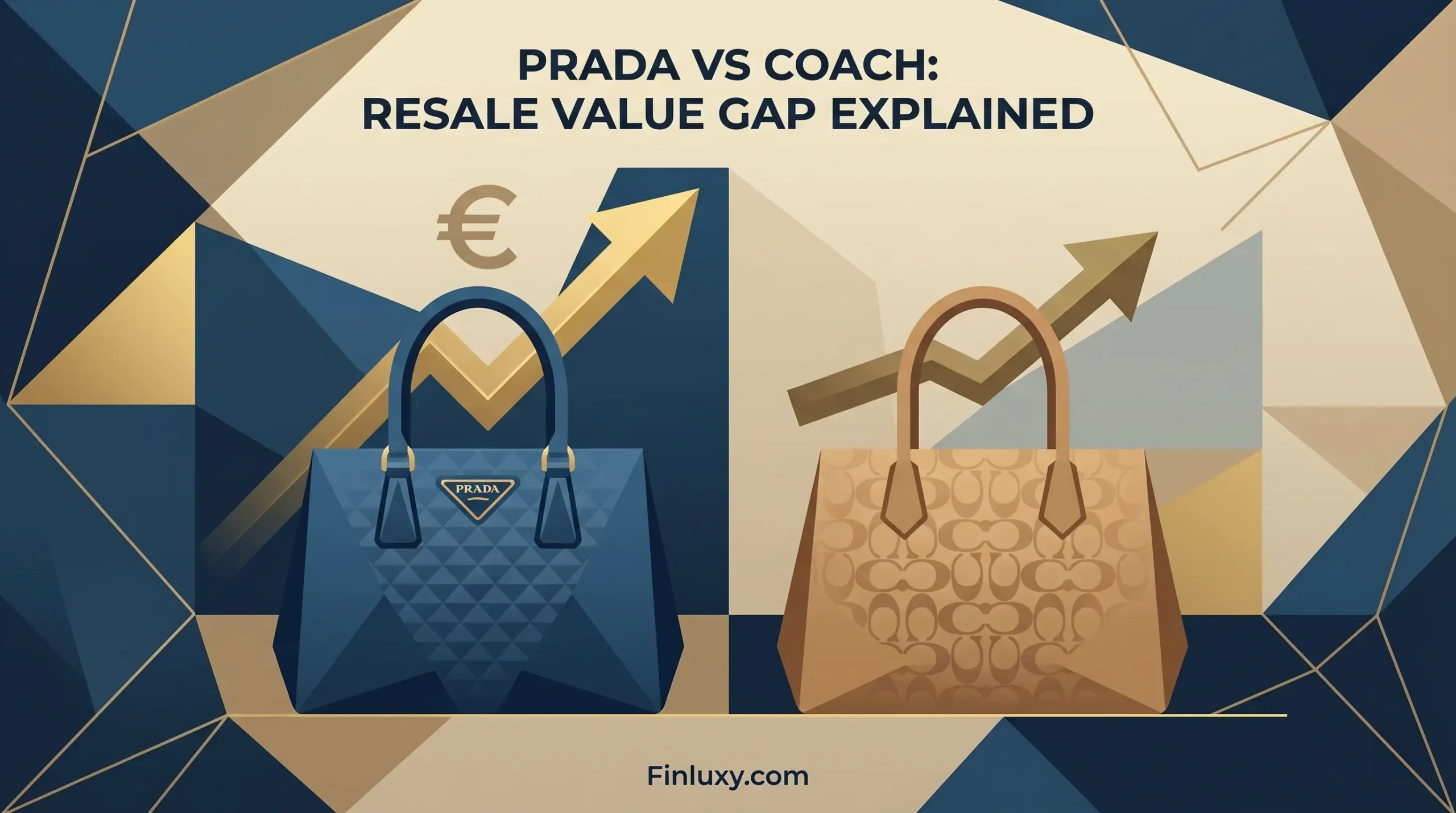
A Prada Galleria in Saffiano leather retails between $4,200 and $5,300 in the US and recovers 50% to 70% of that on the secondary market. A Coach Tabby 26 retails for $475 and recovers 60% to 70%. The brand priced nine to eleven times higher does not hold a larger share of its sticker — it holds a smaller one. That single inversion is the entire story most “Prada vs Coach” coverage gets backwards, and it reshapes which bag is actually cheaper to own per wear.
The instinct among $150k+ buyers is that paying more buys durability of value. Resale retention percentages from The RealReal, Vestiaire Collective, and specialist price guides say otherwise for this particular matchup. Retention rate and absolute dollars recovered move in opposite directions here, and conflating the two is where the analysis usually breaks.
Scope: this analysis compares the Prada Galleria (Saffiano leather, small to medium) against the Coach Tabby 26 in leather, using US retail prices current as of June 2026 and resale retention ranges drawn from secondary-market platforms. Retail figures are confirmed from Prada’s US listings and Coach’s official site; resale retention is reported as a range because neither The RealReal nor Vestiaire Collective publishes a public, model-specific completed-sale index for these two bags. Resale percentages reflect bags in good-to-excellent condition with original packaging — damaged or incomplete examples sell well below these ranges. Cost-per-wear depends on a wears assumption stated explicitly below; the BLS American Time Use Survey does not track individual garment wearings, so the wear counts are modeling assumptions, not measured data. Figures span 2024 (BLS Consumer Expenditure Survey) through June 2026 (retail). This is cost analysis, not financial or investment advice; handbags are consumer goods, not securities.
The numbers that matter
| Figure | Prada Galleria | Coach Tabby 26 |
|---|---|---|
| Retail price (US, June 2026) | $4,200–$5,300 | $475 |
| Resale value retention | 50%–70% | 60%–70% |
| Estimated resale value | $2,100–$3,710 | $285–$333 |
| Net cost (retail − resale) | $1,490–$2,650 | $143–$190 |
| Finluxy Cost-Per-Wear Index | 1.49×–2.65× | 0.29×–0.38× |
Sources: Prada US retail listings and Haute Secret Shoppers Prada price guide (2026); Coach official site (June 2026); resale retention from The RealReal commentary and secondary-market price guides (2025–2026). Net cost and Index calculated on 100-wear assumption; see methodology.
Retail price: where the gap is widest
Start with what each bag costs new, because this is the only figure in the comparison that carries no estimation error. The Prada Galleria, the brand’s most iconic structured silhouette in scratch-resistant Saffiano leather, sells in the US for roughly $4,200 for a small Saffiano version, climbing to $5,300 for medium and larger formats, per Prada’s US listings and the Haute Secret Shoppers price guide updated in 2026. designer handbag price trends have pushed these figures up steadily; the Galleria now sits at the top of Prada’s bag range by price.
Coach occupies a different universe on the sticker. The Tabby 26 in polished pebble leather retails at $475 on Coach’s official site as of June 2026, with quilted variants at $575 and smaller Tabby 20 formats lower still. Fortune reported the Tabby as a viral hit precisely because it costs a fraction of a comparable shoulder bag from Dior or Chanel. The price gap between a Galleria and a Tabby runs roughly nine to eleven times. Hold that ratio in mind, because nothing else in this comparison comes close to it.
Resale retention: where the gap nearly closes
Retention rate is the percentage of retail price a bag recovers on the secondary market. It is not the same as dollars recovered, and the distinction is the analytical core of this article. The Coach Tabby holds 60% to 70% of retail on platforms like The RealReal, according to secondary-market commentary tracking the bag through 2026. Southeast Asian resale data cited by regional sellers runs higher, into the 70%–80% band, but US-platform figures cluster in the lower 60s to 70.
Prada’s Galleria, despite costing an order of magnitude more, retains 50% to 70% of retail in good-to-excellent condition in classic colorways, per the Haute Secret Shoppers guide, with rare colorways and the mini format occasionally trading above retail. The RealReal’s 2025 Resale Report noted Prada’s strength in vintage — sales of its vintage bags nearly quadrupled year over year — but the structured Galleria’s everyday-leather retention sits in roughly the same band as Coach’s, not above it. The brand commanding nine times the price does not command a higher retention floor. Compared against bags that genuinely appreciate, the Galleria is a value-holder, not an investment vehicle; readers weighing the latter should consult the data on handbags that appreciate over time.
| Metric | Prada Galleria | Coach Tabby 26 |
|---|---|---|
| Retention rate (% of retail) | 50%–70% | 60%–70% |
| Dollars recovered on resale | $2,100–$3,710 | $285–$333 |
| Dollars lost to depreciation | $1,490–$2,650 | $143–$190 |
Retention ranges per secondary-market price guides and The RealReal commentary (2025–2026). Dollar figures derived by applying retention range to confirmed retail prices.
Read the table in both directions. By retention rate, the two bags are nearly tied — Coach edges Prada at the low end. By dollars recovered, Prada returns roughly ten times more cash, simply because there is vastly more money in the bag to begin with. Neither framing is wrong; they answer different questions. A buyer asking “what share of my money survives” gets one answer. A buyer asking “how much depreciation am I absorbing in absolute terms” gets the opposite.
Finluxy Cost-Per-Wear Index
Cost per wear converts the resale question into the only metric that reflects actual ownership: net cost spread across use. The formula is net cost — retail price minus residual resale value — divided by projected total wears. The Finluxy Cost-Per-Wear Index then benchmarks that figure against a $50 fast-fashion bag with zero resale value and 10 wears, a baseline of $5.00 per wear. An index below 1.0 means the luxury item costs less per wearing than disposable fashion.
Assume 100 wears for each bag over the ownership period — a reasonable midpoint for a daily-rotation handbag held several years, though the true figure depends entirely on how often it leaves the closet. The same methodology underpins the broader cost per wear framework for designer fashion.
| Step | Prada Galleria | Coach Tabby 26 |
|---|---|---|
| Net cost | $1,490–$2,650 | $143–$190 |
| Cost per wear (÷100) | $14.90–$26.50 | $1.43–$1.90 |
| Fast-fashion baseline | $5.00 | $5.00 |
| Finluxy Cost-Per-Wear Index | 1.49×–2.65× | 0.29×–0.38× |
Index = item cost per wear ÷ $5.00 fast-fashion baseline. Net cost from confirmed retail prices and retention ranges; 100 wears assumed per the scope disclaimer. Index above 1.0 = costlier per wear than fast fashion.
The Coach Tabby lands at 0.29× to 0.38× — between a third and 38% of the cost per wear of a $50 disposable bag. The Prada Galleria lands at 1.49× to 2.65×, meaning it costs 49% to 165% more per wearing than fast fashion even after resale recovery. The Tabby is cheaper per wear than fast fashion. The Galleria is not. At 100 wears, the verdict is unambiguous, and it runs directly against the assumption that the pricier bag is the smarter long-run buy.
One caveat sharpens rather than softens this. The Galleria’s index improves with heavy use: at 300 wears its net cost spreads to $4.97–$8.83 per wear, pulling the low end just under the fast-fashion baseline. The Tabby never needs that rescue. To make the Prada competitive on cost per wear, a buyer must commit to wearing it into the ground — which most $150k+ buyers, who rotate among several bags, do not.
What most coverage overlooks
Comparison articles fixate on retention percentage and stop there, which produces the misleading conclusion that Prada and Coach are roughly equivalent stores of value. The overlooked figure is absolute depreciation in dollars. A Galleria buyer absorbs $1,490 to $2,650 in lost value over the ownership period. A Tabby buyer absorbs $143 to $190 — somewhere between a tenth and a fourteenth of the loss. The percentages look similar; the dollar bleed does not. That gap is invisible to any analysis that reports only retention rate, and it is the single most decision-relevant number for a buyer who cares about money rather than bragging rights about “holding value.” Resale rate is a ratio that flatters expensive bags. Dollars lost is the figure that bills you.
What the $150k+ household should weigh
The BLS Consumer Expenditure Survey 2024, released December 2025, sets the lower bound of the highest income quintile at $155,925 and reports average apparel spending of $2,001 per year — about 2.5% of total expenditures. A single Galleria consumes more than two years of that average apparel budget; a Tabby consumes under a quarter of one year. For a household near the $150k+ threshold, the Galleria is not an accessory purchase, it is a budget event, and the cost-per-wear math should inform whether it earns that status.
The defensible case for the Galleria is not financial — it is durability, Saffiano leather’s resistance to wear, and a status signal Coach does not transmit. If those qualities justify the spread to a given buyer, the purchase is rational on its own terms. But the buyer should make that trade with eyes open: the premium buys craftsmanship and signaling, not superior value retention. The household optimizing strictly for cost per wear, or building toward a sensible annual designer fashion budget, gets dramatically more wearings per dollar from the Tabby and can redirect the $1,300-plus difference toward bags that actually appreciate, or toward nothing at all. For anyone planning to eventually resell, the spread between gross resale price and net payout matters too — platform commission structures, detailed in our breakdown of luxury consignment payout rates, can erode the recovered dollars further on both bags.
Does the Prada Galleria hold its value better than the Coach Tabby?
By retention rate, no meaningful edge: the Galleria retains 50%–70% of retail and the Tabby 60%–70%, per 2025–2026 secondary-market data. By absolute dollars recovered, the Galleria returns far more cash simply because it costs far more new. “Holds value better” depends on which of those two questions you are asking.
Which bag is cheaper per wear?
The Coach Tabby, decisively. At 100 wears its Finluxy Cost-Per-Wear Index is 0.29×–0.38× versus the Galleria’s 1.49×–2.65×. The Tabby costs less per wearing than a $50 fast-fashion bag; the Galleria costs more, unless worn several hundred times.
Why do the figures appear as ranges instead of exact numbers?
Neither The RealReal nor Vestiaire Collective publishes a public, model-specific completed-sale index for these two bags, and retail varies by size and material. Reporting a defensible range from secondary sources is more honest than fabricating a single point figure that resale platforms do not actually confirm.
Is either bag a genuine investment?
Neither, in the appreciation sense. Both lose value from retail in most condition and colorway scenarios. The Galleria preserves a larger share in dollars; the Tabby preserves a comparable share in percentage. Bags that reliably trade above retail are a different category entirely.
Methodology
Retail prices were confirmed from primary brand-adjacent sources: Prada’s US listings and a 2026 Prada price guide for the Galleria, and Coach’s official site for the Tabby 26 ($475, June 2026). Income and apparel-spending context comes from the primary government source for this cluster, the BLS Consumer Expenditure Survey 2024 (released December 2025). Resale retention is drawn from secondary analytical sources — The RealReal’s 2025 Resale Report and specialist secondary-market price guides — and reported as a range because no platform publishes a public model-specific completed-sale index for these bags; per cluster rules, secondary sources contextualize but cannot anchor a key claim as a sole point figure, so ranges are used. The Finluxy Cost-Per-Wear Index applies net cost (retail minus residual resale value) divided by a stated 100-wear assumption, benchmarked against a $50 fast-fashion bag at 10 wears ($5.00 per wear baseline). The wear count is a modeling assumption; the BLS American Time Use Survey does not track individual garment wearings. Where figures appear in both body text and tables, they were copied verbatim to ensure consistency.
Sources & References
- BLS Consumer Expenditure Survey 2024 — income quintile bounds and apparel spending
- The RealReal 2025 Resale Report — luxury resale trends and brand demand
- Haute Secret Shoppers — Prada bag price guide and Galleria retention, 2026
- Coach official site — Tabby 26 retail pricing, June 2026
- Fortune — Coach Tabby pricing and accessible-luxury positioning
- Bagaholic — Prada Galleria US and Europe retail pricing, 2026