 Analysis by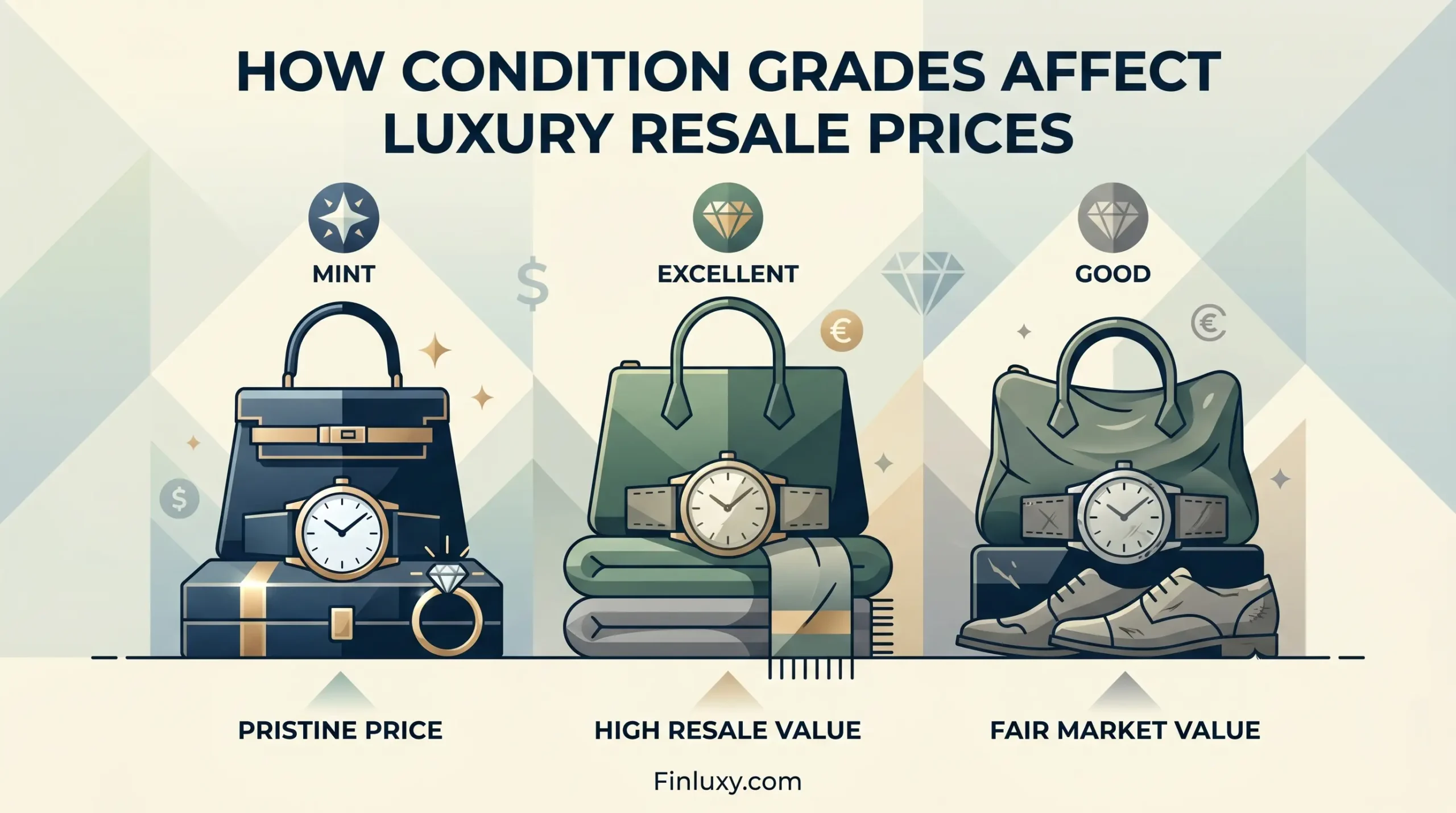
A Hermès Birkin in pristine condition and the identical reference in fair condition are not the same asset — they can sit 40 to 50 percentage points apart on the same pricing sheet, before a single dollar of seller’s commission is deducted. That spread is the entire subject here. Brand and model determine whether a luxury item retains value at all; condition grade determines how much of that retained value you actually collect at exit.
Most resale coverage fixates on which brands appreciate. The grade you carry into the transaction is the variable you can still influence after purchase, and it is the one buyers scrutinize hardest. The RealReal accepts items across five named tiers — luxury asset resale value guide conventions track the same logic — and the price gap between adjacent tiers is wider than most sellers assume going in.
Scope: This analysis covers condition-grade effects on secondary market value across handbags, fine watches, and collector vehicles, drawing on 2025 platform reports where available. Grade nomenclature is not standardized across platforms — The RealReal, Rebag, Chrono24, and Hagerty each use different scales — so cross-category comparisons describe directional magnitude, not interchangeable grades. Brand-level retention figures (e.g., Hermès, The Row) reflect averages across conditions and do not isolate grade alone. Figures are point-in-time and shift with market demand; treat ranges, not single numbers, as the operative guidance. This is cost analysis, not financial or investment advice.
The numbers that matter most
Five figures frame the entire condition-grade question for a $150k+ seller deciding whether to restore, sell as-is, or hold.
| Metric | Figure | Source & Period |
|---|---|---|
| Handbag price band, excellent condition | 60–80% of original retail | Secondary reseller data, 2024–2026 |
| Handbag price band, good/fair condition | 40–60% of original retail | Secondary reseller data, 2024–2026 |
| Full-set premium (box, card, receipt) | 10–20% over “item only” | LuxPricer, 2026 |
| Collector vehicle #2 vs #3 condition gap | 31.3% (Jan 2025), up from 23.3% (Jan 2020) | Hagerty Price Guide, 2025 |
| The RealReal “fair condition” sales growth | +32% year over year | The RealReal 2025 Resale Report, Sept 2025 |
Sources: The RealReal 2025 Resale Report (Sept 2025); Hagerty Price Guide condition analysis (2025); LuxPricer (2026); aggregated secondary reseller pricing (2024–2026). Bands are directional; specific items vary by brand and demand.
What the grades actually are
The RealReal grades on a five-tier accepted scale — fair, good, very good, excellent, and pristine — with an additional “as-is” designation for items needing repair. Items in pristine condition are identical or nearly identical to new items, complete with tags. Excellent means essentially identical to new without the tags; the gradient runs down from there to fair, which carries significant visible wear and possible repair needs.
Watches follow a different vocabulary. Chrono24 distinguishes principally between unworn and worn, with condition sub-descriptors layered on top, and the platform updated its condition framework in April 2025 to sharpen how sellers describe wear. Collector vehicles use a numeric scale entirely. Hagerty Price Guide publishes values according to four grades — #1 (concours), #2 (excellent), #3 (good), and #4 (fair) — and notes that the vast majority of collector cars are in #3 condition. The vocabulary differs, but the structure is identical across categories: a top tier almost no item reaches, a broad middle where most real inventory sits, and a discounted floor.
This matters because grading is not symmetric. The distance from excellent to pristine is small in description but can be large in price, while the distance from good to fair compresses value sharply on the downside. A seller who assumes grades are evenly spaced misprices the decision to restore.
Handbags: the steepest documented cliff
For leather goods, the grade-to-price relationship is the clearest. Industry pricing convention places bags in excellent condition at roughly 60–80% of original retail, while good or fair examples fall to roughly 40–60%, depending on wear. That is a swing of up to 40 percentage points of original retail attributable to condition alone, before accounting for brand. The exact figure depends heavily on which house made the bag — a topic covered in the designer handbag resale by brand data.
Documentation compounds the grade effect. “Full set” items — those including the original box, dust bag, authenticity card, and receipt — typically fetch 10% to 20% more than “bag only” listings. A pristine bag missing its papers can price like an excellent bag with full documentation. The two variables interact rather than add.
Why the brand floor changes the grade math
Condition discounts apply to a base value, and that base value is set by brand. This is where the grade conversation gets misread. A 40% condition haircut on a Birkin and a 40% haircut on a contemporary “it” bag produce wildly different dollar outcomes, because the starting retention is not comparable.
Rebag’s 2025 Clair Report, released December 2025, quantifies the brand floor. Hermès reclaimed the top position, reaching an average 138% value retention—a 38% year-over-year increase, with eight Hermès styles sold above their original retail prices this year, led by the Kelly Mini II at 282 percent of its original cost, the Sellier Birkin at 183 percent, and the Constance at 137 percent. When a bag resells above retail even in graded-down condition, the condition discount eats into appreciation rather than into principal. The Hermès Birkin resale value figures show this buffer in detail.
Contrast that with the broad middle of the market. Contemporary or “it” bags from brands like Prada, Gucci, or Fendi may see a steeper initial drop, often retailing for 40% to 60% of their original price on the secondary market. A condition downgrade on these bags lands directly on a value that has already fallen below retail. The same grade slip costs the Hermès seller surrendered upside and costs the Gucci seller real principal.
One 2025 development complicates the assumption that worse condition always means a weaker market. Sales for “fair condition” items—or pieces with heavy wear—are up 32 percent, with growth driven by new buyers. The RealReal also reported that sales for timeworn bags are up 45 percent in 2025, concentrated in classic houses — Louis Vuitton, Chanel, Hermès, and Balenciaga. The discount on fair-condition classics is real, but liquidity at that grade has improved, which shortens time-to-sale even if it does not lift price.
Timepieces invert part of the handbag logic. An unworn modern watch from a high-demand brand can carry a premium over a serviced, worn example of the same reference — and in certified channels, that premium is measurable. A Chrono24 analysis found that official Rolex CPO watches are notably more expensive than identical unworn references sold by reputable gray dealers, with one mid-January 2023 check showing a Submariner Date ref. 116610LN CPO cost $19,400, whereas the same watch brand-new cost only $15,700 on Chrono24 — a markup of roughly 25%.
That figure is dated to early 2023, and the watch secondary market has moved since, so treat it as illustrative of the structure rather than the current spread. The structural point holds: in watches, the buyer is partly paying for certification and condition assurance, not just the physical object. A worn watch with full box and papers can outprice an unworn watch without provenance. Sellers weighing channels should read the luxury watch selling platforms fee comparison, because the platform’s grading standard interacts with the price it will support.
The condition vocabulary itself is a transaction risk. Chrono24’s distinction between “unworn” and “new” confuses many sellers, and a mislabeled grade invites returns. Accurate self-grading is not pedantry here — it is the difference between a clean sale and a disputed one.
Collector vehicles: the widening gap
Vehicles show the most striking recent trend in condition pricing: the gap between grades is growing. Hagerty’s data is explicit. In January 2020, the average difference between #3 and #2 values was 23.3%. In January 2025, the gap had grown to 31.3%, suggesting a shift in buyer preferences to perfect cars with no needs—and the willingness to pay up for them.
Appreciation rates diverge by grade as well. Over a recent five-year window, Hagerty’s John Wiley reported the average increase by condition: condition #1 value is 32.4 percent; for condition #2 it is 33.8 percent; for condition #3 it is 29.4 percent; for condition #4 it is 23.4 percent. The best examples are not just worth more — they are pulling away. That has a direct implication for the restore-or-sell decision, since the math on moving a #3 up to #2 changes when the grades themselves are diverging in value. Sellers running the channel math should consult the classic car auction seller fees breakdown before committing to an auction exit.
Documentation and originality layer on top of the numeric grade. An original-owner car with full service history outprices an identical car of equal physical condition, because provenance reduces buyer uncertainty. Grade measures the object; provenance measures the story, and both price separately.
Finluxy Resale Premium Index by condition grade
To make the grade effect concrete, the Finluxy Resale Premium Index expresses secondary market value as a percentage of original retail. Index above 100 means the item resells above what it originally cost; below 100 means it has depreciated. The table below models the same item at different condition grades, holding brand and reference constant, using the documented price bands.
| Category & example | Condition grade | Resale as % of original retail | Finluxy Resale Premium Index |
|---|---|---|---|
| Classic-house handbag (e.g., Hermès core style) | Pristine / full set | 120–140% | 120–140 |
| Classic-house handbag | Good / fair | 85–110% | 85–110 |
| Contemporary “it” bag (e.g., Gucci, Fendi) | Excellent | 60–80% | 60–80 |
| Contemporary “it” bag | Good / fair | 40–60% | 40–60 |
| Collector vehicle (#2 vs #3, segment-dependent) | #2 excellent vs #3 good | #2 ≈ 131% of #3 value | Relative, not retail-based* |
Index = (secondary market value ÷ original retail price) × 100. Bands derived from secondary reseller pricing (2024–2026), The RealReal 2025 Resale Report, Rebag 2025 Clair Report, and Hagerty Price Guide (2025). *Vehicle figure expresses #2-to-#3 ratio (Hagerty, Jan 2025), not a retail-based index, because collector vehicles are typically valued against price-guide condition tiers rather than original MSRP. Model-specific point figures were unavailable; ranges reflect segment averages.
Read the index this way: a classic-house bag can stay above 100 even after a downgrade to good condition, meaning the seller surrenders appreciation but not principal. A contemporary bag crossing from excellent to fair can fall from the 60s into the 40s — a loss measured against money already spent, not against a gain. Same percentage-point move, opposite financial meaning. That asymmetry is the single most underweighted fact in condition-grade pricing.
Methodology
Figures were prioritized from primary platform reports: The RealReal 2025 Resale Report (published September 2025) for condition-tier definitions and 2025 demand shifts, the Rebag 2025 Clair Report (published December 2025) for brand-level value retention, and the Hagerty Price Guide (2025 analysis) for collector vehicle condition-grade spreads. Chrono24 supplied watch condition framework and CPO-versus-unworn pricing, with the specific markup figure flagged as dated to early 2023.
Condition-to-price bands for handbags draw on secondary reseller pricing conventions (2024–2026) rather than a single primary source, because no platform publishes a standardized public schedule of grade-by-grade discounts; these bands are presented as ranges, not point figures, and cross-checked across multiple resellers for consistency. The Finluxy Resale Premium Index was calculated as secondary market value divided by original retail, times 100, applied to documented price bands. Where model-specific transaction data was unavailable, ranges reflect segment averages and are labeled as illustrative. Asking-price data without confirmed sold prices was excluded, as were platform-sponsored value reports with undisclosed methodology.
What the data shows that most coverage misses
The standard advice — “condition matters, keep your items pristine” — is directionally true and analytically useless, because it treats the grade penalty as uniform. It is not. The data shows the grade penalty is a function of where the item already sits relative to retail. For an item resting above 100 on the Finluxy Resale Premium Index, condition downgrades consume appreciation, and the seller still exits whole or ahead. For an item resting below retail, the identical downgrade consumes principal.
The 2025 data adds a second overlooked point: at the bottom of the grade scale, liquidity and price have decoupled for classic houses. Fair-condition sales rose 32% and timeworn classic bags rose 45% year over year — meaning a heavily worn Chanel or Louis Vuitton now sells faster than it used to, even as it sells for less. For a seller who values speed of exit over maximum proceeds, a fair-grade classic is no longer the dead inventory it once was. That is a behavioral shift, not a pricing one, and it does not appear in any grade-discount table.
The $150k+ household calculation
For a household at this income level, the operative decision is rarely “should I keep my Birkin nice.” It is whether to spend on professional restoration before sale, which channel to use, and whether grade-driven proceeds justify the effort at all. Restoration economics turn on the index position. Moving a sub-retail contemporary bag from good to excellent may recover real principal and clear the cost of the “spa day”; moving a classic-house bag already trading above retail rarely returns its restoration cost, because the buyer at that tier is often buying provenance and rarity, not flawless corners.
For collector vehicles, the widening #2-to-#3 gap argues differently. With the spread at 31.3% as of January 2025 and #2 cars appreciating faster than #3, a credible path from #3 to #2 can be worth pursuing on the right model — but only on the right model, since segment gaps range from under 3% on mature collectibles to over 50% on emerging ones. The decision is model-specific, and the luxury category value retention data should anchor it before any restoration check is written. Channel choice then compounds the outcome: auction commissions, consignment rates of 20–35%, and dealer trade-ins below market each subtract differently from the grade-determined price, and the luxury car selling channel comparison quantifies that drag. The grade sets the ceiling; the channel sets how much of the ceiling you keep. A financially sophisticated seller models both before deciding whether condition is worth defending or simply disclosing.
Frequently asked questions
How much does one condition grade cost in resale value?
It varies by category and by where the item sits relative to retail. For handbags, the move from excellent (roughly 60–80% of original retail) to good or fair (roughly 40–60%) can cost up to 40 percentage points of retail value. For collector vehicles, the #2-to-#3 gap averaged 31.3% as of January 2025 per Hagerty. There is no universal per-grade figure because grade scales and base values differ across platforms and brands.
Does a full set really add 10–20% to resale price?
For handbags, yes — original box, dust bag, authenticity card, and receipt typically add 10–20% over “item only” listings, per LuxPricer (2026). For watches, box and papers function similarly, and certified provenance can outweigh a one-grade condition difference. The premium reflects reduced buyer uncertainty, not the physical condition of the item itself.
Is it worth restoring a luxury item before selling?
Depends on the Finluxy Resale Premium Index position. For an item already trading above retail (many classic-house bags), restoration rarely returns its cost, since buyers at that tier prioritize rarity and provenance. For an item trading below retail, restoration that lifts the grade can recover real principal. Always net restoration cost against the realistic grade-driven price increase, not the gross.
Why are worn-out luxury bags suddenly selling well?
The RealReal reported fair-condition sales up 32% and timeworn classic bags up 45% in 2025, driven by new buyers and a cultural embrace of visible wear in heritage brands. Price per item at that grade remains discounted, but liquidity has improved — these items now sell faster than before, even if not for more.
Sources & References
- The RealReal — 2025 Resale Report (condition tiers, 2025 demand shifts)
- The RealReal — The Role of Condition in Luxury Resale (grade definitions)
- Rebag — 2025 Clair Report (brand value retention, Dec 2025)
- Hagerty — Condition-grade value gaps (#2 vs #3, 2025)
- Hagerty — Appreciation rates by condition grade
- Chrono24 — CPO vs gray market Rolex pricing (Jan 2023)
- Chrono24 — Watch condition framework update (April 2025)
- LuxPricer — Second-hand designer bag grading and full-set premium
- My Luxury Bargain — Condition-to-price bands for handbags