 Analysis by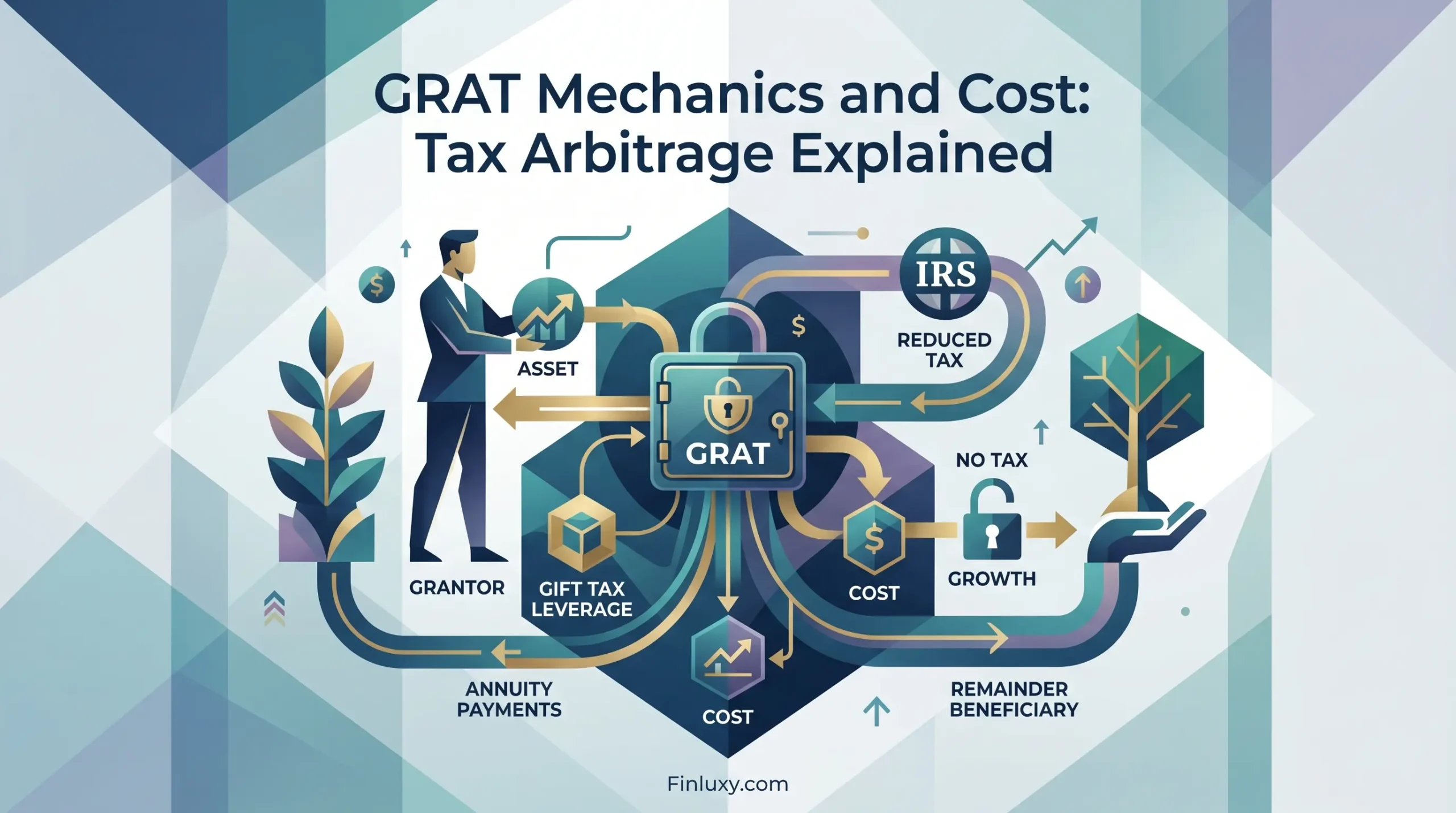
A two-year zeroed-out grantor retained annuity trust (GRAT) funded in June 2026 has to beat a 5.0% hurdle rate — the Section 7520 rate published by the IRS in Rev. Rul. 2026-11 — before a single dollar moves to your heirs tax-free. That number is the entire game. Everything below it is annuity payments flowing back to the grantor; everything above it is wealth transfer that escaped the 40% federal estate tax, and the spread between the two is the only thing a GRAT actually sells.
The arbitrage is narrower than it was. When the Section 7520 rate sat near 1% in 2020 and 2021, almost any equity portfolio cleared the hurdle. At 5.0%, the assets inside the trust have to work harder, and the legal and administrative costs of running the structure — which do not shrink when the hurdle rises — eat a larger share of the benefit. This article breaks down what a GRAT costs to build and operate, how the hurdle rate converts into a break-even return, and what the math looks like across the $5M–$25M net worth band.
This is educational cost analysis, not legal or tax advice. GRAT outcomes depend on the exact Section 7520 rate in the funding month, asset selection, the grantor surviving the annuity term, and drafting that conforms to Treasury regulations. Figures here reflect federal law as of June 2026 following the One Big Beautiful Bill Act (OBBBA), which made the elevated estate and gift tax exemption permanent and superseded the previously scheduled 2026 reduction. State estate and inheritance taxes are not modeled. Anyone implementing a GRAT should engage a licensed estate planning attorney and a CPA before funding.
The numbers that matter
| Figure | Value |
|---|---|
| Section 7520 hurdle rate (June 2026) | 5.0% |
| Federal estate tax rate (top) | 40% |
| Federal estate & gift tax exemption (2026, individual) | $15,000,000 |
| Typical GRAT setup cost (attorney drafting) | $3,000–$10,000 |
| Typical annual administration / trustee cost | $1,500–$5,000+ |
Sources: IRS Section 7520 interest rates, Rev. Rul. 2026-11 (June 2026); IRS estate and gift tax inflation adjustments for 2026; ACTEC and practitioner fee surveys (2024–2026). Cost ranges are segment estimates; model-specific fee data varies by jurisdiction and asset complexity.
How the mechanism works
A GRAT is an irrevocable trust. The grantor transfers appreciating assets in, then retains the right to a fixed annuity for a set term — most commonly two years for rolling structures. The Tax Adviser describes the present value of that retained annuity as calculated using the Section 7520 rate in effect the month the trust is funded. The remainder — whatever is left after the annuity stream is paid back — is the gift to the beneficiaries.
Zeroing out is the standard design. The annuity is set so that the present value of the payments back to the grantor equals the value of the assets contributed, which drives the remainder’s reported value to roughly zero. No taxable gift, no exemption consumed. The grantor is betting that the assets will earn more than the hurdle rate over the term, and that excess — the appreciation above 5.0% — lands with the heirs outside the estate.
Consider the asymmetry, because it is the reason GRATs persist despite a higher hurdle. If the assets underperform the 5.0% threshold, the grantor simply receives the assets back through the annuity payments. No wealth transfers, no gift tax exemption is touched, and the only loss is the setup and administration cost. If the assets outperform, the excess passes free of federal estate tax. Limited downside, open-ended upside — that profile does not change when rates rise; only the frequency of clearing the hurdle does.
The cost of building and running one
GRAT costs split into two buckets: the one-time drafting expense and the recurring administrative load. Neither is exotic, but both matter more now that the hurdle absorbs more of the benefit.
Drafting a GRAT agreement runs from roughly $3,000 to $10,000 depending on jurisdiction, asset type, and whether the funding assets need a qualified appraisal. Marketable securities are cheap to value; closely held business interests or real estate require a professional valuation that can add several thousand dollars per funding event. For a complexity-driven estate planning cost profile, the appraisal — not the legal drafting — is often the variable that moves the total.
Administration is the recurring drag. A GRAT must file its own fiduciary income tax return, track annuity payments that must be made in cash or in-kind at fair market value, and document each transfer. Annual costs commonly land between $1,500 and $5,000, and higher where a corporate trustee is involved or where in-kind annuity payments require fresh valuations each year. Rolling GRATs — a fresh two-year trust funded each year — multiply the administrative count, which is the trade-off for spreading mortality and interest-rate risk.
| Cost component | Marketable securities | Closely held / real estate |
|---|---|---|
| Attorney drafting (one-time) | $3,000–$7,000 | $6,000–$10,000+ |
| Qualified appraisal (per funding) | Not required | $3,000–$15,000+ |
| Annual fiduciary return / admin | $1,500–$3,500 | $3,000–$5,000+ |
| Corporate trustee (if used, annual) | 0.3%–1.0% of assets | 0.3%–1.0% of assets |
Source: ACTEC practitioner fee data and Trusts & Estates practitioner analysis (2024–2026). Ranges are segment estimates; period-specific and jurisdiction-specific fee data was not uniformly available and totals vary materially by market.
Break-even: what the hurdle rate actually demands
The hurdle rate is not a fee, but it functions like one. To produce any transfer at all, the GRAT’s internal rate of return has to exceed 5.0% over the term. Below that, the structure is a wash — assets return to the grantor, and the only cost incurred is the drafting and administration outlay.
Run the numbers on a $5M two-year zeroed-out GRAT funded in June 2026. At the 5.0% hurdle, an asset that returns exactly 5.0% transfers nothing. At 10%, the excess over the hurdle compounds into the remainder — roughly $250,000 to $260,000 of value lands outside the estate after the annuity stream is satisfied, which at the 40% rate represents about $100,000 in avoided federal estate tax. At 20% annual returns, the transferred remainder climbs past $700,000 and the estate-tax saving exceeds $280,000. The setup and admin cost — call it $5,000 to $15,000 over the two years — is trivial against those outcomes but is pure loss in the years the assets fail to clear 5.0%.
That is the structural shift from the low-rate era. Whittier Trust notes that GRATs were particularly effective when the Section 7520 rate sat near historic lows, because nearly any growth asset cleared the bar. At 5.0%, the strategy still works — but it works selectively, favoring volatile assets with genuine appreciation potential over a diversified portfolio that might only modestly outperform. The case for an annual gifting strategy using the exclusion improves on a relative basis when the GRAT hurdle is high.
Finluxy Estate Tax Exposure Index
The Finluxy Estate Tax Exposure Index estimates federal estate tax owed under current law versus a reduced-exemption scenario. A note on construction: the cluster framework originally modeled a 2026 TCJA sunset that would have cut the exemption to roughly $7M. That sunset did not occur. OBBBA extended and raised the exemption to $15M per individual effective January 1, 2026, indexed for inflation. The Index below therefore pairs current law against a hypothetical reverted-exemption scenario (~$7M individual / ~$14M married) to quantify the legislative-change risk that survives even after the sunset was repealed — the relevant exposure for anyone weighing whether to lock in transfers now via a GRAT. The TCJA sunset exemption risk remains a live planning variable precisely because Congress can revisit the threshold.
| Net worth | Current-law exposure (≈$30M combined exemption) | Reduced-exemption exposure (≈$14M combined) |
|---|---|---|
| $5M | $0 | $0 |
| $10M | $0 | $0 |
| $15M | $0 | $400,000 |
| $20M | $0 | $2,400,000 |
| $25M | $0 | $4,400,000 |
Source: calculated from IRS 2026 exemption ($15M individual / $30M married) and 40% top estate tax rate. Reduced-exemption column applies a hypothetical reverted exemption (~$7M individual, inflation-adjusted) to illustrate legislative-change risk; it is not current law. Calculation: (net worth − combined exemption) × 40%.
The Index makes the GRAT’s relevance concrete. At $15M of net worth, a married couple owes nothing under current law — but a future exemption reversion would expose them to $400,000. Moving appreciation out now, while the exemption is high and before any asset has grown into the estate, is the logic behind funding a GRAT today rather than waiting. The structure transfers future growth, not the principal, which is why it pairs naturally with the high current exemption.
What most coverage overlooks
Most GRAT explainers fixate on the hurdle rate and stop. The dataset says the more decisive variable is asset volatility, not the rate level. A 5.0% hurdle is not a wall — it is a threshold that volatile assets cross unevenly, and the rolling two-year structure exists specifically to capture the good crossings while discarding the bad ones. Whittier Trust’s own modeling emphasizes asset selection over the prevailing rate: a portfolio that returns 5% on average but swings between −10% and +25% will, through a series of short GRATs, lock in the up years and reset the down years with no exemption used. A flat 5% asset clears nothing; a volatile asset averaging 5% can transfer meaningfully. That asymmetry — invisible if you only look at the hurdle — is the part the rate-focused coverage misses.
Context for the $150k+ household
For a household earning $150k+ with net worth in the lower half of the $5M–$25M band, the current $15M individual exemption means there is no federal estate tax owed today, full stop. The decision is not about avoiding a present tax — it is about insuring against a future exemption cut and removing high-growth assets before they compound inside the estate. A GRAT costs a few thousand dollars to set up and run, and in years the assets miss the hurdle, that cost is the entire downside. That asymmetry is what makes the structure defensible even when the arbitrage is tight.
The threshold question is whether you have an asset with genuine appreciation potential and volatility — concentrated stock, pre-liquidity-event equity, recovering real estate — rather than a balanced portfolio likely to track the hurdle. If not, the recurring administration cost may outrun the benefit, and a straightforward annual gifting strategy or a SLAT trust setup cost comparison may serve better. Households at the $20M–$25M level, where the reduced-exemption exposure runs into the millions, have the clearest case for acting while the exemption is high — and for those holding life insurance, an ILIT for life insurance addresses a different slice of the same estate. The mechanics reward precision: the right asset, the right month’s rate, and an attorney and CPA who can confirm the drafting and the annuity schedule conform before the trust is funded. Weighing the estate planning cost for $5M–$25M net worth against the modeled exposure is the practical starting point.
What is the GRAT hurdle rate in June 2026?
The Section 7520 rate for June 2026 is 5.0%, published by the IRS in Rev. Rul. 2026-11. A GRAT funded that month must have its assets appreciate faster than 5.0% over the annuity term to transfer any wealth to beneficiaries tax-free.
What does a GRAT cost to set up?
Attorney drafting typically runs $3,000–$10,000, with closely held assets or real estate at the higher end because they require a qualified appraisal that can add $3,000–$15,000+ per funding. Annual administration commonly costs $1,500–$5,000 or more.
What happens if the GRAT assets underperform the hurdle rate?
The assets return to the grantor through the annuity payments. No wealth transfers, no gift tax exemption is consumed, and the only loss is the setup and administration cost. This is why a zeroed-out GRAT is described as a limited-downside structure.
Did the 2026 estate tax exemption drop as scheduled?
No. The OBBBA superseded the scheduled TCJA reduction and set the exemption at $15M per individual ($30M married) effective January 1, 2026, indexed for inflation. The previously projected drop to roughly $7M did not take effect.
Methodology
Primary figures were verified against IRS sources before drafting. The Section 7520 hurdle rate was taken directly from the IRS Section 7520 interest rate table (Rev. Rul. 2026-11, June 2026). The 2026 exemption amount and 40% top estate tax rate were confirmed against IRS 2026 inflation-adjustment guidance reflecting OBBBA. The cluster framework’s original “TCJA sunset” premise was reconciled against current law: because OBBBA repealed the scheduled reduction, the Finluxy Estate Tax Exposure Index was constructed to compare current law against a hypothetical reverted exemption rather than a now-defunct automatic sunset, preserving the metric’s purpose — quantifying exposure to a lower threshold — without asserting a figure that current law no longer supports. Cost ranges draw on ACTEC and Trusts & Estates practitioner data (2024–2026) as secondary sources; these contextualize the primary regulatory figures but are presented as ranges because model-specific, period-specific fee data was not uniformly available. Break-even and Exposure Index calculations apply the cluster’s stated formulas to the verified inputs. Insurance-company estate planning illustrations were excluded by design.
Sources & References
- IRS — Section 7520 interest rates (Rev. Rul. 2026-11, June 2026 rate)
- IRS — 2026 inflation adjustments including OBBBA amendments (estate exemption, annual exclusion)
- IRS — Estate and Gift Tax FAQs (basic exclusion amount and prior sunset provision)
- Nelson Mullins — 2026 Estate and Gift Tax Update (OBBBA exemption, portability)
- The Tax Adviser — Wealth transfer strategies and the Section 7520 hurdle rate
- Whittier Trust — Rolling GRATs and asset selection mechanics
- WealthCounsel — Zeroed-out GRAT mechanics and the wash outcome