Skip to content
Finluxy
Finluxy
  • Affluent Living
  • Income Reality
  • Life & Money
  • Luxury Spending
  • Real Estate
  • Smart Spending
  • Tax & Wealth

Retirement Accounts

Retirement accounts are one of the most powerful tax reduction tools available to high earners, and they’re frequently underutilized — not because high earners don’t contribute to their 401(k), but because they’re often unaware of the full menu of options available beyond the standard employee contribution. For high earners, the additional vehicles — backdoor Roth IRA, mega backdoor Roth, defined benefit plans, health savings accounts — can add tens of thousands of additional dollars in annual tax-advantaged savings.

The 2024 401(k) employee contribution limit is $23,000 ($30,500 for those 50 and older). Many plans allow after-tax contributions above this limit up to the total plan limit of $69,000 — and plans with the right distribution provisions allow those after-tax contributions to be converted to a Roth IRA immediately (the “mega backdoor Roth” strategy), adding up to $46,000 in additional Roth savings annually for high earners whose plans permit it. This strategy is worth verifying with your plan administrator and tax advisor, as plan rules vary significantly.

The backdoor Roth IRA — making a non-deductible traditional IRA contribution and converting it to Roth — remains available to high earners despite the income phase-out that eliminates direct Roth IRA contributions above $240,000 (MFJ). The strategy works cleanly when the contributor has no pre-existing pre-tax IRA balances; the pro-rata rule complicates the conversion tax calculation when prior IRA balances exist. A $7,000 annual backdoor Roth contribution ($8,000 for 50+) is modest but compounds meaningfully over a multi-decade career.

Self-employed high earners and business owners have access to SEP-IRAs (up to $69,000 in 2024) and Solo 401(k)s with similar contribution limits. Defined benefit pension plans — available to solo business owners — can shelter $100,000–$300,000+ annually depending on age and income, making them the highest-impact vehicle for late-career self-employed professionals. The interaction with business structure is covered in business taxes. The Tax & Wealth pillar covers retirement accounts as part of the complete picture of high-income tax strategy.

Geometric vector illustration for a retirement guide, featuring a modern abstract building, financial icons, and text on a dark background.

Retirement Account Guide for $150k+ Earners (2026)

Geometric vector illustration showing a stylized figure looking toward a $1M star, representing financial goal planning for Finluxy.com.

At $100k Income, What Savings Rate Gets You to $1M?

Geometric vector illustration for Finluxy article titled '401k Contribution Limits', featuring abstract growing pillars in blue and gold.

401k Contribution Limits 2026: Max Out Strategy

Geometric financial illustration featuring the headline "401k at $100k Income: Net Monthly Cost After Tax Benefit" with a modern teal background.

401k at $100k Income: Net Monthly Cost After Tax Benefit

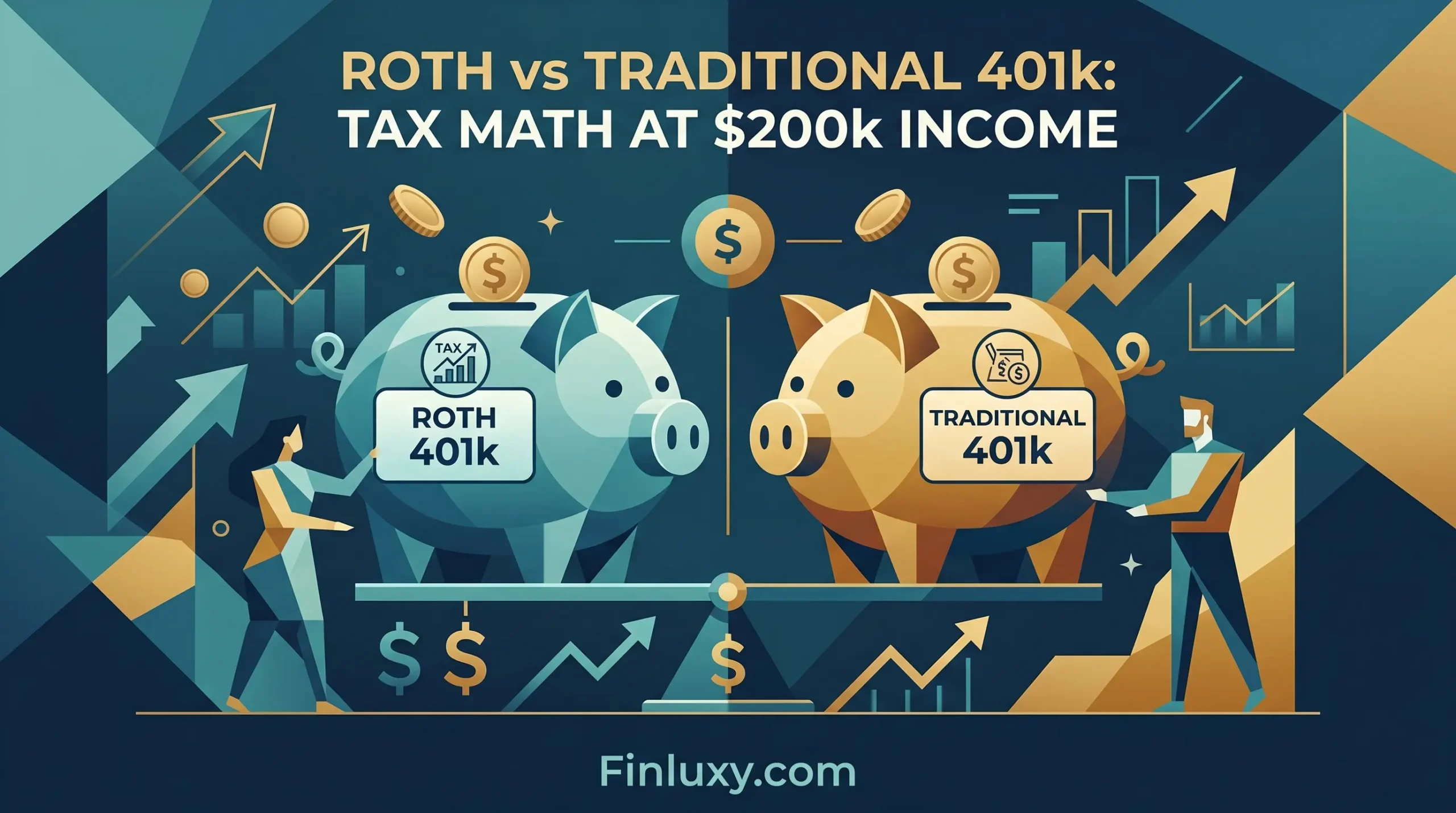
Geometric vector illustration comparing Roth and Traditional 401k on a scale for Finluxy.com.

Roth vs Traditional 401k: Tax Math at $200k Income

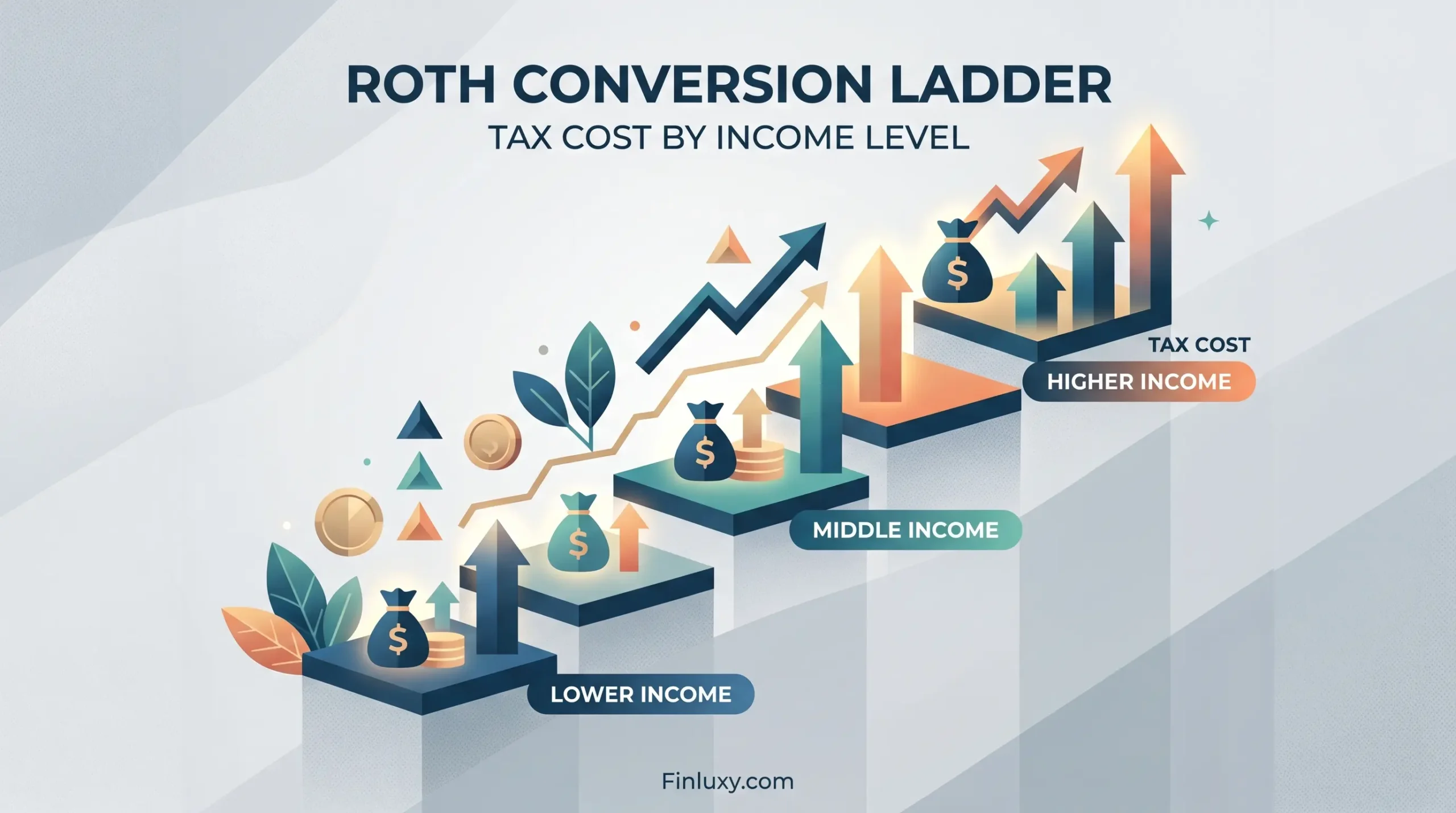
Modern illustration shows growing tax costs for different income levels using a tiered structure and rising arrows.

Roth Conversion Ladder: Tax Cost by Income Level

Geometric illustration of a businessman with a magnifying glass examining tax documents and financial symbols.

IRA Deductibility at $100k–$130k: What You Can Claim

Modern illustration showing people and financial icons rising through different ages, representing growing retirement savings over time.

How Much to Save in Retirement Accounts by Age

A clean geometric illustration showing an employee and employer handshake, with funds being matched and directed into a growing 401k account structure.

Employer 401k Match Value at $80k–$120k Income

Geometric illustration showing a business person walking up a rising arrow next to a bank, representing a self-employed retirement plan.

Defined Benefit Plan for High-Income Self-Employed

Geometric vector illustration for Finluxy featuring a person climbing steps next to coins and a vault, with article title text.

Backdoor Roth IRA: Step-by-Step Cost and Tax

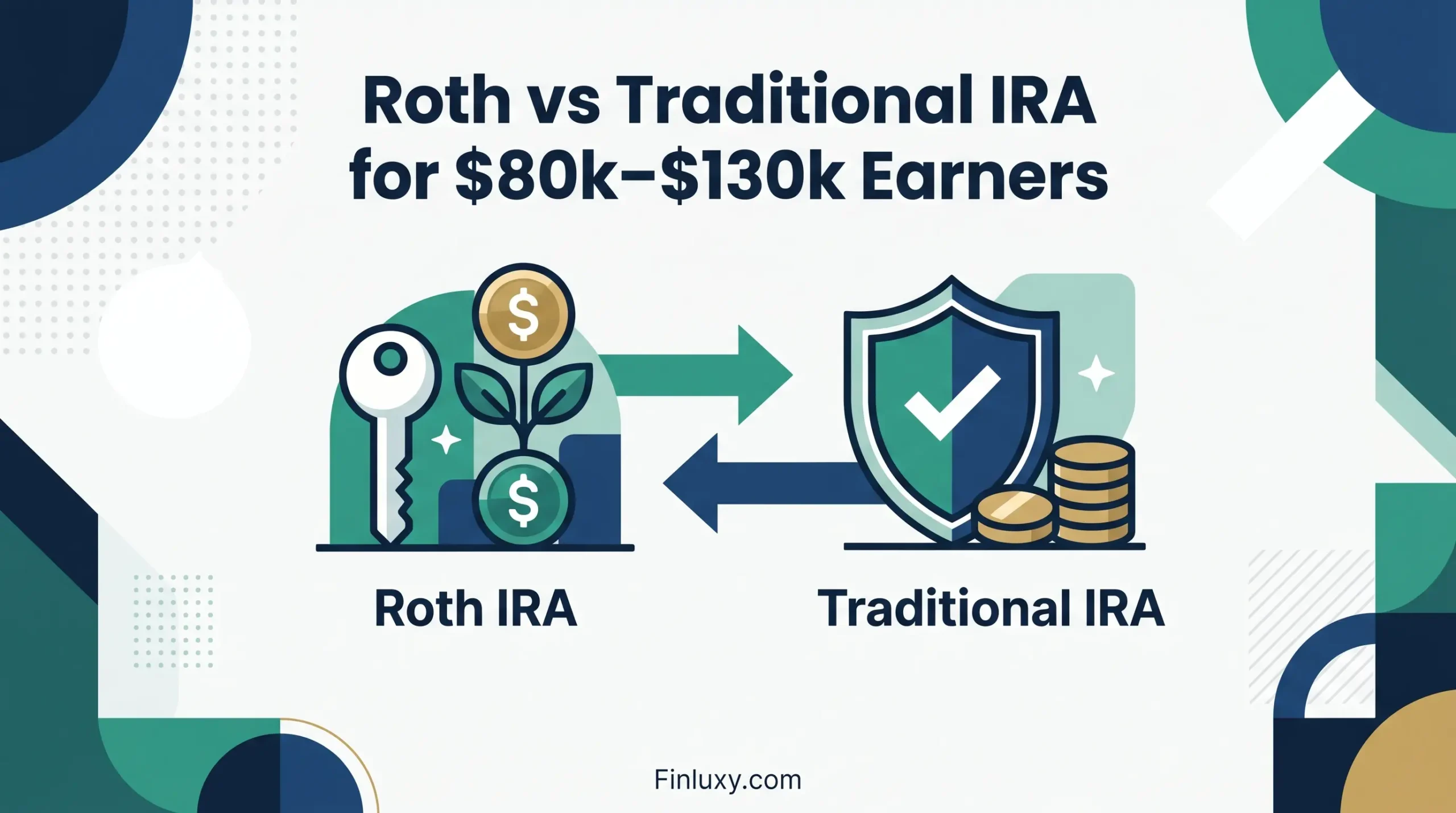
Geometric vector illustration comparing Roth and Traditional IRAs with a headline for mid-income earners on a clean, modern financial background.

Roth vs Traditional IRA for $80k–$130k Earners

Geometric vector illustration featuring financial shapes and the headline "SEP-IRA Contribution Limit: Self-Employed Math" on a clean, modern background.

SEP-IRA Contribution Limit: Self-Employed Math

A vector illustration of a man contemplating a savings timeline with money stacks for ages 35 and 40.

How Much Should You Have Saved by 35 and 40 at $100k

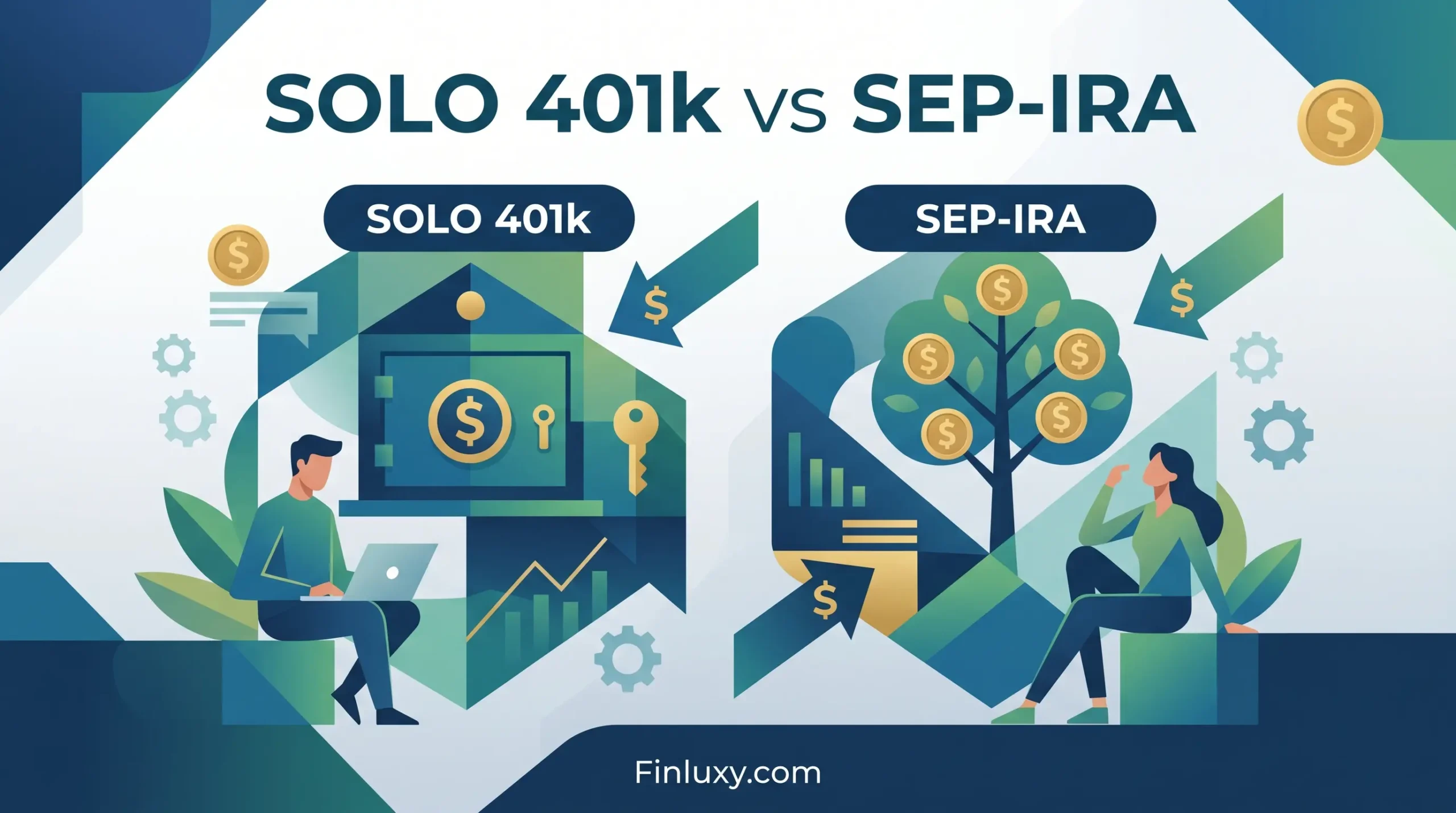
A comparison of retirement plans showing a person with a vault for a Solo 401k and a person with a money tree for a SEP-IRA.

Solo 401k vs SEP-IRA: Which Saves More in Taxes?

An isometric vector illustration of a person reviewing financial documents at a desk, featuring geometric shapes and teal tones.

RMD Tax Cost: What Required Withdrawals Cost

Geometric vector illustration of two figures shaking hands, symbolizing an employer 401k matching agreement, with growing arrows.

Employer 401k Match: True Value and Tax Benefit

Geometric vector art shows a massive open vault door and keys for a "Mega Backdoor Roth" strategy.

Mega Backdoor Roth: How to Add $40k More Per Year

Geometric illustration showing a man analyzing the timing of deferred compensation and taxes over time for Finluxy.

Deferred Compensation Plan: Tax Timing Analysis

  • About
  • Privacy Policy
  • Editorial Policy
  • Disclaimer
  • Affiliate Disclosure
  • Terms of Use
  • Contact
© 2026 Finluxy. All Rights Reserved.