 Analysis by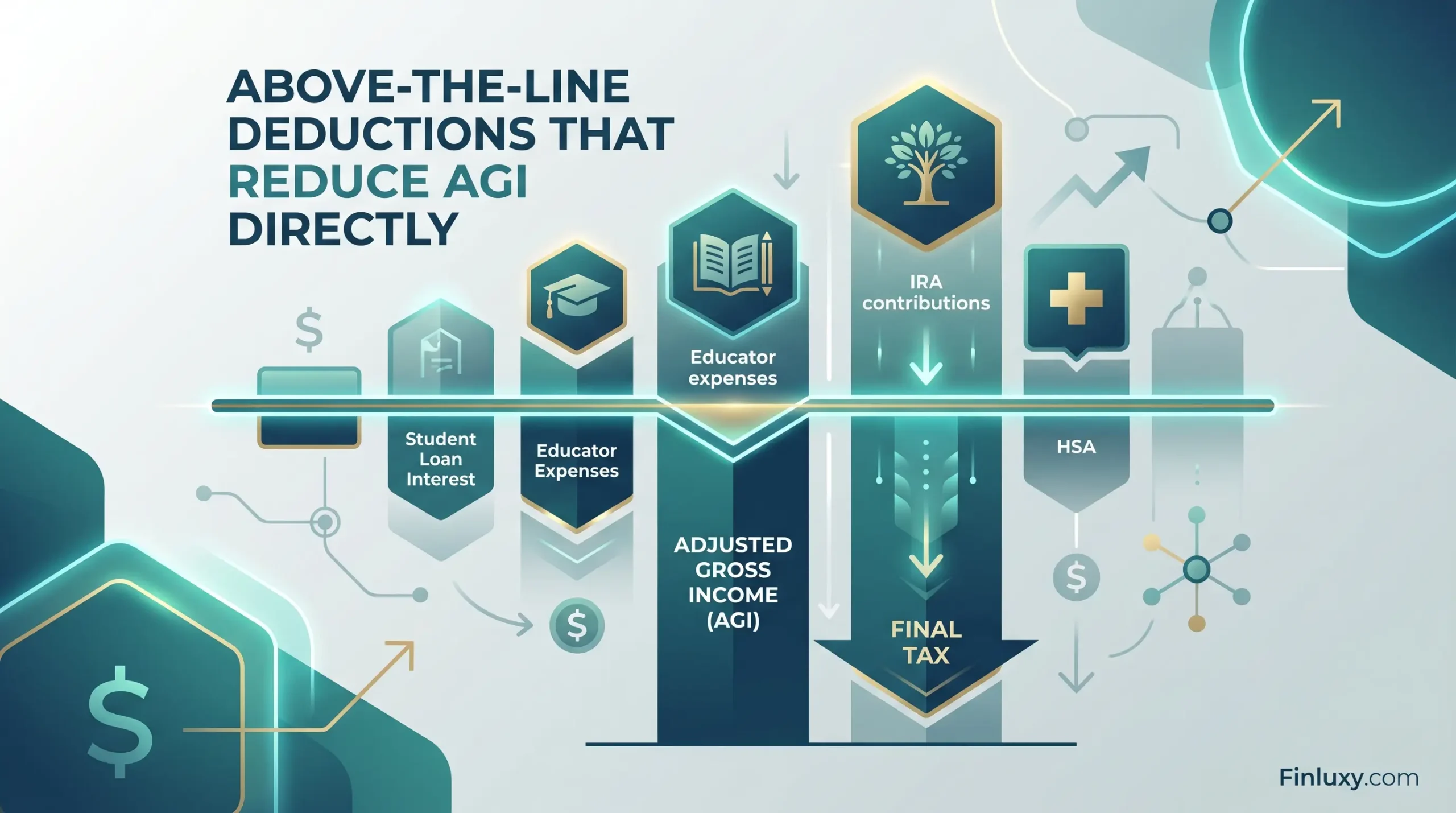
A self-employed consultant earning $200,000 can move $72,000 off the top of their income in 2026 through a single above-the-line deduction—the SEP-IRA—before touching a single itemized line. A W-2 household at the same income, covered by a workplace 401(k), can deduct exactly $0 of a traditional IRA contribution. Same income, same instinct to save, wildly different outcomes. That gap is the entire story of above-the-line deductions at higher incomes: the tax code rewards the structure of your income more than the size of your generosity.
Above-the-line deductions—formally, adjustments to income reported on Schedule 1 of Form 1040—reduce adjusted gross income (AGI) directly, before the choice between the standard deduction and itemized deductions ever comes up. That sequencing matters more than most coverage admits. AGI is the input for dozens of downstream phase-outs: the SALT cap workaround, IRA deductibility, the student loan interest deduction itself, and education credits. Lowering AGI by a dollar is frequently worth more than lowering taxable income by a dollar, because the AGI dollar can rescue a phase-out you would otherwise lose entirely.
This analysis covers federal above-the-line deductions for tax years 2025 and 2026, with figures drawn from IRS publications, revenue procedures, and the One Big Beautiful Bill Act (OBBBA) of July 2025. Figures span two tax years because several limits and phase-out ranges changed between them; each is labeled inline at first mention. State treatment of these adjustments varies and is outside this scope. Contribution-based deductions assume the taxpayer has sufficient earned income and meets all eligibility tests; phase-out math is shown for married filing jointly unless noted. This is cost analysis, not tax advice—the interaction of these provisions with the alternative minimum tax (AMT), net investment income tax, and state returns can change the result for any individual return.
The figures that define the category
Five numbers anchor every above-the-line decision a $150k+ household will face. They are not the deductions with the highest profile—mortgage interest and charitable giving get more attention—but they are the ones that reduce AGI directly, which is the lever that matters.
| Deduction | 2025 limit | 2026 limit |
|---|---|---|
| HSA contribution (family coverage) | $8,550 | $8,750 |
| SEP-IRA / solo 401(k) total (under 50) | $70,000 | $72,000 |
| Solo 401(k) employee deferral | $23,500 | $24,500 |
| Student loan interest (cap) | $2,500 | $2,500 |
| Educator expense | $300 | $350 |
Source: IRS Publication 969, Publication 590-A, Publication 970; IRS Notice 2025-67; Revenue Procedure 2024-25 and 2025-19 (2024–2026).
Notice what is missing: the traditional IRA deduction. For most households reading this, it carries a limit of effectively zero, and the reason is the single most overlooked constraint in the category.
The traditional IRA trap at $150k+
The traditional IRA contribution limit is $7,000 for 2025 and $7,500 for 2026. The deduction limit, for anyone covered by a workplace retirement plan, is a different number. Per IRS Publication 590-A, a married-filing-jointly taxpayer who is an active participant in an employer plan sees the deduction phase out between $126,000 and $146,000 of modified AGI for 2025, rising to $129,000–$149,000 for 2026. Above $149,000, an active participant deducts nothing.
Every household this article addresses sits above that ceiling. If you or your spouse have a 401(k)—even one you never contribute to, because the W-2 “Retirement plan” box gets checked the moment an employer makes a match—your traditional IRA contribution is nondeductible. You can still contribute. You simply get no above-the-line benefit, only basis tracked on Form 8606. The deduction most “don’t miss these write-offs” lists put first is the one a $150k+ W-2 earner almost never gets. For the mechanics of when this account still earns its place, the broader tax deduction guide for high earners works through the nondeductible-contribution and backdoor-Roth sequence.
The exception proves the rule. If neither spouse is covered by a workplace plan, the income phase-out does not apply at all—the full contribution is deductible regardless of income. That is rare at this income level but not impossible: a household where both earners are self-employed without a formal plan, or where one spouse left a corporate job mid-year, can land there.
Where the real money is: self-employment plans
The deduction with genuine scale at high incomes isn’t available to most W-2 employees at all. It belongs to the self-employed.
A SEP-IRA allows an employer contribution of up to 25% of compensation, capped at $70,000 for 2025 and $72,000 for 2026, with compensation counted up to $350,000 (2025) and $360,000 (2026). For a sole proprietor, the effective rate works out to roughly 20% of net self-employment earnings after the self-employment tax adjustment. A solo 401(k) reaches the same $70,000/$72,000 combined ceiling but gets there differently—it adds an employee deferral of $23,500 (2025) or $24,500 (2026) on top of the ~20% employer side, which means it maxes out at a far lower income than a SEP. Below roughly $175,000 of net self-employment income, the solo 401(k) almost always wins; above it, the two converge and the SEP’s lighter paperwork becomes the deciding factor. The full comparison lives in the analysis of business deductions for self-employed professionals.
Run the dollar value. A consultant with $200,000 of net self-employment income, filing jointly at a 24% marginal federal rate, contributing $40,000 to a solo 401(k): the deduction is above the line, so it reduces AGI by the full $40,000. Tax saved is $40,000 × 24% = $9,600. That is the entire mortgage-interest deduction of a $400,000 loan, delivered by a single Schedule 1 entry, with no itemizing required.
The half-of-SE-tax adjustment
Self-employment carries a second, automatic above-the-line deduction that requires no contribution and no decision: one-half of self-employment tax. The self-employment tax rate is 15.3% on net earnings—12.4% Social Security plus 2.9% Medicare—and the deductible half lands on Schedule 1 mechanically. It is not optional and not strategic. It is simply the structural offset for the employer-side payroll tax a self-employed person pays on both sides. On $200,000 of net earnings, this adjustment alone moves several thousand dollars off AGI before any retirement plan enters the picture.
The HSA: the only triple-tax-advantaged line
The health savings account is the cleanest above-the-line deduction in the code, and the one most underused by high earners who treat it as a spending account rather than an investment vehicle.
Per IRS Publication 969, the 2025 contribution limit is $4,300 for self-only coverage and $8,550 for family coverage, rising to $4,400 and $8,750 for 2026. Taxpayers 55 and older add a $1,000 catch-up. The contribution is deductible whether or not you itemize, the growth is untaxed, and qualified withdrawals are untaxed—the only account in the code with all three properties. The eligibility gate is enrollment in a qualifying high-deductible health plan, which for 2026 means a deductible of at least $1,700 self-only or $3,400 family.
At a 32% marginal rate, a maxed family HSA of $8,750 in 2026 is worth $2,800 in federal tax saved in year one—and that ignores the decades of tax-free compounding that make the account most valuable to households that can afford to pay current medical costs out of pocket and leave the HSA invested. The mechanics of medical-cost deductibility more broadly, including the itemized route, are covered in the breakdown of the medical expense deduction threshold.
Student loan interest: structurally out of reach
The student loan interest deduction is above the line, capped at $2,500, and—for nearly everyone this article addresses—gone. The phase-out for married-filing-jointly runs from $170,000 to $200,000 of modified AGI for 2025, shifting to $175,000–$205,000 for 2026, per IRS Publication 970. Above the top of that range, the deduction is fully eliminated. Married-filing-separately taxpayers cannot claim it at any income.
A $150k+ joint-filing household sits at or above the phase-out’s upper edge. The deduction was never designed for them—it was built to disappear precisely at the income where it could have mattered most to people carrying large professional-degree loan balances. The interaction with filing status and the rare cases where it survives are detailed in the analysis of who can actually use the student loan interest deduction. One AGI lever is worth noting: because the deduction phases on modified AGI, a large pre-tax retirement contribution that lowers AGI can, at the margin, pull a household back under the ceiling—an example of why the AGI-first sequencing of these deductions compounds.
What OBBBA changed for 2026
The One Big Beautiful Bill Act, signed in July 2025, added one genuinely new above-the-line-style deduction relevant here and reshaped the itemized landscape around it. Beginning with the 2026 tax year, taxpayers who take the standard deduction can deduct up to $1,000 (single) or $2,000 (married filing jointly) of cash charitable contributions without itemizing, per Tax Foundation analysis of the law. For 2025, no such deduction exists—non-itemizer charitable giving carries no federal benefit.
The catch for high earners is that this deduction was built for non-itemizers, and OBBBA simultaneously raised the SALT cap—the $10,000 state and local tax deduction cap from the Tax Cuts and Jobs Act of 2017 (TCJA)—to roughly $40,000 for 2026. The higher cap pushes far more high-income, high-tax-state households back into itemizing, which means many of them won’t qualify for the $1,000/$2,000 non-itemizer charitable line at all. Whether the raised cap actually helps depends on income, since it phases down at very high earnings—the constraint is mapped in the analysis of SALT cap impact on high earners. The same itemizers also face a new 0.5%-of-AGI floor on charitable deductions starting in 2026, a wrinkle examined in the charitable deduction math at the 37% bracket.
The Finluxy Deduction Value Index
To compare these deductions on a single scale, the Finluxy Deduction Value Index expresses total tax savings from all claimed deductions as a percentage of gross household income: total deduction tax savings ÷ gross income × 100. The table below runs the index for three representative $150k+ households, isolating above-the-line deductions only, for tax year 2026.
| Household | Gross income | Above-the-line deductions claimed | Marginal rate | Tax savings | Deduction Value Index |
|---|---|---|---|---|---|
| W-2 dual earner, 401(k)-covered | $220,000 | HSA family $8,750 | 24% | $2,100 | 1.0% |
| Self-employed consultant | $200,000 | Solo 401(k) $40,000 + HSA $8,750 + ½ SE tax ~$9,400 | 24% | $14,196 | 7.1% |
| High-income professional couple | $400,000 | HSA family $8,750 only | 32% | $2,800 | 0.7% |
Source: author calculation applying IRS 2026 limits (Publication 969, Notice 2025-67) at stated marginal rates. Half-of-SE-tax figure approximate; rounds net earnings after the SE-tax adjustment. Index = tax savings ÷ gross income × 100.
The spread is the finding. The self-employed household clears 7% on above-the-line deductions alone, while two W-2 households at similar or higher incomes sit near or below 1%. The Cluster benchmark—2–4% of gross income in total deduction value at $300k including itemized deductions—is exceeded by the consultant on above-the-line lines alone, and missed badly by the W-2 earners until itemized deductions are added back. Income structure, not income size, drives the index.
What most coverage overlooks
The standard framing treats above-the-line deductions as a checklist of write-offs to remember at filing time. The data says something sharper: at $150k+, the entire category collapses into a binary. Either you have self-employment income, in which case above-the-line deductions can shelter tens of thousands of dollars and produce a Deduction Value Index above 5%, or you are a covered W-2 earner, in which case the category shrinks to essentially one line—the HSA—worth one to two percent of gross income.
The deductions that dominate the popular lists for these households—traditional IRA, student loan interest—are precisely the ones engineered to phase out before $150,000. That is not an accident of your filing. It is the structure of the statute. Recognizing which side of the binary you are on is worth more than memorizing any single limit, because it tells you whether the productive move is to optimize a handful of W-2 adjustments or to restructure how income arrives in the first place.
For the $150k+ household
The practical decision tree is short. If any portion of your income is self-employment or 1099 work—even a side consultancy on top of a W-2 job—the solo 401(k) is the highest-leverage above-the-line move available, and it stacks on top of a workplace 401(k) up to the shared employee-deferral limit. Establishing one converts business income from fully taxed to substantially sheltered, at a marginal rate that is highest exactly when it helps most.
If your income is entirely W-2 and plan-covered, the realistic above-the-line menu is the HSA and, for 2026, the modest non-itemizer charitable deduction only if you take the standard deduction—which the raised SALT cap may now make irrational anyway. The traditional IRA is a basis-tracking exercise, not a deduction. The honest read is that above-the-line optimization has a low ceiling for covered W-2 earners, and the larger dollars at this income level live in itemized choices: mortgage interest, SALT under the new cap, and bunched charitable giving. Where a single decision could swing four or five figures—forming an entity for self-employment income, or timing a year of large charitable gifts against the 2026 floor—the interaction with AMT and state tax is genuinely individual, and modeling it against your actual return before year-end is where the value gets captured rather than left on the table.
Can I deduct a traditional IRA contribution if I earn over $150,000 and have a 401(k)?
For 2026, if you are an active participant in a workplace plan and file jointly, the deduction phases out between $129,000 and $149,000 of modified AGI and is eliminated above $149,000 (IRS Publication 590-A). You can still contribute up to $7,500 on a nondeductible basis, tracked on Form 8606, but you receive no above-the-line deduction.
Do above-the-line deductions require me to itemize?
No. That is the defining feature. Above-the-line deductions are claimed on Schedule 1 and reduce AGI before the standard-versus-itemized choice. You claim them whether you take the $31,500 (2025) / standard deduction or itemize.
Why can’t I claim the student loan interest deduction at my income?
For married-filing-jointly filers, the $2,500 deduction phases out between $175,000 and $205,000 of modified AGI for 2026 ($170,000–$200,000 for 2025), per IRS Publication 970. Above the top of the range it is fully eliminated, and married-filing-separately taxpayers cannot claim it at any income.
Is the HSA deduction available if I’m a high earner?
Yes—the HSA has no income phase-out. The only gate is enrollment in a qualifying high-deductible health plan. The 2026 limits are $4,400 self-only and $8,750 family, plus a $1,000 catch-up at age 55 or older (IRS Publication 969).
Methodology
Figures were drawn first from primary IRS sources: Publication 969 (HSAs), Publication 590-A (IRA deductibility and phase-outs), Publication 970 (student loan interest), and IRS Notice 2025-67 and Revenue Procedures 2024-25 and 2025-19 for inflation-adjusted 2025 and 2026 limits. OBBBA provisions were verified against Tax Foundation analysis as a secondary analytical source, used to contextualize the non-itemizer charitable deduction and SALT cap changes rather than as the sole citation for any limit. Every limit, rate, and phase-out range was confirmed against a current-year primary source before inclusion; where 2025 and 2026 figures differ, both are stated and labeled by year. The Finluxy Deduction Value Index was calculated by applying each household’s stated marginal rate to its above-the-line deductions and dividing by gross income; the half-of-self-employment-tax figure is approximate and rounds net earnings after the SE-tax adjustment. Marginal rates used are illustrative of 2026 brackets at the stated income levels and exclude state tax and AMT effects.
Sources & References
- IRS Publication 969 — HSA and HDHP contribution limits
- IRS Publication 590-A — IRA contribution deductibility and phase-out ranges
- IRS Publication 970 — student loan interest deduction and education benefits
- IRS Notice 2025-67 summary — 2026 retirement plan and IRA limits
- Tax Foundation — OBBBA charitable deduction and SALT cap analysis
- Fidelity — SEP-IRA and solo 401(k) contribution limits, 2025 and 2026