 Analysis by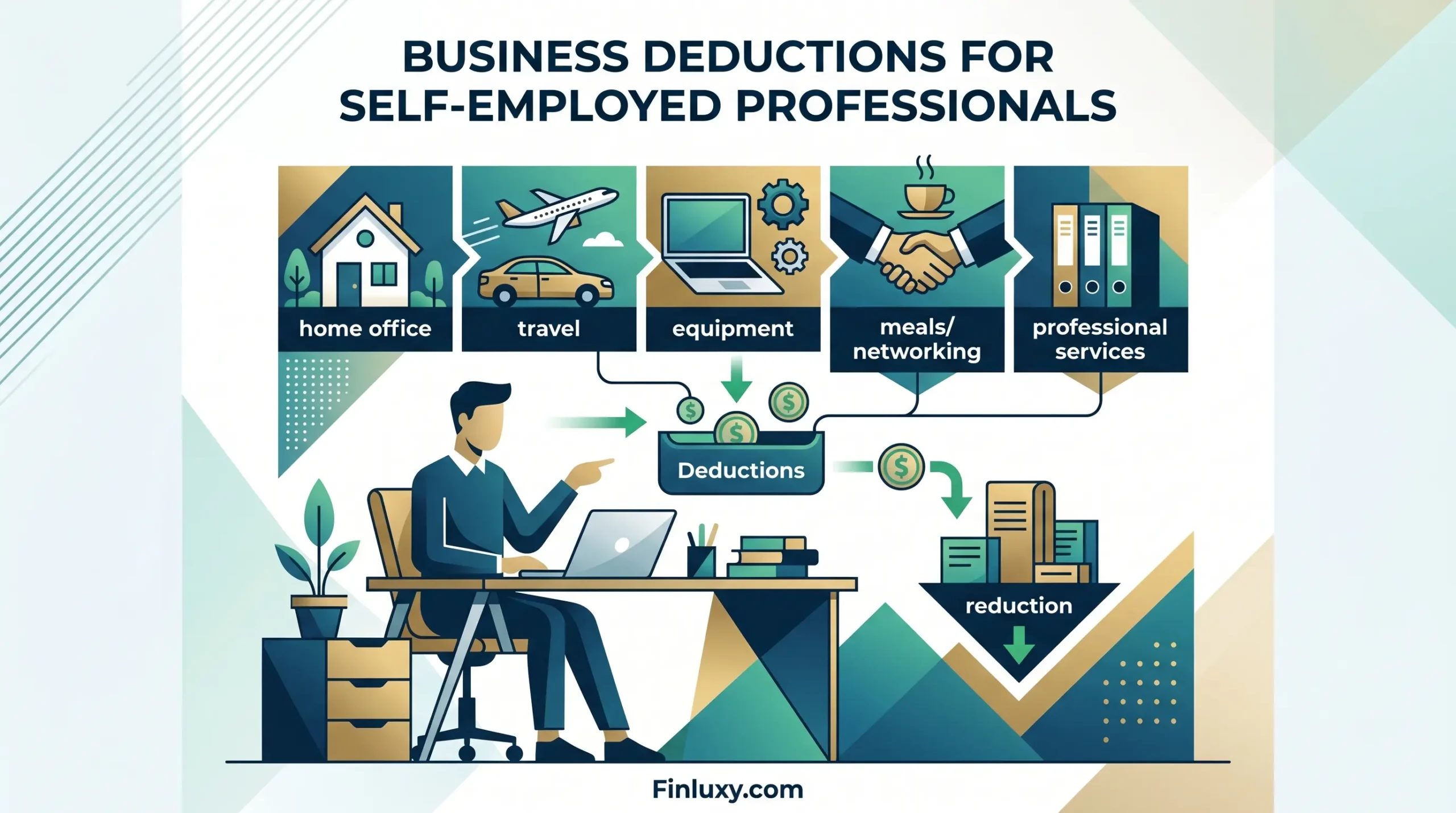
A self-employed consultant earning $250,000 in net profit will hand the IRS roughly $27,193 in self-employment tax alone — before a single dollar of federal income tax is calculated. Half of that figure, about $13,596, is deductible above the line. That deduction is automatic, requires no receipts, and is the single most overlooked number in most freelancer tax planning at this income level.
The story of business deductions for high-earning self-employed professionals is not the story most coverage tells. The “don’t miss these write-offs” lists fixate on coffee, mileage, and co-working memberships — line items that move a $250,000 tax picture by a few hundred dollars. The deductions that actually matter operate at a different order of magnitude: the qualified business income deduction, the deductible half of self-employment tax, and retirement plan contributions that can shelter $70,000 in a single year. This analysis quantifies each using 2025 figures confirmed against primary IRS sources, then expresses the combined effect through the tax deduction guide for high earners framework.
Scope: This analysis covers federal business deductions for sole proprietors, single-member LLCs, and partners filing Schedule C or Schedule SE for the 2025 tax year. All figures reflect IRS amounts as adjusted by the One Big Beautiful Bill Act (OBBB), enacted July 2025. Figures assume net self-employment income — gross receipts minus ordinary business expenses — and do not model S-corporation election, which changes the self-employment tax calculus materially. State tax treatment is excluded; several states decouple from federal QBI and SALT provisions. This is cost analysis, not tax preparation or financial advice. Individual outcomes depend on entity structure, total household income, and state of residence.
The figures that move the needle
Before breaking down each deduction, here is the summary block for a self-employed professional with $250,000 in net business profit, single filer, 2025 tax year.
| Deduction | Mechanism | Approximate Value |
|---|---|---|
| Deductible half of SE tax | 50% of self-employment tax, above-the-line | $13,596 |
| QBI deduction | 20% of qualified business income | $47,281 |
| SEP-IRA / Solo 401(k) | Employer + employee contribution cap | Up to $70,000 |
| Self-employed health insurance | Premiums deductible above the line | Varies; full premium |
| Home office (simplified) | $5 per sq ft, 300 sq ft cap | Up to $1,500 |
Source: IRS Publication 560, Schedule SE instructions, and IRC §199A, 2025 tax year. SE tax and QBI figures calculated from $250,000 net profit; see methodology.
Self-employment tax: the deduction nobody claims as a deduction
Start with the tax that defines self-employment. The self-employment tax rate is 15.3% — 12.4% for Social Security and 2.9% for Medicare — applied to 92.35% of net earnings. The Social Security portion stops at the wage base, which the Social Security Administration set at $176,100 for 2025. The Medicare portion has no ceiling.
Run the arithmetic on $250,000 in net profit. The taxable base is $250,000 × 0.9235 = $230,875. Social Security tax applies to $176,100 of that: $21,836. Medicare tax applies to the full $230,875: $6,695. An additional 0.9% Medicare surtax kicks in above $200,000 for single filers, adding roughly $277 on the income between $200,000 and the base. Total self-employment tax lands near $28,531, and the deductible half — excluding the non-deductible 0.9% surtax — is approximately $14,127 against income.
Here is where most planning goes wrong. Freelancers treat self-employment tax as a cost and stop there. The deductible half is an above-the-line deduction that reduces adjusted gross income directly, which in turn can affect eligibility for other phase-outs. It belongs in the same category as the above-the-line deductions that reduce AGI — claimed whether or not you itemize, and worth the marginal rate times the deduction. At a 32% marginal rate, that $14,127 deduction is worth roughly $4,521 in federal income tax savings, layered on top of the SE tax it partially offsets.
QBI: the 20% that dwarfs everything else
The qualified business income deduction is the largest lever available to a pass-through business owner, and the One Big Beautiful Bill Act made it permanent in July 2025 after it was scheduled to sunset at the end of the year. The mechanics: eligible taxpayers deduct up to 20% of qualified business income, subject to income thresholds and a special rule for specified service trades or businesses.
That distinction matters enormously at $150k+. A specified service trade or business — health, law, accounting, consulting, financial services, athletics, and similar fields where the principal asset is the reputation or skill of the owner — faces a phase-out the moment taxable income crosses the threshold. For 2025, the SSTB phase-out runs from $197,300 to $247,300 for single filers and from $394,600 to $494,600 for married couples filing jointly, per IRS guidance under IRC §199A. Above the top of that range, an SSTB owner gets zero QBI deduction. A non-service business — software, manufacturing, e-commerce, design that isn’t consulting — keeps the deduction above the threshold, subject instead to a wage-and-property limitation.
Two consultants, identical incomes, wildly different outcomes:
| Scenario | Taxable Income | SSTB? | QBI Deduction |
|---|---|---|---|
| Software developer | $240,000 | No | ~20% of QBI (full) |
| Management consultant | $240,000 | Yes | Partial (within phase-out) |
| Management consultant | $260,000 | Yes | $0 (above $247,300) |
| Graphic designer | $180,000 | No* | ~20% of QBI (full) |
Source: IRC §199A, IRS 2025 thresholds; OBBB expanded phase-in ranges apply for tax years after 2025. *Design work is generally not an SSTB unless it constitutes consulting. Classification is fact-specific.
One planning note the lists omit: because the SSTB phase-out is keyed to taxable income, deductions that lower taxable income can pull a service-business owner back under the threshold and restore the QBI deduction. A consultant at $260,000 in taxable income who contributes $30,000 to a retirement plan drops to $230,000 — back inside the phase-out range, recovering a partial QBI deduction worth thousands. The retirement contribution does double duty.
Retirement plans: $70,000 of shelter
Consider what a W-2 employee cannot do. The self-employed professional can establish a SEP-IRA or Solo 401(k) and contribute far beyond the standard 401(k) employee limit. For 2025, IRS Publication 560 sets the total defined-contribution limit at $70,000, with the compensation cap for calculating contributions at $350,000.
The two vehicles reach that ceiling differently. A SEP-IRA allows employer contributions of up to 25% of net self-employment earnings (after the SE tax deduction adjustment), capped at $70,000. A Solo 401(k) combines an employee deferral of $23,500 for 2025 with employer profit-sharing of up to 25% of compensation — which means a Solo 401(k) reaches the $70,000 ceiling at a lower income than a SEP-IRA, because the flat employee deferral stacks on top of the percentage-based employer piece. For a consultant netting $150,000, the Solo 401(k) typically allows a larger total contribution than the SEP.
The deduction value compounds. A $70,000 contribution at a 32% marginal rate saves $22,400 in federal income tax. It also lowers AGI and taxable income, which — as noted above — can restore QBI eligibility for service businesses near the phase-out. That interaction is the most valuable and least discussed dynamic in self-employed tax planning at this income level.
Home office, health insurance, and the smaller line items
Health insurance premiums are the sleeper. A self-employed professional who is not eligible for employer-subsidized coverage can deduct 100% of health, dental, and qualifying long-term care premiums above the line, for self, spouse, and dependents. For a family buying coverage on the individual market at $24,000 a year, that is a $24,000 above-the-line deduction — worth $7,680 at a 32% rate, and it reduces AGI in a way that ripples through other thresholds.
The home office deduction draws disproportionate attention for its modest size. The simplified method, unchanged since the IRS introduced it under Revenue Procedure 2013-13, allows $5 per square foot up to 300 square feet — a maximum of $1,500. The regular method, which allocates actual home expenses by the business-use percentage of the residence, can exceed that for a large dedicated office in a high-cost home, but it requires depreciation tracking and recapture on sale. For most professionals the math favors the simplified method’s certainty; the full mechanics are covered in the home office deduction guide. Either way, the figure is a rounding error next to QBI and retirement contributions, and treating it as a centerpiece is a sign of misplaced priorities.
Note what self-employed business deductions do not touch: the personal itemized deductions on Schedule A. Mortgage interest, the SALT deduction, and charitable gifts are separate computations that compete with the standard deduction — $15,750 for single filers and $31,500 for married couples filing jointly in 2025. A business owner can claim the full slate of Schedule C and above-the-line business deductions and take the standard deduction, because QBI, SE tax, retirement, and health insurance deductions sit outside Schedule A entirely. This is the structural advantage that the standard versus itemized deduction decision often obscures: for the self-employed, the biggest deductions don’t require itemizing at all.
The SALT cap context for self-employed homeowners
One legislative change reshapes the personal side of the picture. The SALT cap — the state and local tax deduction limit — was $10,000 from 2018 through 2024 under the Tax Cuts and Jobs Act (TCJA) of 2017. The One Big Beautiful Bill Act temporarily raised that cap to $40,000 for tax years beginning in 2025 through 2029, per IRS guidance implementing H.R. 1. For a self-employed homeowner in a high-tax state who previously hit the $10,000 wall on property taxes alone, the expanded cap can flip the itemize-versus-standard math. That interaction is examined in detail in the SALT cap impact analysis, but the headline for business owners is that the personal deduction landscape changed in 2025 in a way most freelancer-focused coverage hasn’t caught up to.
The Finluxy Deduction Value Index
To compare the total deduction efficiency across scenarios, the Finluxy Deduction Value Index expresses total deduction tax savings as a percentage of gross income. The benchmark from the cluster framework: at $300,000 income with typical itemized deductions, 2–4% is typical. Self-employed professionals routinely exceed that, because their deductions are structural rather than discretionary.
| Profile | Gross Income | Est. Deduction Tax Savings | Deduction Value Index |
|---|---|---|---|
| Non-SSTB, max retirement | $250,000 | ~$31,000 | 12.4% |
| SSTB consultant, partial QBI | $250,000 | ~$22,000 | 8.8% |
| SSTB above QBI phase-out | $300,000 | ~$18,000 | 6.0% |
Index = total deduction tax savings ÷ gross income × 100. Savings combine deductible SE tax, QBI, retirement, and health insurance deductions at applicable marginal rates. Illustrative; assumes single filer, no S-corp election, 2025 figures.
The Index makes the central point visible: a self-employed professional’s deduction value runs two to three times the benchmark for a wage earner with typical itemized deductions. The structural deductions — QBI and retirement — do the heavy lifting, and they’re available regardless of whether the taxpayer itemizes.
What the data shows that most coverage misses
The dominant narrative around self-employed deductions is additive: track every expense, save every receipt, claim every small write-off. The data points the other direction. For a professional at $250,000 net profit, the small expenses — phone, software, mileage, meals — might total $8,000 and save $2,560 at a 32% rate. The three structural deductions (deductible SE tax, QBI, and a maxed retirement plan) save roughly $40,000 combined. The marginal hour spent optimizing receipts returns a fraction of the marginal hour spent on entity structure, retirement contribution timing, and QBI threshold management. The professionals who save the most are not the ones with the most detailed expense logs; they’re the ones who structured the big three correctly.
What this means at $150k+
The decisions that matter at this income level are structural, not clerical. First: the SSTB threshold. A service-business owner approaching $197,300 (single) or $394,600 (married) in taxable income should model whether a retirement contribution or other above-the-line deduction can pull taxable income back under the phase-out and restore QBI — a move that can be worth more than the contribution’s direct tax savings. Second: the retirement vehicle choice. At incomes below roughly $200,000 net, a Solo 401(k) generally allows larger contributions than a SEP-IRA because the employee deferral stacks on the employer percentage; above that, the difference narrows. Third: the S-corporation question, which this analysis deliberately excludes because it changes the SE tax calculation fundamentally — converting some profit to wages and some to distributions, trading SE tax savings against payroll complexity and a reduced QBI base. That trade-off deserves its own modeling against your specific income and state.
The figures here are 2025 amounts confirmed against IRS sources, but several are legislatively volatile. The OBBB made QBI permanent and raised the SALT cap temporarily through 2029; the retirement and SE tax figures adjust annually for inflation. A self-employed professional building a multi-year plan should treat the thresholds as moving targets and re-verify each filing season. Where the numbers land for your household depends on entity structure, state residence, and whether your work is classified as a specified service trade — distinctions worth modeling against current figures rather than assuming last year’s math still holds.
Can I claim the QBI deduction and the standard deduction in the same year?
Yes. The QBI deduction is taken after adjusted gross income and is available whether you itemize or claim the standard deduction. It does not appear on Schedule A and does not compete with itemized deductions. For 2025 the standard deduction is $15,750 for single filers and $31,500 for married couples filing jointly, and a business owner can take it while still claiming the full 20% QBI deduction.
Why does my consulting business lose the QBI deduction at higher income when a software business doesn’t?
Consulting is a specified service trade or business under IRC §199A. For SSTBs, the QBI deduction phases out between $197,300 and $247,300 of taxable income for single filers and between $394,600 and $494,600 for joint filers in 2025, reaching zero above the top of the range. Non-service businesses keep the deduction above those thresholds, subject instead to a wage-and-property limitation.
Is the deductible half of self-employment tax really automatic?
Effectively, yes. Once you calculate self-employment tax on Schedule SE, you deduct 50% of it as an above-the-line adjustment to income — excluding the 0.9% additional Medicare surtax, which is not deductible. It requires no separate documentation beyond the SE tax calculation itself and reduces AGI directly.
SEP-IRA or Solo 401(k) — which lets me contribute more?
It depends on income. Both cap total contributions at $70,000 for 2025. A Solo 401(k) combines a $23,500 employee deferral with employer profit-sharing of up to 25% of compensation, so it reaches the ceiling at a lower income than a SEP-IRA, which relies solely on the 25% employer contribution. Below roughly $200,000 in net earnings, the Solo 401(k) generally allows a larger total contribution.
Methodology
Figures were drawn from primary IRS sources prioritized for this analysis: Publication 560 for retirement plan limits, IRC §199A and IRS 2025 guidance for QBI thresholds, Schedule SE instructions and Social Security Administration data for self-employment tax and the wage base, and IRS releases implementing the One Big Beautiful Bill Act for the standard deduction and SALT cap. Self-employment tax figures were calculated by applying the 92.35% adjustment to net profit, then the 12.4% Social Security rate up to the $176,100 wage base and the 2.9% Medicare rate to the full base, with the 0.9% additional Medicare surtax above $200,000 for single filers. QBI and retirement figures are illustrative of the mechanism rather than personalized; the Deduction Value Index combines estimated tax savings across deductions at applicable marginal rates and divides by gross income. Where the cluster brief listed a $10,000 SALT cap, the figure was updated to the $40,000 cap enacted for 2025 under OBBB, confirmed against IRS implementation guidance. Tax software “average deduction” claims and unsourced media write-off lists were excluded per sourcing standards.
Sources & References
- IRS Publication 560 — retirement plan contribution limits for the self-employed, 2025
- IRS — standard deduction amounts and individual credits, 2025
- IRS — inflation adjustments and OBBB amendments, tax years 2025–2026
- IRS Publication 505 — tax withholding and estimated tax
- Tax Foundation — 2025 federal tax brackets and marginal rates
- Congressional Research Service — standard deductions and brackets, 1988–2026
- Northern Trust — QBI deduction thresholds after OBBBA